Four miles east of Johnstown, near Mineral Point, the Little Conemaugh River swings in a long loop around a ridge. In the late 1820s, the engineers laying out the Allegheny Portage Railroad looked at that loop, about two and a half miles of riverbank, and chose to go through the hill instead. The country had yet to see a railroad tunnel. They built one anyway.
The work went at the speed of a man’s arm. A three-man crew could spend up to three hours drilling a single hole, one inch wide and three feet deep, into solid rock. They drilled nine or ten of those per face, packed each with a pound of black powder wrapped in paper, tamped it, set a fuse, and timed the blast for mealtime. The crews ate while the dust settled, then went back in to muck out the rubble. Each round bought them about eighteen inches. Two crews worked toward each other from opposite ends of the ridge, and on December 21, 1832, they broke through to each other’s light. There were speeches and toasts. By the time the excavation wrapped in April 1833, they had pulled roughly 14,900 cubic yards of bedrock out of the hill and left behind a bore 901 feet long and twenty feet across.
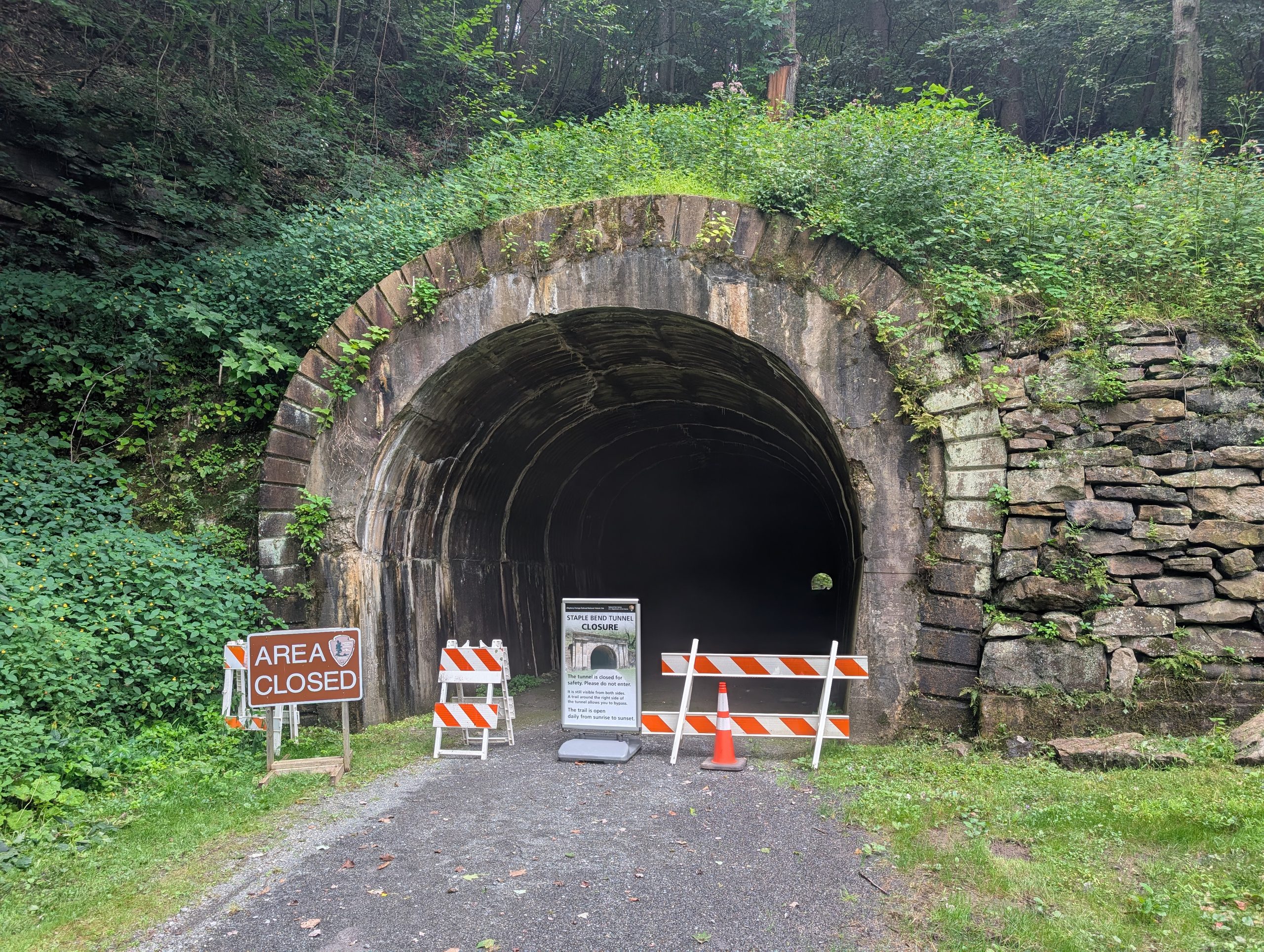
The builders dressed the two ends differently. The west portal got the full treatment: sandstone ashlar shaped like a Roman triumphal arch, with paired Doric pilasters on either side, a bit of stagecraft for passengers who had paid to cross a mountain. The east portal, the one in this photograph, is a working man’s arch. A horseshoe ring of cut stone voussoirs, a dry-laid retaining wall shouldering the hillside to the right, and a stone lining set into the first stretch of the bore because the engineers expected the rock above to shed in rain and frost.
The Portage Railroad itself was a strange and wonderful machine. It carried canal boats, cargo and passengers included, up and over the Allegheny Front on a chain of ten inclined planes, five up and five down, so freight could float from Philadelphia to Pittsburgh with a mountain in the middle. It ran from 1834 to 1852, about the lifespan of a good pickup truck, before the Pennsylvania Railroad’s direct line made it obsolete. The PRR bought the old route in 1857 and left the tunnel out of its plans.
So the tunnel went on to a second life. Wagons used it, then automobiles. Floods chewed at the approach. Local couples went out there to court well into the 1940s, which makes sense if you’ve stood in it: a dark stone room with a lit doorway at each end is about as private as a valley gets. The tunnel became a National Historic Landmark in 1994, joined the Allegheny Portage Railroad National Historic Site in 2001, and got a careful restoration around the same time, with masons cleaning and patching the portals and resetting stones that had wandered out of place. For two decades after, you could walk the two miles of old railbed from the trailhead and stroll right through.
Today there are barricades. An “Area Closed” sign, sawhorses, a traffic cone, and an easel explaining that the tunnel is shut for safety and that a path around its right side lets hikers bypass it. Look past the signs to the right edge of the arch, where the lining meets the retaining wall. The stone there has broken and pushed outward, and water stains run down the liner like rust from an old nail. The hill is doing what the builders expected it to do in 1833. The Park Service has put out a contract to inspect the walls and the rock bolts holding them and to stabilize the bore through the end of 2027.
In this photograph, if you look into the dark, there’s a small round coin of daylight at the far end. That’s the west portal, 901 feet away, the same light two crews of powder men chased toward each other one winter almost two hundred years ago.
Sources
- National Park Service, Allegheny Portage Railroad NHS — Staple Bend Tunnel: https://www.nps.gov/alpo/learn/historyculture/staplebend.htm
- NPS, Staple Bend Tunnel Trailhead: https://www.nps.gov/places/staple-bend-tunnel-trailhead.htm
- SAH Archipedia, Staple Bend Tunnel: https://sah-archipedia.org/node/17233
- Clio, Staple Bend Tunnel: https://theclio.com/entry/547
- National Register of Historic Places / NHL nomination: https://npgallery.nps.gov/GetAsset/bbc305b9-f9db-4971-863a-d07b5a80317e
- Graciano Corporation, Staple Bend Tunnel restoration: https://graciano.com/project/staple-bend-tunnel
- ASCE Historic Landmarks, Allegheny Portage Railroad: https://www.asce.org/about-civil-engineering/history-and-heritage/historic-landmarks/alleghany-portage-railroad
- HigherGov, NPS Solicitation 140P4226R0026, Stabilization of Staple Bend Tunnel: https://www.highergov.com/contract-opportunity/alpo-stabilization-of-staple-bend-tunnel-140p4226r0026-o-f8a5f/