St. John the Baptist Ukrainian Catholic Church, Johnstown
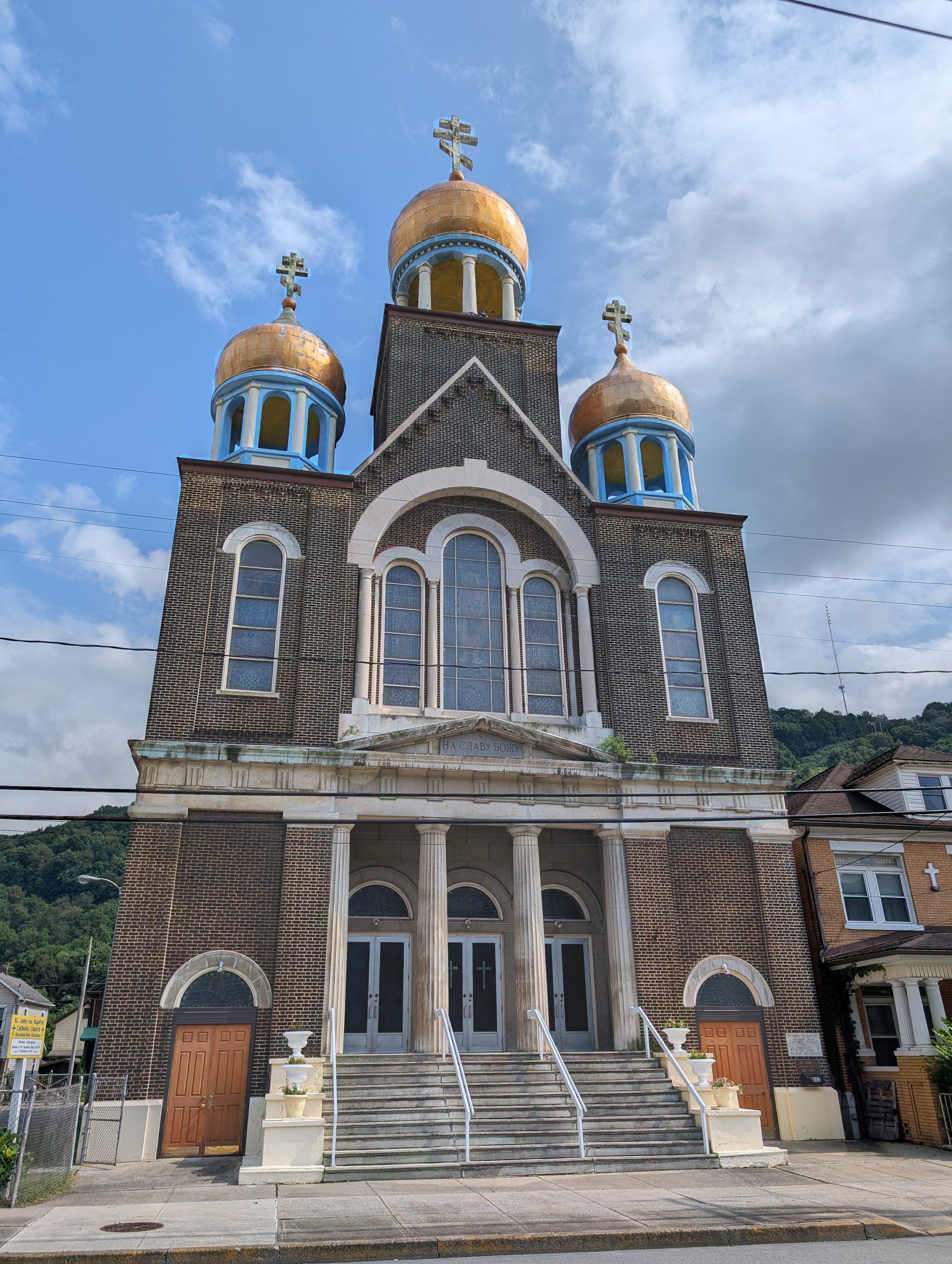
Drive down Maple Avenue and the skyline does something you don’t expect from a Pennsylvania mill town. Three onion domes rise over the rooftops, the color of an old penny, each topped with a three-barred cross. Underneath them stands a dark brick tower block that could pass for a bank, a courthouse, or a Carnegie library, until you notice the Cyrillic carved over the door.
The inscription reads На славу Божу, “To the Glory of God.” It sums up the building well. Here is a church that speaks two architectural languages at once and doesn’t apologize for either one.
The people who built it
Johnstown was built on iron. The Cambria Iron Company opened in 1852. Within four years it employed 1,500 men, and by the late 1880s the payroll had grown to 7,000. In its early decades the mills ran on skilled hands, puddlers, rollers and heaters, mostly Irish, German and Welsh. As steelmaking mechanized after 1870, the company needed something different: large numbers of men willing to do hard, unskilled work. Poles, Croatians, Slovaks, Magyars, Rusyns, Ukrainians and others answered that call. They arrived in the heaviest numbers through the 1890s and early 1900s, and by 1900 an estimated 5,000 East Central Europeans lived in greater Johnstown.
They were not made welcome. The established town lumped them together under slurs like “Hunkies” or simply “Hungarians,” whatever their actual homeland. A city directory from 1891 dismissed the newcomers as poor citizens and worse neighbors. They took the dirtiest jobs in the mills and lived in housing the local paper itself nicknamed “Rotten Row.”
The communities followed a pattern the federal historians who surveyed Johnstown traced across group after group. First came a mutual-aid society, which pooled dues for sick benefits, burial insurance, and small loans. Then came a church. Parishioners often dug the foundation and hauled the materials themselves. The first church was usually a modest wood frame building. A brick one followed when the congregation could afford it, and sometimes a grander third building after that, each one a measure of how firmly the community had taken root.
For Ukrainians, the path was tangled. They were Greek Catholics, Eastern Christians in full communion with Rome since the Union of Brest in 1596. They kept the Byzantine liturgy, married priests, and their own calendar, which made them a puzzle to the Irish and German Latin-rite bishops who ran the American church. In Johnstown’s early years, the lines between Slavic Greek Catholic groups were fuzzy. Rusyns, Ukrainians and others from the Carpathian borderlands often worshipped side by side, as historians found at St. Mary’s Greek Catholic in Cambria City, founded in 1895.
Those lines hardened over the following decades. In 1924 Rome gave American Greek Catholics two separate jurisdictions, one for Ukrainians from Galicia and one for Carpatho-Rusyns. A few years later, a Vatican decree requiring celibate priests in America drove a large group of Rusyn parishes out of Catholic communion entirely. They formed a new Orthodox diocese, and they headquartered it right here in Johnstown, where it remains today. Johnstown’s Ukrainians split along similar lines: a Ukrainian Orthodox parish, Sts. Peter and Paul in Moxham, served one branch of the community for about a century before it closed in 2020.
St. John the Baptist is the Ukrainian Catholic thread of that story. Today the parish belongs to the Ukrainian Catholic Eparchy of St. Josaphat, seated in Parma, Ohio.
Its mother church endured a harder century than the parish here did. Under Soviet rule, the Ukrainian Greek Catholic Church was outlawed and driven underground. It worshipped in secret for decades until it was legalized again in 1989. For much of the twentieth century, small parishes like this one in western Pennsylvania kept the liturgy openly in a way the old country couldn’t.
Reading the building, top to bottom
The façade works like a layer cake baked by two different families.
The crown. Three domes sit on three towers. The central one is larger and set higher, flanked by two smaller ones over the corner towers. A three-dome arrangement is commonly read as the Trinity. The bulbous, pointed profile descends from the churches of Kyivan Rus and the later Ukrainian baroque. Each dome rests on a drum ringed with slim columns, painted a soft sky blue, so the domes seem to float on lanterns rather than sit on solid walls. That open-arcade drum is the airiest part of the building. Light passes straight through it, and on a bright day the domes look like they’re hovering. On the left dome you can see where the gilded surface has worn away to the darker metal beneath. It’s the kind of patina that comes from a lot of winters in the Conemaugh Valley.
The crosses. Each dome carries the three-barred cross of the Slavic East: a short bar on top for the inscription plaque, the main crossbar, and a footrest below. It marks the building as Eastern from a block away.
The tower block. Below the domes, the body of the church is dark chocolate-brown brick laid with real craftsmanship. Look at the cornices and the gable outline over the center bay: the brick steps out in little corbelled teeth, like a row of dentils done in masonry instead of carved stone. The bricklayers used the material for ornament as well as structure. The central gable carries a stepped profile that draws the eye up toward the main dome.
The great window. The showpiece of the upper façade is a tripartite stained-glass composition under a broad semicircular stone arch. A tall center window rises between two shorter arched windows, each framed by its own smaller arch, with slender columns between them. It reads like a cathedral rose window rebuilt out of Roman arches. The flanking towers each carry a single tall arched window of their own, balancing the composition like two attendants standing beside a throne.
The portico. Then the language changes completely. The lower story is pure classical revival: four fluted columns set between brick piers, carrying a full entablature with a band of blocky ornament in the frieze and a shallow pediment holding the Cyrillic dedication. The cream-colored stone stands out sharply against the dark brick. Behind the columns, three doors sit under arched stained-glass transoms, reached by a broad flight of stone steps.
My read on the mix: Immigrant congregations of this era often hired local architects trained in the American classical tradition. Those architects knew how to build a dignified public entrance in the Greek and Roman vocabulary that every courthouse in the country used. The parishioners knew what a church in their homeland should look like from a distance. The result here splits the difference by elevation: an American civic front at street level, where the building meets the neighborhood, and a Kyivan skyline up top, where it meets the sky. Whether by plan or by compromise, it tells the story of a congregation determined to be both fully American and fully Ukrainian.
The flanks. At each corner tower, a secondary entrance sits under a round arch with a stained-glass fanlight. These are simpler, wooden double doors, the everyday way in. On the right, a plaque names the church in English and Ukrainian, and the rectory adjoins at number 612.
Wear and weather. Small plants have taken hold along the cornice above the portico, and the stone shows a century of soot and rain. Buildings like this hold up for a long time, but they depend on shrinking congregations to keep the gilding bright and the gutters clear.
Why it stands out in Johnstown
Johnstown has no shortage of fine immigrant churches: St. Columba’s Lombard Romanesque, St. Stephen’s exuberant baroque, St. Mary’s Byzantine splendor in Cambria City. St. John the Baptist earns its place among them by being so frank about its double identity. Most churches pick one style and commit. This one stacks two styles on top of each other and lets you see the seam, the way a family album might hold an old-country wedding portrait next to a snapshot from a 1950s Fourth of July picnic.
The workers who built it took the worst jobs in a town that called them names. Then they put their savings and their Sundays into a building that looks up past the mill smoke toward the dome-studded skyline of home, and wrote over the door who it was for.
Sources
- GCatholic.org – Church of St. John the Baptist (Ukrainian), Johnstown: https://gcatholic.org/churches/usa-03/17401
- Eparchy of St. Josaphat parish listing: https://stjosaphateparchy.com/parishes/
- Historic American Buildings Survey, “Cambria City and Minersville Neighborhoods,” HABS No. PA-5672 (Hickey and Goslin, 1988): https://tile.loc.gov/storage-services/master/pnp/habshaer/pa/pa2300/pa2328/data/pa2328data.pdf
- Ukrainian History and Education Center, St. Peter and Paul Ukrainian Orthodox Church of Johnstown records: https://archives.ukrhec.org/repositories/3/resources/76
- Heritage Johnstown, Walking Tour of Cambria City: https://www.heritagejohnstown.org/attractions/heritage-discovery-center/visitor-information/walking-tour-cambria-city/
- Newark History, St. John the Baptist Ukrainian Catholic Church (background on Soviet-era suppression and the 1989 legalization): http://www.newarkhistory.com/stjohnukrainian.html