A republic is explicitly designed to resist a cult of personality.
That isn’t a modern insight or a partisan one — it is a core design constraint baked into constitutional democracies from the beginning.
The framers understood a simple risk:
When political power becomes emotionally concentrated in a single individual, reason gives way to loyalty, and accountability collapses.
A cult of personality is not primarily a moral failure of voters.
It is a structural failure of institutions that allow symbolic power to accumulate faster than institutional checks can dissipate it.
The American system’s primary defense was never “better leaders.”
It was balance of power.
What the System Was Supposed to Do
At a high level, the design intent was clear.
Congress — Popular, Messy, Responsive
Congress was meant to be:
- Closest to the people
- Fragmented by design
- Slow, argumentative, unstable
- Explicitly political
Congress was supposed to be annoying.
It was meant to churn.
It was meant to reflect public mood swings in real time.
This was not a bug. It was the pressure-release valve of the system.
The Presidency — Administrative, Limited, Symbolic
The President was meant to:
- Execute the will of Congress
- Coordinate national action
- Provide diplomatic and moral leadership
- Enforce law, not invent it
Powerful in operation. Constrained in policy.
The President was never intended to be the primary policy engine.
They were the executor, not the author.
Charisma was expected — but contained.
The Courts — Cold, Corrective, Unpopular
The judiciary was designed to be:
- Not representative
- Not responsive
- Not democratic in temperament
- Actively restraining both Congress and the Executive
Courts were meant to be irritatingly slow and out of step.
Their legitimacy came from consistency, not popularity.
What Actually Happened
Over time, the system inverted.
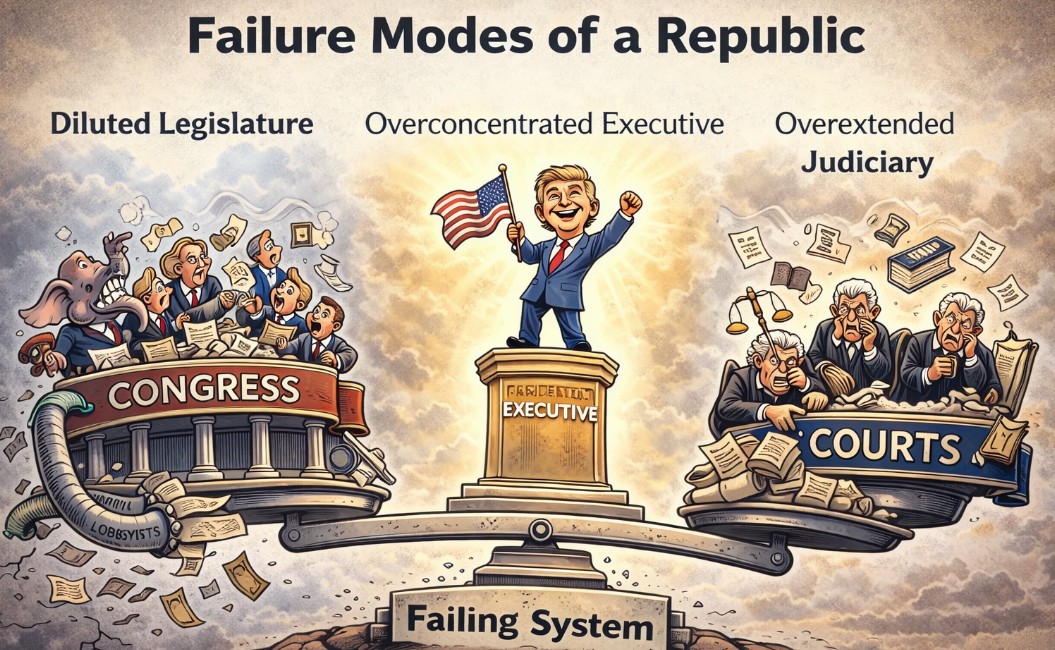
1. Congressional Power Was Diluted
Districts became safe.
Party leadership centralized authority.
Lobbying replaced local accountability.
Procedure replaced deliberation.
Congress stopped being feared — and started being ignored.
The people still vote.
But their influence is diffuse, delayed, and filtered.
Public frustration grows because Congress no longer visibly responds to public will.
2. Presidential Power Became Overconcentrated
As Congress weakened, power did not disappear. It migrated.
Executive orders replaced legislation.
Emergency powers normalized.
Media attention collapsed governance into a single face.
The public began asking presidents to solve everything.
The presidency became:
Too visible.
Too symbolic.
Too emotionally charged.
This is fertile ground for cults of personality — not because voters are irrational, but because the system trained them to look there.
3. The Courts Became the Last Line of Defense
With Congress ineffective and the presidency overextended, courts were pushed into a role they were never meant to dominate.
Policy disputes turned into legal battles.
Judges became proxy legislators.
Judicial legitimacy eroded under partisan pressure.
The referee was dragged onto the field and blamed for the game.
Why Everyone’s Complaints Are “Right” — and Still Wrong
Every major public complaint maps to a real failure — but often to the wrong institution.
“The President has too much power.”
Correct. But that power was abandoned by Congress first.
“Congress is useless.”
Also correct. But Congress behaves exactly as insulated bodies behave when they no longer fear voters.
“The courts are political.”
They are forced into politics when legislative clarity collapses and executive overreach fills the vacuum.
“The system is broken.”
Yes — but not because democracy failed.
It broke because the balance flipped:
- The people’s branch became remote.
- The administrator became dominant.
- The referee became a combatant.
The Core Inversion
In one sentence:
The people’s will is too diluted where it should be strongest (Congress) and too concentrated where it should be weakest (the Presidency).
That inversion creates cults of personality.
It invites authoritarian instincts.
It guarantees recurring crisis cycles.
No single leader caused this.
No single election fixes it.
The Uncomfortable Truth
A healthy republic does not feel smooth.
It feels argumentative.
It feels unstable.
It feels frustrating.
When people say they want a “strong leader,” what they often mean is:
“The system has stopped responding to me.”
That is a legislative failure, not a moral one.
Closing Frame
Cults of personality are not the disease.
They are a symptom of imbalanced institutional load.
The cure is not better presidents.
It is a Congress that once again fears the people more than donors, parties, or paralysis.
And a presidency that returns to what it was meant to be:
The executor of a collective will — not the substitute for it.