An Idea That Could Change Fish Farming
If you spend any time around fish ponds, you eventually notice the same invisible constraint that every fish farmer runs into.
It isn’t land.
It isn’t equipment.
It’s water.
Fish farming systems are limited by how much nutrient load the water can safely hold. As fish grow and feed rates increase, ammonia, nitrite, and suspended waste begin to accumulate. Eventually the farmer has to respond — thinning stock, slowing feeding, or exchanging water.
Those solutions work. But they also cap production.
What if the nutrients in pond water weren’t a problem at all?
What if they were fertilizer waiting to be harvested?
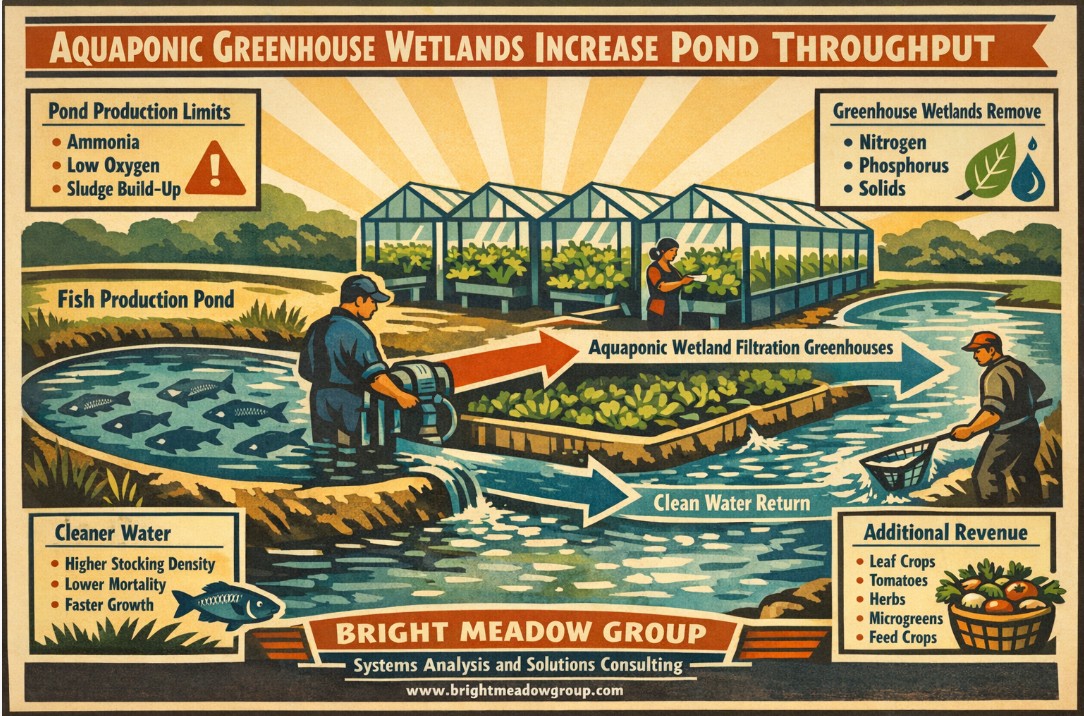
That question leads to an intriguing possibility: connecting fish ponds to greenhouse systems that function as controlled mechanical wetlands. Water cycles through plant beds where bacteria and crops remove nutrients before the water returns to the pond cleaner, more oxygenated, and more stable.
The pond becomes easier to manage.
The greenhouse becomes productive.
And the same water begins generating two harvests instead of one.
The following proposal from Bright Meadow Group explores that idea in more detail — how aquaponic greenhouse wetlands could increase pond throughput while producing secondary crops at the same time.
Using Aquaponic Greenhouse Wetlands to Increase Pond Throughput in Fish Farming
A Bright Meadow Group Systems Proposal
Fish farmers understand the problem better than anyone: production is limited not by space, but by water quality.
In pond systems, stocking density, feed rate, and growth speed all push against the same wall — nutrient loading. Ammonia, nitrite, suspended solids, and low oxygen levels eventually force the operator to slow down, thin stock, or exchange water. Every one of those options costs money.
There is another way to handle the nutrient load without reducing production.
Instead of treating pond water as waste that must be diluted, it can be treated as a resource that can be harvested.
Bright Meadow Group has been developing aquaponic greenhouse systems designed to function as mechanical wetlands connected to existing ponds.
These systems remove nutrients, increase oxygenation, stabilize water chemistry, and produce secondary crops at the same time.
The result is higher pond throughput, healthier fish, and multiple additional revenue streams from the same water.
The Core Idea: A Mechanical Wetland Connected to the Pond
A pond already contains everything needed to grow crops:
- Nitrogen
- Phosphorus
- Trace minerals
- Suspended organic matter
- Constant water supply
- Thermal stability
In a natural system, wetlands remove these nutrients slowly.
In a controlled system, we can do the same work faster, in a smaller footprint, while producing saleable crops.
The greenhouse aquaponic unit acts as:
- A biofilter
- A solids settling system
- A plant production system
- An oxygenation loop
- A temperature moderation loop
- A controlled environment for year-round growth
Water is pumped from the pond through the greenhouse beds and returned cleaner and better oxygenated.
The pond becomes easier to manage, and the greenhouse becomes productive instead of ornamental.
Increasing Pond Throughput Without Expanding the Pond
Most pond systems are limited by one of three factors:
- Oxygen depletion
- Ammonia / nitrite buildup
- Organic sludge accumulation
By continuously cycling water through a greenhouse wetland system:
- Ammonia is converted by bacteria
- Nitrate is absorbed by plants
- Solids are captured and composted
- Water returns with higher oxygen
- Temperature swings are reduced
This allows:
- Higher stocking density
- Higher feed rates
- Faster growth
- Lower mortality
- Fewer emergency water exchanges
In practical terms, this often means the same pond can support significantly more production without increasing surface area.
Healthier Fish from Cleaner, More Stable Water
Fish raised in stable water conditions:
- Grow more evenly
- Resist disease better
- Require fewer treatments
- Convert feed more efficiently
Greenhouse filtration systems improve stability by:
- Buffering pH swings
- Reducing suspended waste
- Increasing dissolved oxygen
- Reducing harmful nitrogen spikes
Operators frequently report that fish behavior improves noticeably when water is consistently cycled through plant systems.
Healthier livestock is not only a welfare issue — it is a profit issue.
Secondary Revenue Streams From the Same Water
The greenhouse portion of the system can produce crops year-round using nutrients that would otherwise accumulate in the pond.
Leaf Crops
- Lettuce
- Spinach
- Herbs
- Greens mixes
Fruiting Crops
- Tomatoes
- Peppers
- Cucumbers
- Berries
Raw Material Crops
- Duckweed
- Watercress
- Aquatic grasses
- Fiber plants
- Medicinal plants
High-Value Specialty Crops
- Microgreens
- Nursery plants
- Seed starts
- Ornamentals
- Native wetland plants
Livestock Feed Crops
- Duckweed
- Azolla
- Fodder greens
Value-Added Products
- Dried herbs
- Teas
- Sauces
- Pickled vegetables
- Plant starts
- Compost products
- Fish-and-greens direct sales
In many cases, the greenhouse can generate as much income as the fish operation itself.
A Controlled System, Not a Hobby Greenhouse
These are not hobby aquaponics kits.
Bright Meadow Group designs systems based on:
- Pond size
- Stocking density
- Feed input
- Climate
- Crop goals
- Labor availability
- Existing infrastructure
- Market opportunities
Systems can be built as:
- Small add-on filtration greenhouses
- Full production wetland loops
- Multi-pond integrated systems
- Seasonal systems
- Year-round systems
- Low-tech gravity systems
- Fully automated systems
The goal is always the same: increase production without increasing risk.
Why This Works
Fish farming already produces the nutrients.
Greenhouses already need nutrients.
Wetlands already know how to clean water.
This system simply connects the three.
Instead of fighting biology, we use it.
Bright Meadow Group Consulting
Bright Meadow Group provides system design for:
- Fish farms
- Aquaculture ponds
- Hatcheries
- Farm ponds
- Educational facilities
- Municipal ponds
- Regenerative agriculture projects
Consulting is structured under our standard model:
- One-day on-site evaluation (no fee, travel excluded)
- System analysis and design proposal
- Build-ready layout and operating plan if requested
Each system is designed for the operator, not for a catalog.
Bright Meadow Group
Systems Analysis and Solutions Consulting