The Biggest Man in the Room
I was sitting in a coffee shop this morning — the one with the uneven tables and the plants that are somehow both thriving and dramatic — when I saw it.
Someone had reposted an old quote from Hillary Clinton.
“I’m the last thing standing between you and the apocalypse.”
It had hundreds of likes.
Dozens of comments.
A lot of “she tried to warn us.”
And I just sat there with my mug and felt that old, familiar tightening.
Not anger.
Not even frustration.
Just recognition.
Because I remember that feeling.
That sense that something bad was coming.
That something fragile was about to crack.
And here’s the uncomfortable part.
When I read that quote again this morning, I didn’t think about who was right.
I thought about what it sounds like to someone who is already afraid.
If you tell people the apocalypse is at the door, they don’t start looking for the best résumé.
They look for the biggest shield.
And I don’t mean that in a cartoon way.
I mean it in a very old, very human way.
For most of history, if something dangerous approached your village, you didn’t gather the policy experts. You put the largest, strongest body at the gate.
We have technology now.
We have institutions.
We have nuclear treaties and global markets and all kinds of complicated systems.
But when people feel unstable — economically, culturally, socially — they revert.
They scan the room.
Who looks like protection?
And that question does not always reward competence. It rewards dominance.
Hillary Clinton had trained for executive power her entire adult life.
Kamala Harris built her career inside law enforcement and governance.
Both capable.
Both steady.
Both serious.
But both ran in cycles that were framed as existential danger.
And when you frame an election as survival, you activate something ancient.
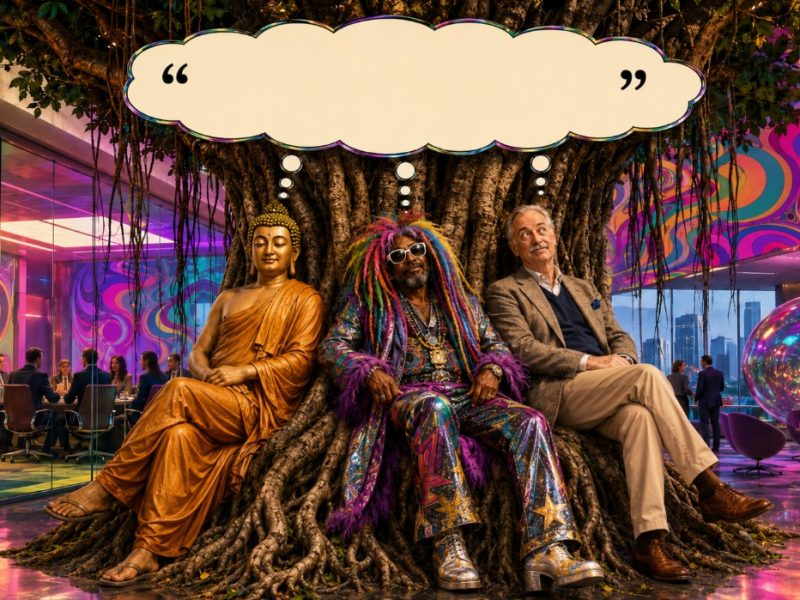
You activate the search for the biggest man in the room.
It doesn’t matter if he’s reckless.
It doesn’t matter if he’s unserious.
It doesn’t matter if he’s chaotic.
If he feels like force, fear will gravitate toward him.
That isn’t fair.
But it is real.
I keep seeing people online repeating the warnings.
“He told you who he was.”
“We tried to protect you.”
“You didn’t listen.”
And I understand the impulse.
But if we make the next election about apocalypse again, we will get the same reflex again.
You cannot out-ox the ox.
If you run against a dominance performer by centering threat, you are stepping onto terrain that rewards spectacle and size.
And culturally — whether we like it or not — size still codes male.
So maybe the shift isn’t about proving toughness.
Maybe it’s about lowering the temperature.
Maybe it’s about refusing to make the bull the center of every sentence.
If voters are afraid, what they actually want is stability.
Predictability.
Repair.
Order.
If you frame the moment as combat, they will choose a combatant.
If you frame the moment as reconstruction, they may choose a builder.
And historically, builders don’t trigger the same reflex as warriors.
This isn’t about diminishing women.
It’s about understanding wiring.
You don’t win by pretending the wiring isn’t there.
You win by navigating around it.
I finished my coffee. The quote was still on my screen.
She told the truth.
But truth delivered as apocalypse activates the wrong instinct.
And if we cannot afford to lose again, we have to be more careful about which instinct we wake up.
Small joys are big deals.
So is strategy.