Name’s Philip Randolph Wright.
Mister Wright if we’re doing business.
And the first thing a working person needs to understand about labor is this: the movement was never about winning fights.
It was about preventing them.
You see, when workers stand together, most fights never start.
When they don’t… well, that’s when begging begins.
Now I’ve been around long enough to watch this lesson get learned and forgotten a few times.
Men and women come into a trade thinking strength means how much weight they can lift or how loud they can shout across a meeting hall.
But that ain’t strength.
Strength is when ten people decide to stand up for the one.
Because the owners understand something very clearly.
A single worker is replaceable.
Ten workers are a problem.
A hundred workers are a negotiation.
And a thousand workers standing shoulder to shoulder?
Well now, that’s when the language changes from orders to respect.
That’s the whole meaning behind the old line:
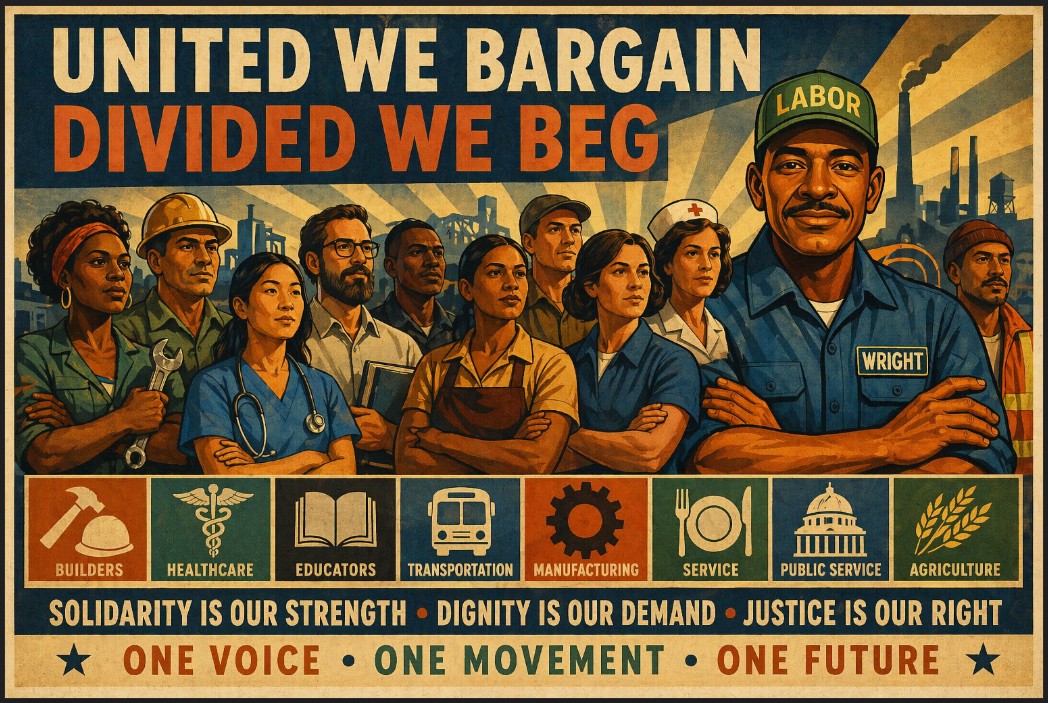
United we bargain. Divided we beg.
Not a slogan.
A measurement.
Because bargaining is what happens when two sides recognize each other’s power.
Begging is what happens when one side forgets it ever had any.
Now I want you to understand something else.
Solidarity is not charity.
A lot of folks misunderstand that.
Taking care of each other in the labor movement isn’t about kindness alone — though kindness certainly helps.
It’s about survival.
When a worker gets hurt on the job, the union steps in because tomorrow that worker might be you.
When wages get negotiated upward, everyone benefits because no boss likes paying one man more than the others for long.
When safety rules get enforced, it’s not about paperwork. It’s about making sure fathers and mothers walk back through the front door at the end of the shift.
Solidarity is simply workers recognizing the truth of their shared condition.
We all sell our labor.
The carpenter. The machinist. The driver. The teacher. The nurse.
Different tools, same bargain.
Time and skill traded for the ability to live a decent life.
Now the people who control wealth understand that equation too.
That’s why they spend a lot of energy trying to convince workers they are not the same.
Different races. Different trades. Different politics. Different neighborhoods.
Every wedge imaginable gets driven into the workforce.
Because if workers start seeing each other clearly again, the math changes.
And wealth, despite its size, is often outnumbered.
But solidarity requires discipline.
It means doing the right thing even when the right thing isn’t convenient.
It means defending the coworker you disagree with.
It means remembering that respect on the job site is just as important as the contract written in ink.
My old man used to say something when I was growing up.
He worked the rail lines as a porter. Carried the baggage of wealthy passengers across half the country.
One night I asked him why those men always seemed to treat workers like furniture.
He said:
“Son, a man who forgets where his comfort comes from eventually forgets who made it possible.”
Labor exists to remind the world of that.
Not with anger. With presence. With discipline. With unity.
Because when workers stand together, dignity becomes part of the bargain.
And dignity is the one thing no paycheck can replace.
So remember the rule.
Take care of each other.
Stand steady when it matters.
And never forget the difference between bargaining and begging.
Check your measure. Then check your motive.
Do the job right.
Do it the Wright way.
Well… now you know, Jack.