I was sitting with a cooling cup of coffee the other morning when I found myself turning over a phrase I hadn’t considered carefully in years.
Duty of Care.
Three words. Ancient lineage. And in the American political conversation, a silence so complete you could mistake it for ignorance.
It isn’t ignorance. That’s the thing worth understanding before everything else.
The Duty of Care is not a modern invention. It does not belong to any party, any movement, or any generation of reformers. It emerges from the same legal and philosophical tradition that produced the republic itself — Roman jurisprudence, English common law, the Stoic moral philosophy that Marcus Aurelius spent a reign trying to practice and a lifetime failing to perfect.
The principle is this: certain relationships generate enforceable obligations. When you hold power over another person’s wellbeing — when they have placed their trust, their safety, or their future in your hands — the law recognizes that you owe them something in return. Not charity. Not goodwill. A duty. Measurable, enforceable, and historically consequential.
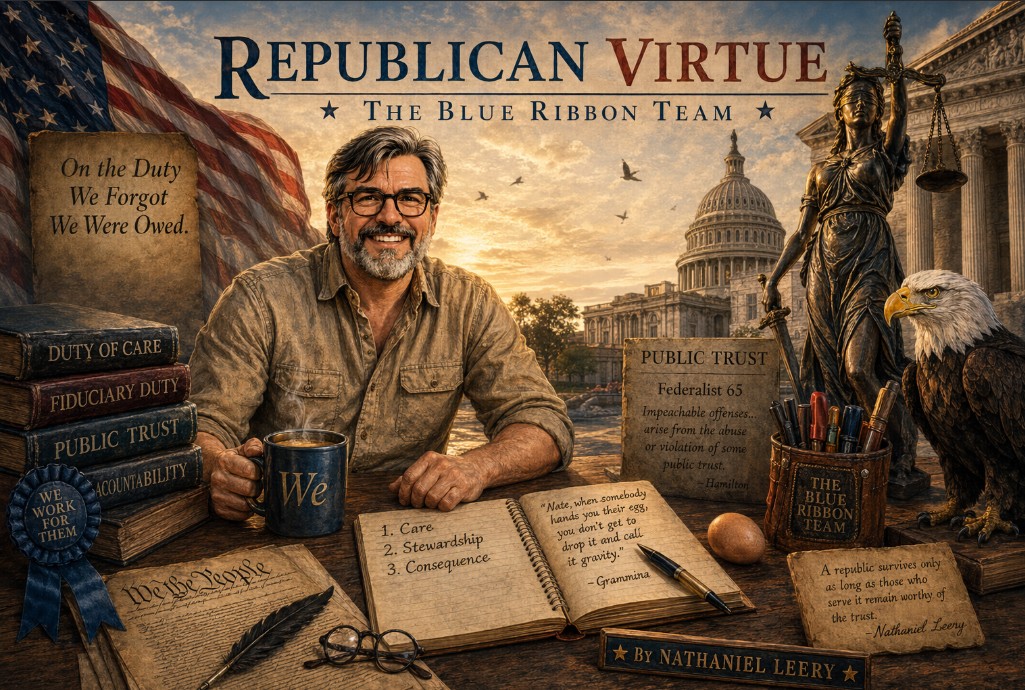
“Nate, when somebody hands you their egg, you don’t get to drop it and call it gravity.”
Grammina had a version of this, as she had a version of most things worth knowing. She was, I believe, paraphrasing no one in particular. She was, as usual, precisely correct.
In private law the doctrine is robust and well-litigated. It governs the physician and the patient, the attorney and the client, the trustee and the beneficiary, the manufacturer and the consumer, the employer and the worker. The fiduciary standard — the highest expression of the duty, requiring undivided loyalty to those one serves — has shaped corporate law, trust law, and the ethical architecture of every profession that asks to be trusted with consequential decisions.
The logic is elegant and old. You cannot occupy a position of responsibility over another person’s life or livelihood and then act with reckless indifference to what happens to them. The law, at its most coherent, reaches in and names that indifference. It assigns it consequences.
What strikes me — what has always struck me, though I confess I pushed the thought aside for too long — is where the doctrine stops.
It stops, with remarkable precision, at the door of public office.
The founders understood the problem, even if they lacked the legal vocabulary we now possess. The oath of office is a codified duty of care. The word faithfully in the presidential oath is not decorative. It implies loyalty to something beyond the self. It implies the kind of diligent, honest stewardship that the law demands of every trustee, every fiduciary, every person entrusted with power that belongs to someone else.
Hamilton was explicit about it in Federalist 65. Impeachable offenses, he wrote, arise from the “abuse or violation of some public trust.” Not necessarily a criminal act. Not necessarily an indictable offense. A fundamental betrayal of the obligations inherent in the position.
That is fiduciary language. That is Duty of Care language. That is the founders reaching for a legal and moral framework they could feel the shape of, even when they couldn’t quite name it.
And then, somehow, in the centuries that followed, we stopped applying it.
The reasons are worth examining — gently, and without too much sentimentality, because each of the doctrines involved carries real justification alongside its real cost.
Sovereign immunity is the oldest of them. The idea, inherited from English common law, is that the government cannot be sued without its own consent. The logic made a kind of sense in a monarchical world; it makes considerably less sense in a republic premised on the idea that power belongs to the people. Still, it persists — and it gives the government a legal shield that no private actor in a comparable position of trust ever receives.
Qualified immunity is newer, and more specific. It protects individual public officials — not just the institution, but the person — from civil liability, unless they have violated a right so clearly established that any reasonable official would have known it. In practice, this has meant that an official can cause considerable harm and face no personal legal consequence, so long as no court has previously ruled against nearly identical conduct. It is, to put it plainly, a doctrine that protects the novel wrongdoer.
The political question doctrine is subtler still. It removes whole categories of governmental conduct from judicial review entirely — courts declining to rule not because the conduct was lawful, but because the question is deemed too political for the judiciary to touch. Which is to say: the more consequential the decision, the less likely anyone is to examine it.
Each doctrine carries genuine justification. Each also creates space — significant, carefully maintained space — in which a public official can act with profound indifference to the welfare of the people they serve, and face no legal consequence for it.
This is not accident. The scaffolding was built by people who understood exactly what they were building. The gap between how we hold a corporate trustee accountable and how we hold a senator accountable is not an oversight of legal history. It is a preference expressed in legal history. And it has been maintained, across administrations and across parties, with a consistency that suggests the preference is bipartisan.
The citizen who wonders why the people they elect seem so insulated from the consequences of their choices is not paranoid. They are reading the architecture correctly.
What would it look like to take the principle seriously?
Not as a cudgel. Not as a partisan instrument. As a standard — the same standard we apply to the physician who fails their patient, the trustee who enriches themselves at a beneficiary’s expense, the employer who ignores a hazard until someone gets hurt.
A public official who is warned of a foreseeable harm to the people they serve — to public health, to economic security, to constitutional order — and who takes no meaningful action, would be held to account not for malice but for negligence. The standard is not whether they intended harm. It is whether they exercised the care the position required. Whether a reasonable person, faithfully executing the office, could have done what they did and called it stewardship.
That is a modest standard. It is the standard we hold everyone else to.
“If the man’s holding your egg, it doesn’t much matter whether he dropped it on purpose.”
I am not arguing for the criminalization of political failure. Governance is hard. Decisions made in good faith with incomplete information go wrong. The republic was designed, wisely, to tolerate a considerable amount of human imperfection in its officials.
What I am arguing is that we have tolerated something more than imperfection. The Duty of Care did not develop as an abstract philosophical exercise. It developed because human experience demonstrated, repeatedly, that relationships of trust, dependence, and asymmetric power generate predictable harm when the more powerful party acts without accountability. The relationship between a citizen and their government is precisely that relationship — and we have built, over generations, a system in which the people entrusted with the greatest power over the most lives are the least accountable to the standard that governs everyone else in a comparable position of trust.
The doctrine was built for this. The fact that we have so carefully avoided applying it to the people with the most power over our lives is not an oversight of jurisprudence.
It is a political choice. And like all political choices, it can be unmade.
A republic survives only as long as its citizens remain worthy of it. But the inverse is equally true, and we say it less often. It survives only as long as those who serve it remain worthy of the trust.