A Proposal to Turn Closed Industrial Capacity Into the Region’s Material Recovery Sector
A BMG Concept Brief
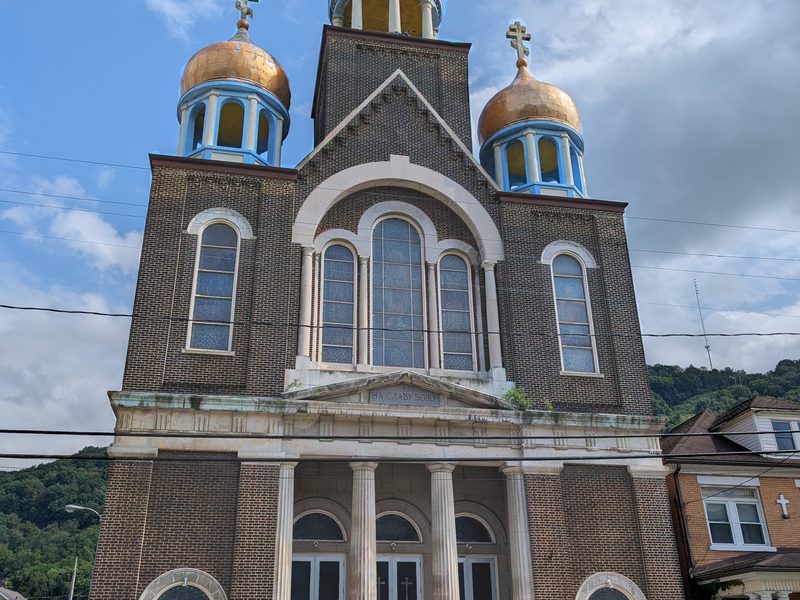
Johnstown is a city built to process material at scale. We have rail. We have water. We have grid capacity sized for an industrial era that left and never came back. We have buildings — some standing, some half-standing, some salvageable foundations on cleared lots — that were designed to take in raw material at one end, transform it under heat and pressure, and ship finished product at the other end.
That is precisely the description of a landfill reclamation and hydrothermal processing facility.
This brief proposes that Johnstown become the regional center for landfill mining, metals recovery, and hydrothermal fuel and char production for western Pennsylvania, eastern Ohio, and the upper Mid-Atlantic. The thesis is straightforward: the work that needs doing in the next twenty years matches the infrastructure we already have, and matches it better than almost any other available use.
Observe
The waste inheritance is national, but it lands locally. The United States operates roughly 1,200 active municipal solid waste landfills and a comparable number of closed legacy sites. Pennsylvania alone hosts dozens, many over forty years old, several over a century. Within a 200-mile radius of Johnstown sit some of the densest concentrations of legacy landfills in the country — the byproduct of having been the manufacturing belt of an industrial superpower for a hundred and fifty years.
What is in those landfills is now valuable. Aluminum, copper, steel, gold, silver, palladium, lithium, rare earths — concentrated by a century of human sorting and decades of compaction, sitting at recoverable grades that compare favorably with active commercial mines. The carbon-bearing remainder — paper, plastic, textile, food waste, yard waste — is feedstock for hydrothermal processing into fuels and soil amendments using technologies (HTC and HTL) whose chemistry has finally become legible at the atomic level.
The market is already moving. Wastenaut, a national waste market intelligence platform launched by a former Obama White House and UN advisor, reports having supported over two billion dollars in waste-to-value projects, with five hundred-plus data sources mapped across all fifty states. Capital is flowing into this sector. The question is where the physical work will happen.
Johnstown has the missing inputs. What does a landfill reclamation and hydrothermal processing operation need?
- Heavy industrial buildings with reinforced floors, high ceilings, crane capacity, and proximity to rail. We have these. Many of them are empty.
- Electrical grid capacity sized for steel and machine tool operations. We have this. The transmission infrastructure is already there.
- Water — large volumes, reliably available, at industrial pressures. Cambria County is named for the Welsh word for the country it resembles for a reason. We have this.
- Rail spurs and trucking corridors sized for inbound bulk material. We have these. They were built for coal and steel.
- A workforce with multi-generational experience in heavy industry, metals handling, high-temperature processing, and shift-based industrial operations. We have this. We have been waiting for someone to ask.
- Permitted industrial zoning and regulatory familiarity. We have this. The land use designation is already correct.
The infrastructure that built the steel industry is the same infrastructure required to build the materials recovery industry. Johnstown did not lose its industrial capacity. It lost its industrial purpose. We are proposing a new one.
Design
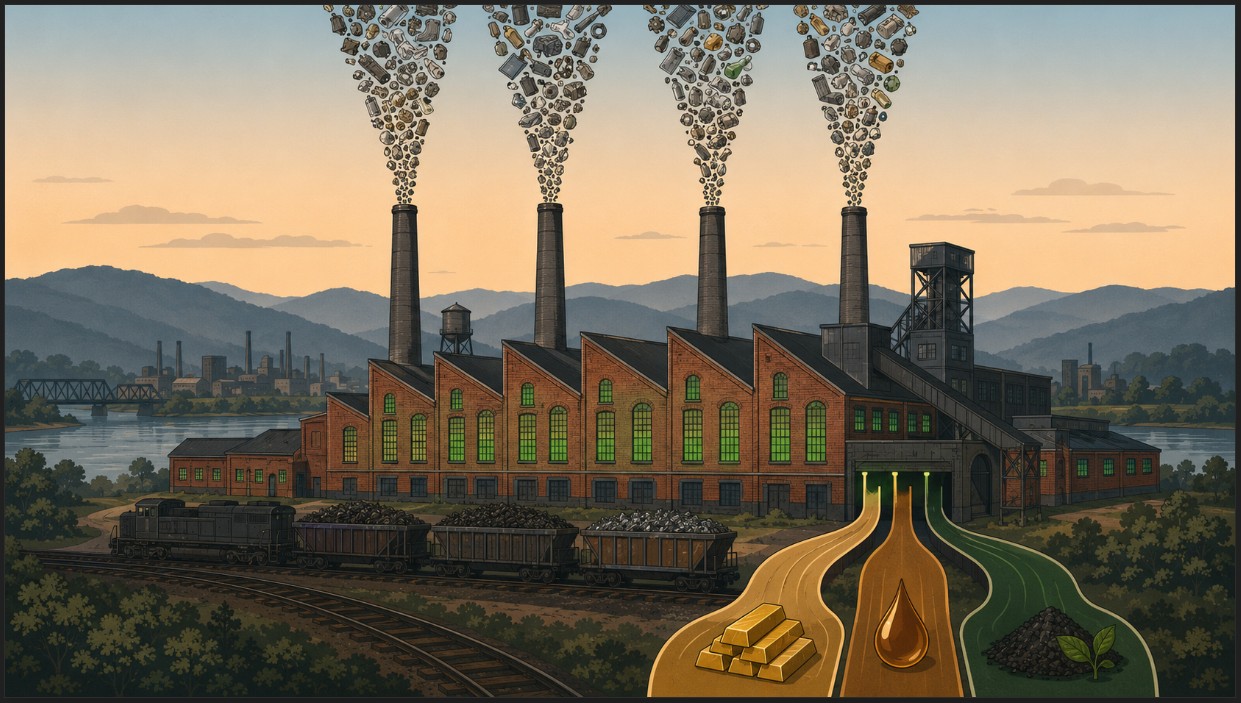
A regional materials recovery center based in Johnstown would integrate three production lines, all of them descended naturally from the work this region has done before.
Line One: Metals Recovery and Processing. Excavated landfill material, sorted and characterized, routed through ferrous and non-ferrous separation, then to smelting and refining. Johnstown’s metallurgical heritage is not incidental here — it is the entire point. The skills, the suppliers, the regulatory familiarity, the supply chain relationships with downstream metals buyers all exist in this region in a form they do not exist almost anywhere else in the country. Reactivating even a fraction of dormant metals processing capacity for landfill-sourced feedstock takes assets currently valued near zero and turns them back into producing infrastructure.
Line Two: Hydrothermal Processing of Organics and Mixed Waste. Carbon-bearing material that is not recovered as metal feeds HTC and HTL reactors. The output is hydrochar (a coal-equivalent solid fuel and soil amendment) and bio-crude (refinable into drop-in liquid fuels). Hydrothermal processing operates in water under pressure at moderate temperatures — the engineering disciplines required are pressure vessel design, heat exchanger management, process control, and continuous-flow industrial chemistry. Every one of those disciplines is represented in Johnstown’s existing skilled labor pool, often by people currently underemployed relative to their training.
Line Three: Research and Documentation Operations. Every batch processed through hydrothermal reactors, with rigorous input characterization and output analysis, adds a data point to a chemistry library that does not currently exist at scale anywhere in the world. A Johnstown facility that documented its operations seriously would become the de facto reference site for hydrothermal processing of mixed legacy waste. That is a research positioning that attracts university partnerships, federal research dollars, and private R&D contracts — durable revenue streams independent of metals and fuel commodity pricing.
Intervene
This is not a speculative proposal in the sense of being unproven. The components are proven. Metals recovery from landfills has been demonstrated commercially. Hydrothermal processing has been demonstrated at pilot and small commercial scale on multiple feedstocks. Waste market intelligence platforms now exist to identify the highest-value reclamation targets. What has not yet happened is the integration of these components at regional scale, in a single location with the industrial infrastructure to support all three lines simultaneously.
That integration is what Johnstown can offer that almost no one else can.
A staged buildout could look like this:
Phase One — Site Assessment and Anchor Tenant. Identify a closed mill or factory site with the structural and grid characteristics required. Engage a single anchor operation — most likely metals recovery, as the most mature of the three lines — to demonstrate the model at one site. Document everything.
Phase Two — Hydrothermal Pilot. Add an HTC or HTL pilot reactor to the anchor site, processing the organic fraction of the same landfill feedstock. Establish supply agreements with regional landfills for excavated material. Begin the documentation operation in parallel with production.
Phase Three — Regional Scale. Expand to additional reactivated industrial sites in the region, each specialized to a different aspect of the recovery operation. Establish Johnstown as the documented, defensible center for landfill reclamation services across a 200-mile radius.
Phase Four — Export of Methodology. The documentation produced in Phases One through Three becomes a licensable methodology, training program, and consulting practice. Johnstown ships not just metals and fuel, but expertise. The next region to reactivate its industrial base on a materials recovery thesis pays Johnstown for the playbook.
What This Requires from the City
This is not a proposal that requires Johnstown to take on debt or to subsidize an industry that has not yet proven itself. It requires the city to do three things it is well-positioned to do:
- Inventory and stage available industrial sites. Identify the closed mills, factories, and warehouses that meet the structural, grid, water, and rail requirements outlined above, and prepare them for industrial tenancy with clear titles and worked-out permitting paths.
- Position the city as a partner, not a permitee. Work with state economic development authorities and the regional waste industry to make Johnstown an attractive landing site for waste-to-value capital that is currently flowing to whichever city moves first.
- Convene the workforce and educational pipeline. Cambria County’s labor pool and the technical and community college infrastructure can be aligned with hydrothermal processing, metals handling, and industrial chemistry training in advance of demand, not after.
What This Returns
Reactivated industrial buildings. Skilled jobs in shift-based operations, mechanical maintenance, process chemistry, materials handling, and research documentation. Tax base. Regional environmental benefit, in the form of legacy landfills that shrink rather than grow. National positioning as the city that figured out, before anyone else did, that the next industrial era would be built on the inheritance of the last one.
Johnstown was built to take in raw material at scale and ship finished product. The raw material has changed. The skills, the infrastructure, and the location have not.
We have the inheritance. We have the inventory. We have the inheritance of the inheritance — the mills, the rail, the river, the workforce, the permits.
We are proposing that Johnstown stop waiting for the last industry to come back, and start building the next one.
Observe. Design. Intervene.
Bright Meadow Group is a systems design and consulting practice based in Johnstown, Pennsylvania. We do the kind of analysis that connects what a region already has to what the next twenty years will require. This concept brief is offered as the opening of a conversation. We are available to develop it further at the city’s interest.