A BMG Concept Brief on Closing the Reclamation Loop
The first three pieces in this series argued that American landfills are inventory, that the cities built to process material at scale are the right places to reclaim them, and that the steel inheritance alone justifies the work. Each of those arguments leaves the same question unanswered: when the reclamation operation finishes excavating a site, what gets left behind?
The conventional answer is: a hole. Possibly a contaminated one. Possibly one that needs decades of monitoring, leachate management, and groundwater remediation. The reclamation operation extracts the value and walks away from a site that, while improved relative to a still-active landfill, is not yet a place anyone would describe as healed.
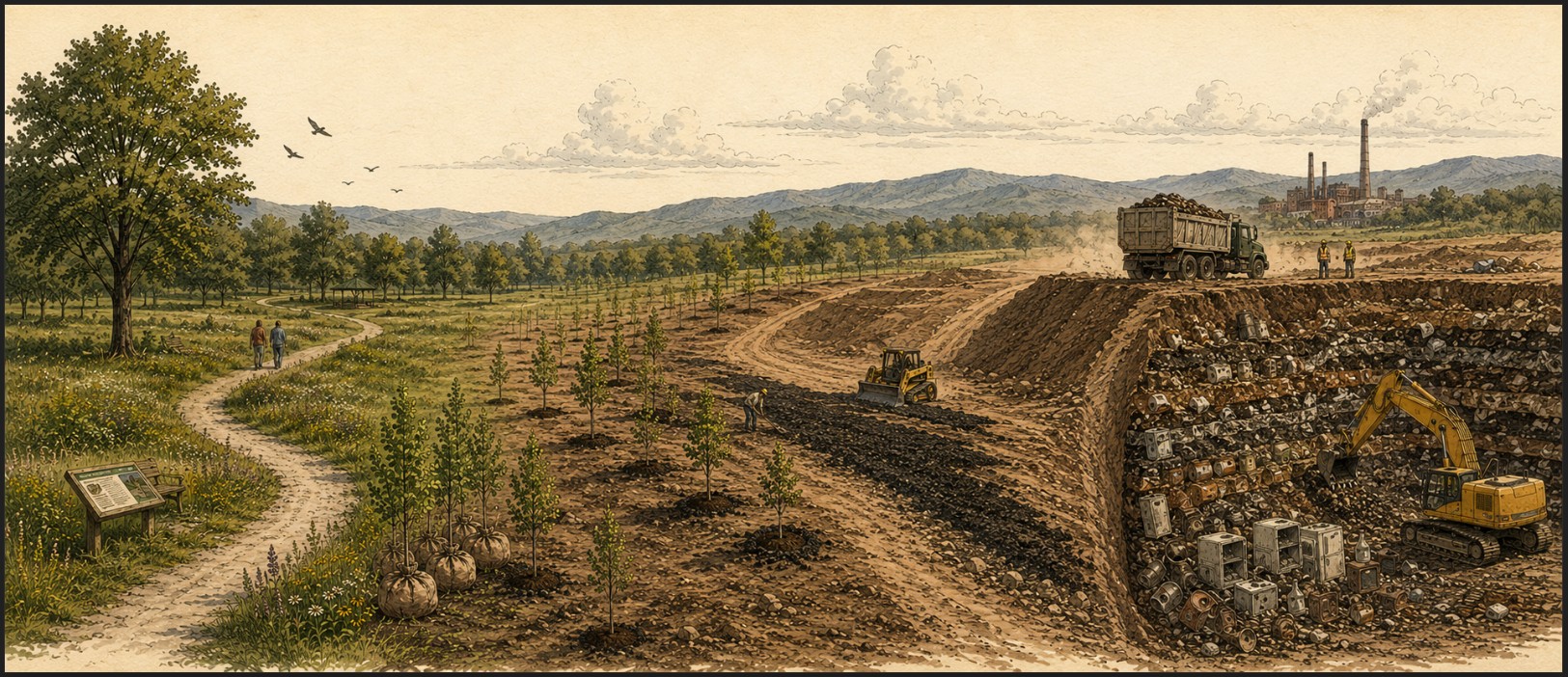
That answer is wrong, or at least incomplete. The same process that recovers the metals and the carbon also produces the material required to remediate what is left. The reclamation operation is not extraction followed by abandonment. It is extraction followed by restoration — and the chemistry has been arranged, by accident of process design, to make the second step a natural consequence of the first.
The substrate that does this work is biochar.
Observe: The Site Is Still Poisoned
A landfill mining operation, even one executed with full metals recovery and complete hydrothermal processing of the carbon-bearing fraction, does not produce a clean site. It cannot. A century of mixed consumer chemistry leaves contamination in the surrounding soil, in the underlying clay or rock, in the groundwater table. Heavy metals migrate. Persistent organic pollutants — PCBs, PAHs, chlorinated solvents, pesticides, plasticizer residues — accumulate in soil matrix beyond the reach of bulk excavation. Even after the visible material is gone, the site continues to leach.
This is the part that the conventional reclamation conversation tends to skip. We pulled out the value, we processed what we could, the methane stopped, we capped it and walked away. That sequence is better than leaving the landfill active. It is not, by itself, restoration. It is partial extraction with the worst contamination spread thinner across the same footprint.
The land beneath an old landfill has been poisoned for decades. Capping it does not undo that. Excavating it improves the situation but cannot reach what has migrated into the matrix soil and groundwater. To genuinely heal the site requires a substrate intervention — a material introduced to the site that actively binds, neutralizes, and immobilizes what extraction could not remove, and that creates conditions for biological recovery to take over the work that engineering cannot finish.
This is what biochar does.
Design: Biochar as Remediation Substrate
Biochar is a stable carbon material produced when biomass is heated in low-oxygen conditions — pyrolysis, hydrothermal carbonization (HTC), or related processes. The product is a porous, mineral-rich, carbon-dense solid that has been studied intensively over the last two decades for its soil and remediation properties. The relevant findings, summarized for the working argument:
Heavy metal binding. Biochar’s surface chemistry adsorbs lead, cadmium, arsenic, mercury, chromium, and a range of other heavy metals — locking them in place rather than letting them migrate through groundwater. The binding is strong, stable across normal soil pH ranges, and persistent over geological timescales. A site backfilled with biochar effectively becomes a heavy-metal sink rather than a heavy-metal source.
Organic pollutant adsorption. The same porous structure that binds metals also adsorbs PCBs, PAHs, chlorinated compounds, pesticides, and pharmaceuticals — pulling them out of soil water and immobilizing them in the char matrix. Combined with the microbial communities biochar supports, many of these compounds are subsequently degraded into less harmful forms.
Methane suppression. Residual organic material in the soil continues anaerobic decomposition long after a landfill is closed. Biochar amendment shifts the soil toward conditions that favor aerobic processes and suppress methanogenic bacteria. The site stops being a methane source, often within months of amendment.
Soil structure recovery. Biochar improves water retention, increases soil cation exchange capacity, and provides physical habitat for the fungal and bacterial communities that drive long-term soil recovery. A site that previously could not support plant communities becomes a site that can — first with hardy pioneer species, then over time with progressively more demanding ones.
Carbon sequestration. Once placed, biochar carbon is stable for hundreds to thousands of years rather than decomposing back into atmospheric CO₂. The backfill operation is also a carbon storage operation. Every ton of biochar deposited represents roughly two to three tons of CO₂-equivalent kept out of the atmosphere relative to the alternative carbon pathways.
What biochar does is not glamorous. It does not glow, it does not produce immediate visible results, and it does not solve the problem in a single intervention. What it does is create the conditions under which natural processes can finish the work. It is a substrate between the toxins and the healthy environment we want to leave behind. The microbial communities, the fungal networks, the early plant colonizers, the slow soil chemistry — they do the actual healing. Biochar makes their work possible by giving them stable, contaminant-binding, water-retaining, carbon-rich material to grow into.
This is restoration in the deepest sense: not the imposition of a new state, but the construction of conditions that allow recovery to happen on its own.
Intervene: The Production Loop Is Already Closed
Here is what makes this argument operationally rather than aspirationally sound.
The hydrothermal processing chain at the heart of a reclamation operation produces hydrochar as a primary output. Some of that hydrochar has fuel value and is sold or used for process energy. But not all of it does. Lower-grade hydrochar, contaminated batches, char that does not meet fuel-spec — that material has to go somewhere. In a stand-alone HTC operation it is a disposal cost. In a closed-loop reclamation operation, it is the backfill.
The economics do not have to support biochar production as a separate line item. The biochar is already being produced as a byproduct of the carbon recovery step. Using it as remediation substrate eliminates a disposal cost on the production side and eliminates a remediation cost on the site-closure side. The waste stream of one process is the input to the next. The chemistry has been arranged, by the structure of the work itself, to be self-completing.
That is the internal economics. The external economics are where this gets genuinely interesting.
The Market Structure That Falls Out of the Operation
Biochar is a commodity with a real and growing market. Agricultural producers buy it as a soil amendment. Civil engineers specify it for stormwater management and contaminated site remediation. Environmental remediation firms use it as a primary tool for legacy site cleanup. Demand has been increasing year-over-year as the research base matures and as carbon-credit frameworks make biochar storage explicitly monetizable.
A reclamation operation producing biochar is therefore producing two distinct value streams from the same material:
Stream one: backfill for the operation’s own remediation. Char that meets the operation’s internal specifications goes back into the hole. This is not sold; it is deployed as part of the project’s remediation budget, which is already accounted for in the cost of doing the reclamation work.
Stream two: char sold to external buyers. Char that exceeds backfill needs, or that meets higher-grade specifications appropriate for agricultural or commercial remediation use, becomes a saleable product. This is revenue.
The natural market structure that emerges: a biochar broker company sits between the reclamation operation and downstream buyers. The broker buys excess char from the reclamation site, certifies and grades it, and sells into established markets — agricultural, civil engineering, remediation, carbon-credit. The broker takes a margin; the reclamation operation gets a clean revenue stream without having to build its own sales and certification infrastructure.
This is good business architecture. The reclamation operation focuses on what it is good at — excavation, processing, and backfill of its own sites. The broker focuses on what it is good at — certification, market relationships, and downstream sales. Neither has to do the other’s job poorly.
It also creates a particular kind of three-way deal that is worth naming explicitly: the broker can sell biochar to the developer who eventually buys the reclaimed site. The reclamation operation excavates and partially backfills the site with internally-produced char. The site is sold to a developer for industrial, commercial, or residential reuse. The developer needs additional remediation substrate to bring the site to spec for their intended use. The broker — already holding char produced at this same site — sells it back to the developer for the final remediation pass.
The material never leaves the site. The transaction structure makes the economics work. The reclamation operation, the broker, and the developer all get clean roles. And the land that was a contaminated landfill becomes a properly remediated site ready for productive use, with the substrate that healed it produced from the same waste that originally poisoned it.
What This Closes
The four articles in this series have moved through a complete argument:
The landfill is inventory, not waste. The cities built to process material at scale are the right places to do the work. The specific material — steel, in particular — is enough by itself to make the operation viable. And what remains after extraction is not a hole to be abandoned, but a site to be restored, with the restoration substrate produced by the same process that did the extraction.
That is a closed loop in the deepest sense: not just material flows that complete a cycle, but a complete economic, ecological, and operational structure where every step produces what the next step requires. Extraction produces value and char. Processing recovers metals and fuel. Backfill remediates the site. Excess char produces revenue. The site becomes useful land. The land was a liability and is now an asset, healed by the same work that recovered the buried inheritance.
This is not novel chemistry. It is not novel economics. It is not even novel methodology — biochar amendment of contaminated sites has been studied and practiced for decades. What is novel is the integration: doing all of these things in one operation, at one site, with the output of each step explicitly designed to feed the next.
That integration is what BMG does. The methodology has always been observe, design, intervene. What this article makes visible is what intervention actually completes. Healing a site is not separate from the work of reclaiming it. It is the work of reclaiming it, finished properly.
The hole heals. The land returns. The loop closes.
Observe. Design. Intervene.
This is the fourth in a series on landfill reclamation, materials recovery, and the case for treating American landfills as the next material frontier. Earlier pieces: “The Hundred-Year Inheritance,” “Johnstown’s Next Mill,” and “The Tin Can Was Steel.”