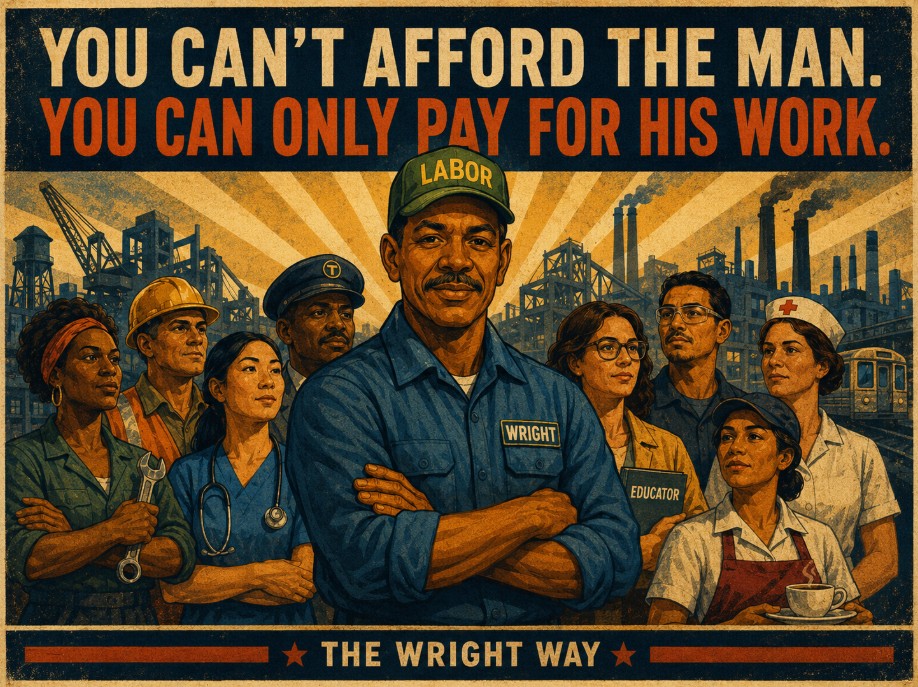
You Can’t Afford the Man. You Can Only Pay for His Work.
Name’s Philip Randolph Wright.
Mister Wright if we are doing business.
The first thing we need to get straight is the measure.
A worker is not the product.
The work is the product.
That sounds simple until you look at how many bosses, companies, towns, systems, and whole economies have tried to live as if it were not true.
A man sells his labor. A woman sells her skill. A worker sells time, attention, judgment, strength, patience, risk, memory, craft, and the wear that every honest job leaves on the body.
That is the product.
The person is not.
You can buy eight hours. You can buy a finished car. You can buy a rail laid straight, a line repaired, a room cleaned, a patient lifted, a meal served, a boiler kept alive through winter, or a thousand parts fitted so cleanly the machine forgets it was ever separate pieces.
You can buy the work.
You cannot buy the worker.
And if you forget that, sooner or later, the worker will have to remind you.
That is why we remember Pullman.
Not just as a strike. Not just as an old labor fight. Not just as a chapter in a history book where men in hats stand beside railcars and everybody already knows who lost.
We remember Pullman because it showed the difference between employment and ownership.
George Pullman built sleeping cars. Fine ones. Polished ones. Comfortable ones. Cars that let people with money cross the country with a mattress under them and a porter nearby to make the distance feel civilized.
Then Pullman built a town.
That is where the story gets serious.
The town of Pullman, south of Chicago, was designed as a company town around the Pullman Palace Car Company. It had order, housing, streets, rules, rents, and the company’s presence folded into daily life. The National Park Service describes the strike beginning at the Pullman factories on May 11, 1894, after a grievance committee failed to get anywhere with the company.
Now, a clean town is not wicked.
A decent house is not wicked.
A planned street is not wicked.
A company building housing near work is not automatically a sin.
The sin comes when the employer starts acting like the paycheck bought more than labor.
The sin comes when the man who buys the work also controls the roof, the rent, the rules, the store, the town, the complaint, and the consequences of speaking up.
That is not a workplace.
That is ownership reaching past the job and toward the human being.
And no employer can afford the human being.
He can only pay for the work.
When the Panic of 1893 hit, Pullman cut wages. The workers still had rent to pay. The company town did not become cheaper just because the company paycheck got smaller. Britannica summarizes the cause plainly: Pullman workers faced layoffs, wage cuts, and firings, and the strike eventually spread into a major railroad boycott.
That is the part that needs saying right.
The workers were not asking for charity.
They were not children asking Father Pullman for a kinder allowance.
They were sellers of labor saying the buyer had changed the price while keeping control over the seller’s life.
There is a difference.
A fair deal starts with the understanding that both sides bring something to the table. The employer brings capital, equipment, orders, organization, and market access. The worker brings labor.
But labor is not air.
Labor is not gratitude.
Labor is not something the boss discovers lying around the shop floor.
Labor belongs to the person producing it until it is sold.
That means the price matters.
The conditions matter.
The dignity matters.
The freedom to leave matters.
The freedom to object matters.
The freedom to live somewhere the boss does not own matters.
Because if the employer can cut your wage and still collect your rent, he is not just buying labor anymore.
He is squeezing the seller.
Pullman wanted cheaper work while the company town kept charging full price for life.
That is not a market.
That is a trap with a payroll department.
Now, some men have always tried to dress that kind of control in fine words.
They call it order.
They call it efficiency.
They call it family.
They call it a model town.
They call it benevolence.
But a worker knows the difference between respect and supervision. He knows the difference between a fair arrangement and a velvet cage. He knows when the hand on his shoulder is helping him stand and when it is checking whether he can still be pushed lower.
Pullman’s company town was supposed to prove that ownership could be benevolent.
Instead, it proved why ownership needs limits.
Because when one company owns the job and the house, the worker is no longer bargaining from level ground.
If the wage is cut, the table shrinks.
If the rent stays high, the floor drops out.
If complaint risks the job, and losing the job risks the house, then the worker is being asked to sell labor under pressure no free person should accept.
That is not labor peace.
That is quiet coercion.
And quiet coercion is still coercion.
So the workers walked out.
May 11, 1894.
There is dignity in that date.
Not because walking out is romantic. It is not. A strike is not a parade. It is not a picnic. It is not a slogan printed clean and hung on a wall. A strike means fear. It means unpaid days. It means kitchens getting quiet. It means wives and husbands doing arithmetic with bad numbers. It means children hearing adults speak low in the next room.
No working person with sense celebrates a strike like a toy.
A strike is what happens when the ordinary channels fail.
It is what happens when workers say: if you will not pay a fair price for the work, then you cannot have the work.
That is not theft.
That is ownership.
The worker owns the product of his labor until he sells it.
If the buyer will not pay fair, the seller can refuse the sale.
That is not radical.
That is business.
Only labor is expected to forget it.
The American Railway Union, led by Eugene V. Debs, later took up the Pullman workers’ cause by refusing to handle trains carrying Pullman cars. The boycott spread widely; Britannica gives the scale as roughly 125,000 to 250,000 railroad workers across 27 states.
That is where Pullman stopped being only Pullman.
The factory hand became visible to the rail hand.
The rail hand became visible to the switchman.
The switchman became visible to the brakeman.
The porter became visible to the passenger, whether the passenger wanted to see him or not.
The country learned something it prefers to forget:
Nothing moves until labor moves it.
Not the train.
Not the mail.
Not the coal.
Not the wheat.
Not the steel.
Not the luggage.
Not the passenger sleeping comfortably behind a curtain someone else hung.
Capital can own the car.
Labor makes it move.
There is a moral distinction there sharp enough to cut steel.
The Pullman car belonged to the company.
The work belonged to the workers until it was fairly bought.
When the country chose sides, it chose order over justice. Federal power came down hard. Injunctions were issued. Troops were sent. The strike was broken. Debs was arrested and later imprisoned. The legal and political aftermath became one of the defining examples of how quickly private ownership could call public force when commerce got interrupted.
So no, this is not a clean victory story.
Do not sand it down.
Workers suffered.
Families suffered.
Men were injured.
Men were killed.
The union was damaged.
The trains moved again.
Pullman did not end with a handshake and a fair bargain under a blue sky.
But defeat is not the same thing as failure.
Sometimes defeat tells the truth so loudly that even the winners cannot bury it.
Pullman exposed the company town.
It exposed paternalism.
It exposed wage cuts without shared sacrifice.
It exposed the danger of letting an employer control too many parts of a worker’s life.
It exposed the old lie that capital alone makes the world run.
And it exposed the central truth Mr. Wright would carry in his bones:
The work is the product.
The worker is not.
That truth runs past the strike and into the sleeping cars themselves.
Because the Pullman story does not end with the men who built the cars.
It continues with the men who worked them.
The Pullman porters were mostly Black men. They carried bags, made berths, shined shoes, answered bells, absorbed insult, kept schedules, handled passengers, and carried themselves through a country determined to confuse service with servitude. The Brotherhood of Sleeping Car Porters was founded in 1925 and led for decades by A. Philip Randolph.
Now you understand why a man named Philip Randolph Wright would take interest.
Randolph understood the line.
Service can be honorable.
Work can be honorable.
Carrying another man’s luggage can be honorable.
Cleaning, lifting, serving, building, driving, cooking, teaching, nursing, hauling, welding, sweeping, repairing — all of it can be honorable.
But the worker is still not for sale.
The service is for sale.
The dignity is not.
The work is for sale.
The person is not.
That is the line Pullman blurred.
That is the line Randolph sharpened.
That is the line Mr. Wright would teach.
Because once a worker understands that his labor is a product, he stands differently.
He does not stand like a beggar.
He does not stand like property.
He does not stand like a child hoping the company father is in a generous mood.
He stands like a seller with something valuable.
He stands like a craftsperson.
He stands like a citizen.
He stands like somebody who knows the buyer needs the product.
That does not make him arrogant.
It makes him accurate.
There is nothing wrong with an employer buying labor. There is nothing wrong with management when management remembers what it is managing. There is nothing wrong with profit when the people producing value are paid, protected, respected, and left enough life to be human after the whistle blows.
Mr. Wright is not anti-management.
He is anti-disrespect.
He is anti-bad-measure.
He is anti-any system that tries to buy the man while pretending it only hired the work.
A fair employer understands the difference.
A fair employer says: I need your skill, and I will pay for it.
A crooked employer says: I pay your wage, so I own your obedience.
A fair employer says: the work has value.
A crooked employer says: be grateful you have work.
A fair employer bargains.
A crooked employer pressures.
A fair employer wants good work from free people.
A crooked employer wants control and calls it loyalty.
That is why Pullman still matters.
Because the company town did not die. It changed clothes.
Today, the company town may not always have brick row houses and a factory gate. Sometimes it looks like employer-tied healthcare. Sometimes it looks like company apps that follow the worker home. Sometimes it looks like scheduling systems that own the whole week without paying for the whole week. Sometimes it looks like wages that cannot cover rent while executives lecture about family. Sometimes it looks like noncompetes, forced arbitration, surveillance, subcontracting, misclassification, or a smiley poster in the break room telling exhausted people they are appreciated.
Same old question:
Are you buying the work?
Or are you trying to own the worker?
Because those are not the same thing.
You can buy a shift.
You can buy a service.
You can buy output.
You can buy skill.
You can buy attention.
You can buy the product of disciplined hands.
But you cannot buy the hands themselves.
You cannot buy the conscience.
You cannot buy the home.
You cannot buy the vote.
You cannot buy the right to speak.
You cannot buy the right to rest.
You cannot buy the person underneath the uniform.
You cannot afford the man.
You can only pay for his work.
And if you want good work, pay a fair price.
That is not a threat.
That is not class warfare.
That is the moral foundation of every honest job ever done.
A fair day’s pay buys a fair day’s work.
Nothing more.
Not silence.
Not worship.
Not fear.
Not the worker’s children.
Not the roof over his head.
Not his future.
Not his name.
Pullman forgot that.
Randolph remembered it.
And the worker still needs to know it.
So when we say “Pullman’s Company Town,” we are not just naming a place.
We are naming a warning.
Do not let the buyer of labor become the owner of life.
Do not let wages be discussed apart from rent, food, time, safety, dignity, and freedom.
Do not let a company call itself family while pricing the family out of its own home.
Do not confuse a job with a deed of ownership over the person doing it.
And never forget the first measure:
The worker owns the work until he sells it.
The employer owes a fair price for what he buys.
That is the deal.
That is the line.
That is the Wright Way.
You can’t afford the man.
You can only pay for his work.
Now you know, Jack.