A Triple Sycamore at Fort Benjamin Harrison State Park
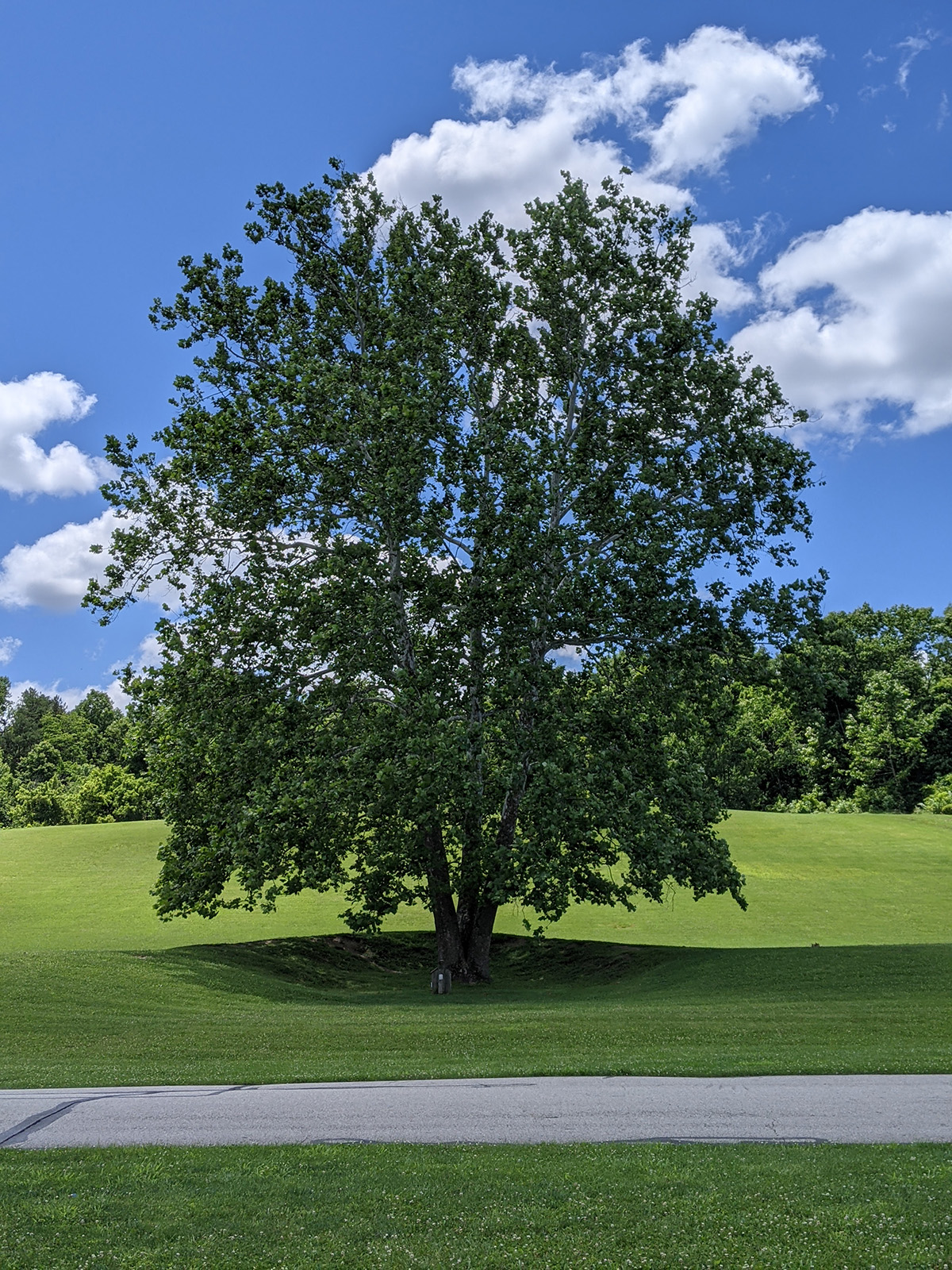
At the bottom of the sled hill in Fort Benjamin Harrison State Park, in Indianapolis, there is a sycamore that is actually three sycamores. Locals call her the Three Sisters. I have heard her called the Witch Tree too, and either name fits depending on the light and the season. Three trunks, each more than three feet across at the base, grown so close together a long time ago that they fused into one and never separated. From a distance she reads as a single enormous tree. Up close you can see the seams where the three meet, the bark folding in on itself where the trunks press together.
She is hard to miss. The sled hill is one of the biggest in central Indiana, and she stands alone at the bottom of it, on the flat where the run-out finally lets the children stop. In summer she pulls a ring of cool shade onto the cut grass and the kids who roll down the hill in July aim for her. In autumn her leaves come down in plates the size of dinner platters — sycamores never bothered to evolve a small leaf — and they crackle for weeks underfoot.
She is older than the park. She is older than the fort. She is older, almost certainly, than any building you can find in Lawrence Township.
The land became Fort Benjamin Harrison in 1903, when the U.S. Army bought roughly two thousand acres from local farmers for a little under $280,000. Theodore Roosevelt officially opened the post in 1906, naming it for the recently deceased twenty-third president, who was from Indianapolis. Through both World Wars the fort served as one of the largest training and induction centers in the country. By 1943 the reception center on the post was the largest in the United States.
Between the wars, from 1933 to 1938, Civilian Conservation Corps crews were posted at Fort Harrison and assigned reforestation work on the base grounds. Much of what is now the largest forested area in central Indiana traces back to those CCC plantings. But not the Three Sisters. She was already there when the CCC arrived, already dropping seed onto the same ground the crews were planting. Stand at the base of her and look up the surrounding ridges, and you can see her work — sycamores in every direction, none of them as old as she is, most of them descended from her. The CCC planted oaks and maples and walnuts. The sycamores are largely her own.
She was here on the farm that stood on this ground before the Army came. She was here when the property changed hands in 1903. She was here when Roosevelt cut the ribbon on the new post in 1906. She watched soldiers drill on this ground for two World Wars. She watched Italian and German prisoners of war held within sight of her in 1944 and 1945. She watched the Pan American Games athletes’ village rise around her in 1987 and come down a few years later. She watched the base close in 1991 and the state park open four years after that.
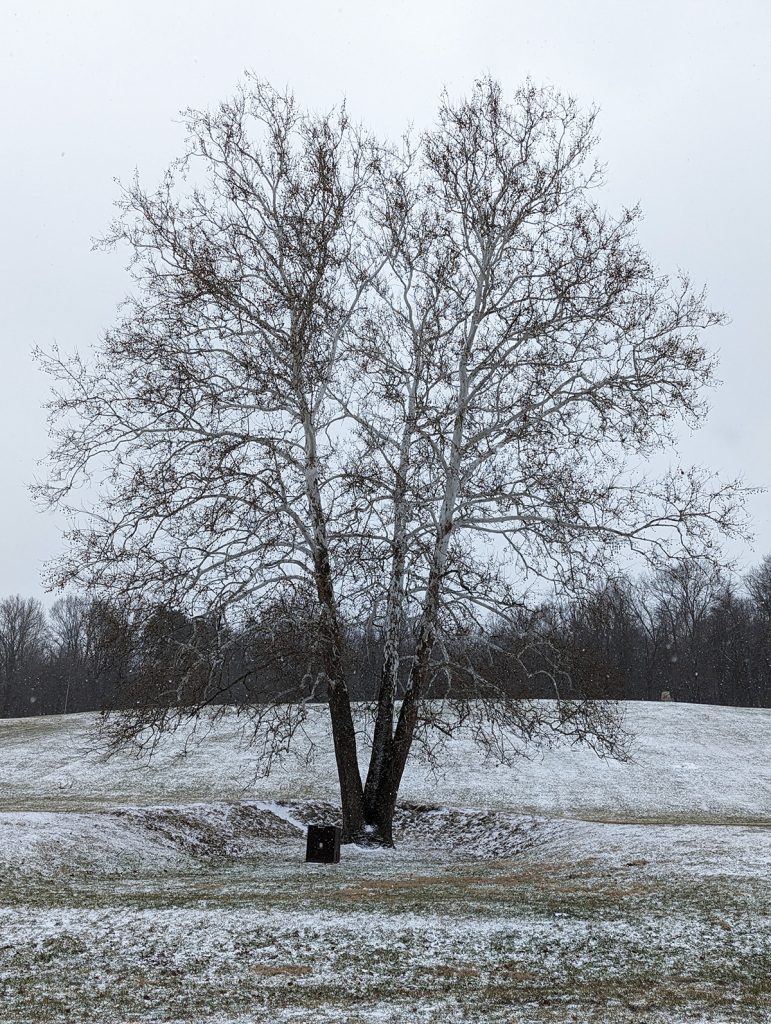
You see her best in winter. With the leaves gone you can finally read her — three trunks rising from one swollen base, dividing and dividing again into the high arms that catch the snow on their upper sides. American sycamores hold their wood in a particular way as they age. The bark on the lower trunk stays dark and plated, but the upper limbs shed and lighten and turn that ghost white the species is known for. On a gray January day with snow drifting down, she looks lit from inside. The depression of bare ground at her base where her roots have raised the soil and her shade has held the snow off the grass becomes its own small landscape. The kids are gone home. The hill is quiet. She is, for a few months a year, the most visible thing in the park.
Sycamores live a long time. Some American sycamores in the eastern forests are documented at over four hundred years. I do not know exactly how old the Three Sisters are. Looking at her trunks and the size of the forest she helped seed, I would not be surprised to find she is closer to two centuries than one. Old enough to have stood on a farm before the fort. Old enough to have watched the whole twentieth century from one spot.
I take a walk past her when I am in Indianapolis. The whole park is full of good trees — Fort Ben preserves the last large forested corner of Marion County, and Fall Creek runs through the north side of it with sycamores all along the banks. Most of them are her grandchildren. But the Three Sisters is the one I go see. She is older than what surrounds her, larger than she has any right to be, and somehow still holding the line at the bottom of a hill that has been a sled hill for as long as anyone can remember.
If you are in Indianapolis and you have not been, go. She is easy to find. The sled hill at Fort Harrison State Park is on the south side of the park near the main loop. She is the one tree standing alone in the lawn at the bottom. You will know her when you see her. Stand under her for a few minutes. Then look up the hill, and down to the creek, and out into the woods, and remember that most of what you are seeing is hers.