Rabbits, Comedians, and the End of the World’s Dumbest Supply Chain
How a conversation about animal urea became a farm-restaurant-television format designed to teach the world to feed itself without anyone noticing they’re being taught.
It started with rabbit poop.
Not metaphorically. Literally. I was watching the news cycle churn through the Hormuz crisis — urea prices up 32% in a week, a million tons of fertilizer stranded in the Gulf, analysts warning about food inflation cascading into 2027 — and I thought: we are about to watch the world’s food supply get strangled because we forgot that animals make nitrogen for free.
Half the world’s traded urea comes from countries currently at war or blocking shipping lanes, and the industrial food system treats that like a supply chain problem instead of what it actually is: a design flaw.
So I ran the animals through a matrix. Which critters produce the most nitrogen per dollar of feed input? Which breed fast, stay small, live in premium pet-like conditions, and serve multiple purposes? If you were going to build a business around biological nitrogen production at the scale of one household, what would the optimal stack look like?
The answer is rabbits, quail, pigeons, chickens, fish, pigs, worms, and duckweed, layered into one system where every organism’s waste feeds another’s growth. And the business model that makes it work is not a farm. It’s a restaurant with a television show attached to it, designed to teach the entire world how to replicate the system without anyone realizing they’re being taught.
Let me explain.
The design flaw
Here is how eight billion people eat: a German chemist’s 1918 Nobel Prize–winning process converts fossil fuel into ammonia. That ammonia becomes urea — white pellets packed with nitrogen, manufactured mostly in the Middle East, loaded onto ships, sailed through a 33-kilometer-wide strait between Iran and Oman, and sprinkled onto fields across Asia, Africa, and the Americas to grow the corn, wheat, rice, and soybeans that everything else depends on.
When the Strait of Hormuz effectively closed after Operation Epic Fury, the fertilizer supply chain didn’t tighten. It seized. Qatar shut 5.6 million tons of annual urea production. India lost 800,000 tons of monthly output. China restricted its own exports. Urea at the Port of New Orleans jumped from $516 to $683 per metric ton in a single week.
You can skip a season of potash and phosphates. You cannot skip a season of nitrogen.
And here’s the part nobody is talking about yet: the food price impact arrives on a six-to-nine-month delay. Farmers who cut nitrogen this spring see lower yields this fall. Lower yields push commodity prices up by early 2027. By the time consumers feel it at the grocery store, the cause will be invisible — buried under nine months of intervening headlines.
This is the background against which everything that follows should be read.
The critter matrix
I ran nine candidates through a feed-cost / space / breeding-speed / nitrogen-yield matrix: rabbits, guinea pigs, rats, Coturnix quail, pigeons, budgies, tilapia, goldfish, catfish.
Three animals dominated: rabbits at 90/100, quail at 85, tilapia at 84. Each dominates a different function.
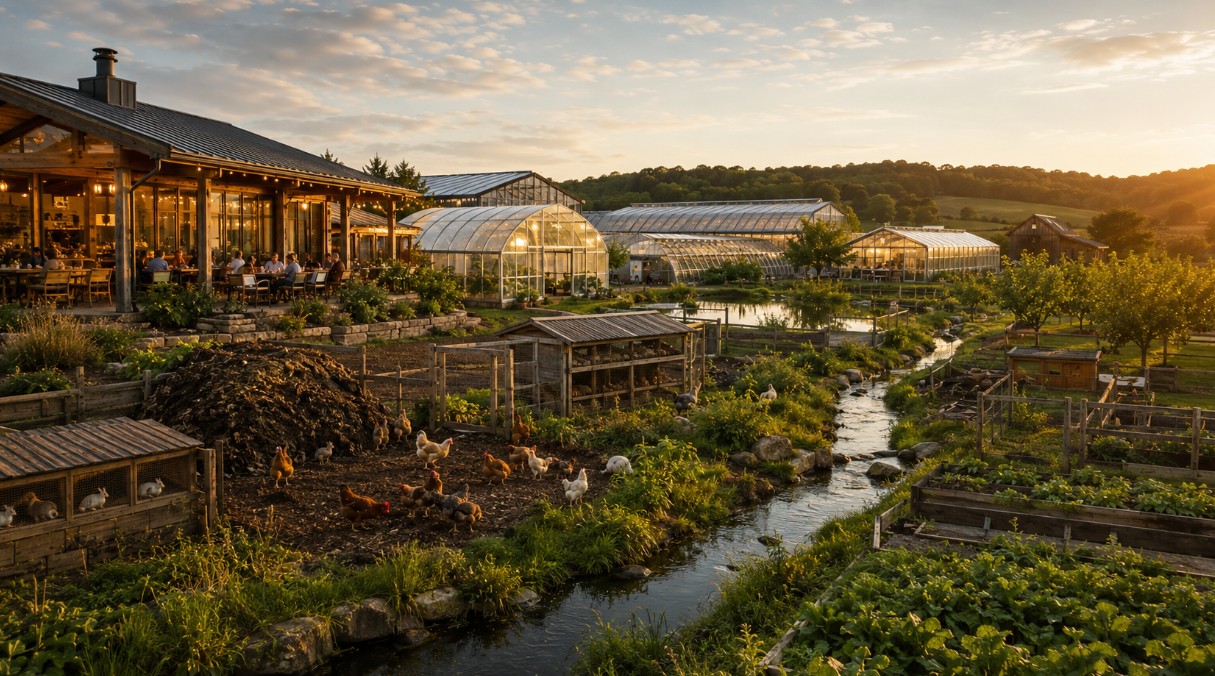
Rabbits are the nitrogen anchor. Their manure is the only livestock manure that goes directly onto plants without composting — “cold” manure, won’t burn roots. A colony of ten produces 40 to 60 pounds of manure per week, twice the nutrient density of chicken manure and four times horse manure. Put worm bins under the hutches and you’ve got a three-tier fertility factory: rabbit waste feeds worms, worm castings go to plants, excess worms feed fish and chickens.
Quail are the compact protein factory. They eat a quarter as much as chickens, use half the water, and are nearly silent — legal almost everywhere, including urban zones where roosters would get you a noise complaint. A 2-by-4-foot cage houses eight to ten birds. Each lays 250 to 300 eggs per year. Egg-to-egg cycle under eight weeks.
Tilapia close the water loop. Fish excrete ammonia, bacteria convert it to nitrate, plants absorb the nitrate while cleaning the water that returns to the fish. Different nutrient pathway than the mammal-and-bird manure route. Complements rather than duplicates.
But the matrix revealed something I hadn’t appreciated: you can’t separate these animals into different businesses. They’re layered. Rabbit manure feeds worms. Worms feed fish and chickens. Fish waste feeds plants. Plant scraps feed rabbits and chickens. Chickens eat everything nothing else will consume — fish guts, spoiled vegetables, broken eggs, BSF larvae from the compost. Their hot manure accelerates the compost pile that the rabbit’s cold manure anchors. Pull one animal out and you break a conversion step.
You also need a couple of seasonal pigs, because they eat literally everything that falls through every other crack in the system, and they till ground by rooting.
One rule governs all of it: nothing raw from an animal goes to another animal’s food or water, except chickens eating meat waste. Everything else goes through compost at 130 to 160 degrees, which kills pathogens. Chickens get the exception because their digestive system evolved for it. One rule. Teachable. Non-negotiable.
The money problem
Here is where most permaculture writing stops. You describe the beautiful system, sketch the build costs, and then either hand-wave the economics or quietly assume the operator has a trust fund.
I ran the numbers honestly. A single person operating the full system at steady state generates roughly $1,500 to $2,500 per month selling at wholesale and farmers market prices.
That’s not a living. Not for the skill required.
The entire small farm economy in America runs on a dirty secret: unpaid or underpaid labor disguised as education. Interns. Apprentices. WWOOFers. That’s not a model I can teach with a straight face, and it’s not something I can release as an open-source system for food sovereignty.
So what if the farm isn’t the business? What if the farm is the credential that makes the business credible?
The restaurant
A 3.5-pound rabbit wholesaled to a restaurant at $12 per pound generates about $16 in margin after feed and processing. The same rabbit served in my own restaurant — two loin plates at $34, a braised leg special at $22, bones to stock for the soup course at $8 — generates $90 in margin. A 5.6x increase on the same animal.
The processing problem disappears. A restaurant kitchen is a licensed food prep facility. The chef breaks down the rabbits, cleans the quail, portions the fish as part of daily prep.
A conventional restaurant spends 30 to 35 percent of revenue on ingredients. This one spends 8 to 15 percent because the operator raised most of the food. On $15,000 to $20,000 in monthly revenue, that 20-point margin difference is $3,000 to $4,000 per month flowing to the bottom line instead of to Sysco.
Format: 20 to 30 seats. Tuesday through Saturday dinner service. Fixed multi-course menu that changes weekly with the harvest. $45 to $65 per person. The menu is not designed by the chef and then sourced from suppliers. The menu is determined by what the farm produced that week and then interpreted by the chef. That inversion is the structural advantage.
The chef is a full equity partner. Non-negotiable.
The show
This is where it gets fun.
Sunday is reserved. No regular service. A guest chef cooks a multi-course tasting dinner for 20 guests, including two to four celebrity diners — comedians, food personalities, curious famous people. The dinner is broadcast live as a podcast. The polished episode drops on YouTube later that week. Clips feed the daily content machine all week long.
One Sunday dinner generates five to seven days of content with no additional production effort.
Each guest chef holds a one-month residency of four Sunday dinners. Week one is discovery: the chef tours the farm, designs the menu. Week two is struggle: first service, things go wrong, the constraints become visible. Week three is refinement. Week four is the masterclass.
The celebrities are not judges. They’re the Greek chorus — the comedian trying squab for the first time, the actress learning the herbs on her plate were fertilized by fish waste, the podcaster asking the question the audience is thinking. Same function as the panelists on Match Game and Would I Lie to You — the famous people aren’t the point. They’re the reaction shots that make the content entertaining for a general audience.
And here’s the Trojan horse: the audience learns closed-loop agriculture without ever being taught it.
Nobody tunes in thinking “I want to learn about nitrogen cycling tonight.” They tune in because a comedian they follow is trying to eat something weird at a beautiful farm table. But the B-roll is the morning harvest. The transitional footage is the duckweed pond and the aquaponics. The establishing shot is the rabbits and the worm bins. By episode six, the audience understands how a closed-loop food system works. They absorbed it the way you absorb a song lyric — not by studying, but by exposure.
That’s how Will Allen got a MacArthur Genius Grant. He wasn’t teaching composting. He was feeding a neighborhood, and the composting was just how it happened. This isn’t teaching nitrogen cycling. It’s feeding celebrities, and the nitrogen cycling is just how the food got there.
The 20-per-town thesis
I don’t want to scale this. I hate scale. Scale is how we got into this mess — a global food system dependent on fossil-fuel nitrogen shipped through a single maritime chokepoint. The answer is not a bigger version of the same vulnerability. The answer is twenty of these in every town.
A town of 5,000 people with twenty households running closed-loop microfarm systems can produce all the premium protein and fresh vegetables the town needs, plus enough compost and nitrogen to supply local grain farmers who close the calorie gap. The twenty operations don’t compete. They trade. The network creates a local food economy that doesn’t care what’s happening in the Strait of Hormuz.
This plan is designed to be copied. The full document — system specifications, restaurant format, financial projections, regulatory pathways, three-year timeline, the whole thing — is released without copyright restriction. No paywall. No course fee. No certification program. No gatekeeping.
If you copy it and succeed, my business gets harder. If enough people copy it, I go out of business entirely.
That is the goal.
The operator’s exit is not a sale. It’s irrelevance. If the model replicates — if enough towns have enough microfarm operations trading with each other — the original operation becomes one node in a network. Its competitive advantage dissolves. That is not a business failure. That is mission accomplished.
I started trying to figure out which animals produce the most urea per dollar of feed input. I ended up designing a farm-restaurant-television format that teaches the world to grow its own nitrogen without anyone realizing they’re in a classroom.
The biological knowledge is ancient. Rabbits and worms and chickens and compost have been cycling nitrogen through small farms for millennia. We industrialized it away because fossil-fuel urea was cheap.
It is not cheap anymore.
The full business plan, system specs, financial model, and three-year rollout are attached as a free download. Use it. Adapt it. Build from it.
If you need help adapting it to your location, your climate, your market — get in touch. That’s consulting, and that’s the part we charge for. Everything else is a gift, because the world needs to eat.
Build the loop. Open the restaurant. Film the dinner. Teach everyone.