I don’t have any Black enemies that I know of. I don’t have any Chinese, Persian, Ukrainian, or Brazilian enemies either. I don’t have Mexican enemies or Filipino enemies or Jewish enemies or Muslim enemies. I have stood watches with most of these people, in the Navy, when the radio room didn’t care where anybody’s grandmother was born. The ones I haven’t stood watches with, I’ve worked the warehouse with, or shared a union hall with, or rented an apartment to, or repaired a sorting machine next to. I know these people. They are not my enemy.
I do have rich enemies. There is only one war for me, and that is the one.
I want to be plain about what I mean and what I don’t, because no war but class war is a phrase that gets misheard by people who want to mishear it, and I am not in the business of giving them the satisfaction.
I am not saying race is a fiction. It is not. I am not saying the civil rights struggle is finished. It is not. I am not saying the harms done to people because of color, creed, country of origin, or anything else they did not choose are imaginary. They are not. I have seen them up close in places most of the people writing about them have never set foot.
What I am saying is something simpler, and older, and harder for people who profit from confusion to hear without flinching.
When the boat is sinking, the boat is what matters. Not the flag painted on the side.
I grew up poor, in mixed neighborhoods — the kind that form at the edges of deindustrialization. Factory closures. Base shutdowns. Tenements with no exit ramp. The kind of places where the American safety net has holes you can fall through for generations, and people do, and nobody writes a story about it because the people falling are too tired to be photogenic.
In a neighborhood like that, you don’t ask what somebody is. You ask what they know, what they can do, and whether they will show up tomorrow when you said you would help each other move the couch. Race doesn’t disappear in poverty. Nobody is claiming it does. But it gets demoted. It moves down the list. Survival has a way of sorting priorities whether you wanted them sorted or not.
I later saw what real poverty looks like overseas. Somalia. South Asia. Places Americans call third world without understanding what the term meant when it was coined or what it means now. What surprised me about those places was not how hard life was — I expected that. What surprised me was that the people in them still had things American poverty had stripped from the people back home. Continuity. Usefulness. Dignity. A grandmother who knew where she was. A trade passed down. A neighborhood that had not been bulldozed for a parking lot.
In too many American neighborhoods, poverty is not just material deprivation. It is managed despair — a condition arranged by people who profit from arranging it, maintained by policies that don’t change no matter which team wins the election, and explained to the people inside it as their own fault.
That is the part I have a problem with.
Here is the thing the people in charge would prefer you not notice.
When resources grow scarce, and when inequality is allowed to harden into something permanent, division becomes profitable. Race, religion, region, language, the way you pray, the way you cook, the way you talk about your mother — none of these are the root cause of the fights they get used to start. They are accelerants. They are what gets poured on the fire when the people running the place need the fire to burn somewhere other than their own front porch.
You can see it work. You have seen it work. Two families on the same block, behind on the same rent, owing the same predator the same money, get walked into a fight with each other over a flag, or a word, or a holiday, while the landlord cashes both checks and goes to dinner. That is not a metaphor. That is the mechanism. That is how the trick works, and it has been working for as long as there have been landlords and tenants and a couple of newspapers willing to print the wrong story above the fold.
That is why I say class first. Not because the other harms don’t matter — they do, and they hurt people I love, and I am not asking anyone to set them down. I am saying that the economic imbalance is the engine that keeps reproducing them. Stabilize the floor underneath people and they begin to recognize each other again. Leave the floor cracked and falling, and resentment hardens into policy, and policy hardens into the kind of country that calls itself exceptional while it eats its own.
There is a civilized way to balance a tilted floor, and there is the other way.
The civilized way is taxes, wages, unions, healthcare, schools that don’t shake the kids down for lunch money, and laws that apply to the people who can afford lawyers in the same way they apply to the people who cannot. None of that is radical. Most of it used to be ordinary. We had it once and we let it be taken from us, a piece at a time, while we argued about the wrong things on television.
The other way is what happens when the civilized way is refused for long enough. History is consistent on this — brutally so. When societies will not correct imbalance peacefully, the imbalance corrects itself, and it does not correct itself gently, and it does not ask permission first, and the people who could have prevented it are usually the most surprised when it arrives.
I am not calling for the other way. I am describing how it shows up when nobody chose it. Scarcity leads to segregation. Segregation leads to stories that explain the segregation. The stories curdle into moral narratives. The moral narratives, given enough time and enough hunger, license what nobody would have licensed at the start.
This is not a threat. This is a weather report.
I want to say one more thing, and I want to say it square.
I am not asking anyone to put down a struggle they are already in. I am not telling any community whose grandmother was beaten by a sheriff that their grandmother’s beating was secondary to something else. That is not my place and it is not my point. The point is that the boat is the same boat, and the people drilling holes in the bottom of it are counting on us to argue about the labels painted on the sides until the water is in our laps.
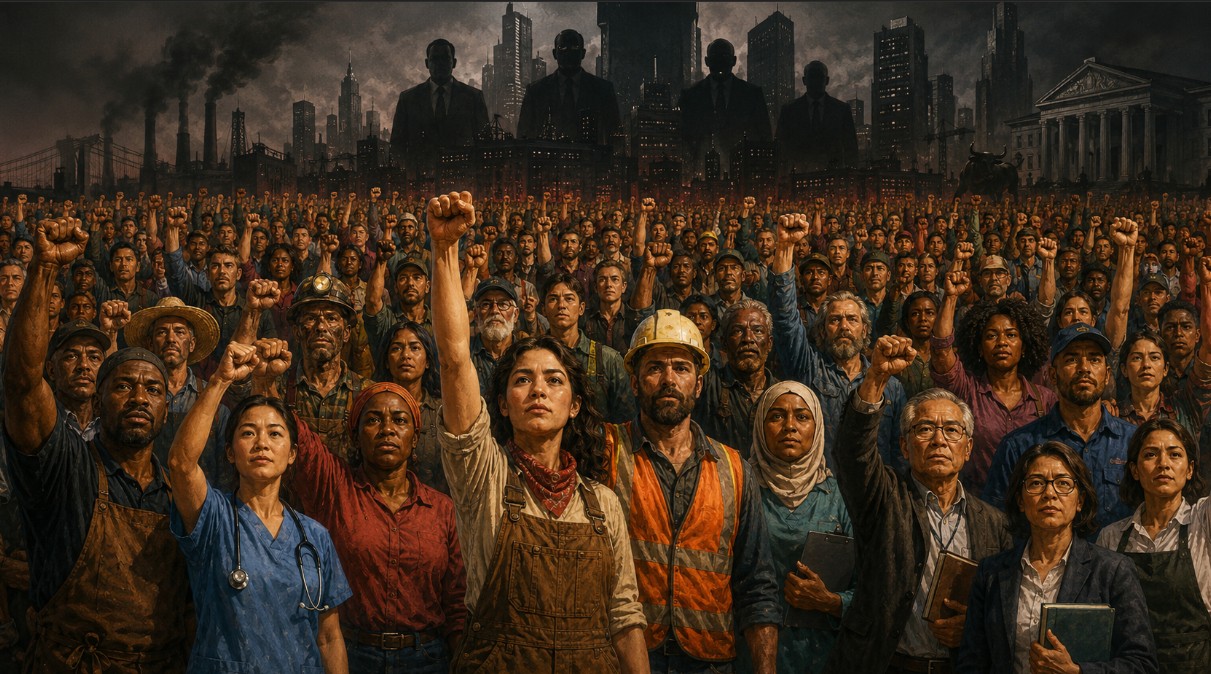
I know who is drilling the holes. They are not the people I served with. They are not the people I worked the warehouse with. They are not my neighbors, of any color. They are a small number of very rich men who have arranged a country to suit themselves and who pay a great deal of money every year to make sure the rest of us are pointed at each other.
That is the war I am in.
It is the only one I have time for.
Steinbeck, who knew a few things about hungry people, said it better than I can:
And in the eyes of the people there is the failure; and in the eyes of the hungry there is a growing wrath. In the souls of the people the grapes of wrath are filling and growing heavy, growing heavy for the vintage.
He meant it as a warning, not a slogan. So do I.