Miss Ordinary orders a mocha and accidentally finds out how much of the law nobody voted for…
I was not eavesdropping.
I was ear hustling. There is a difference, though it depends almost entirely on whether the people at the next table catch you at it.
In my defense, the place was small, my scarf was still damp from the walk over, and I had ordered a double chocolate Swiss mocha — a drink that announces to everyone including yourself that you intend to confront nothing more difficult than whipped cream. It came with a soft white mountain rising over the rim and a dusting of chocolate across the top. Cheerful. Structurally unsound.
Then the man behind me said:
“The law says they had to tell me first.”
And there went my afternoon.
The Sentence Sounded Plain
I did not hear enough to identify the case, and I have changed the few details I did catch, because it was not my conversation and he did not know he was giving it to me.
The shape was simple enough to follow with one ear.
Some government office had taken something away from him. A license, a payment, a permit, a protection at work — I could not tell which. The written law apparently said the agency had to give him a particular notice before it did that.
He read the sentence out loud to whoever he was with. Something close to:
The agency shall provide written notice before taking the action.
An actor. A required thing. A time it had to happen by. That is the sort of sentence we tell people laws are made out of.
He did not get the notice, or did not get it the way the law described, or did not get it in time. The agency went ahead. He objected.
I had the whole thing solved before he finished telling it. The law said they had to tell him. They did not tell him. Therefore somebody should have to look at what they did afterward.
I stirred a little cream into the coffee.
Case closed. Back to my afternoon.
Except it was not, and it was not.
Then the Other Cases Showed Up
The government’s lawyer had found an older case.
Not about his problem. Different agency, different kind of notice. But a court had decided in that one that a procedural requirement does not always undo an agency’s action when the person found out some other way.
Then there was a second case, which leaned on the first while deciding whether a deadline in a statute was a command or more of a suggestion.
Then a third court took that reasoning somewhere else entirely and concluded that a person complaining about a violation has to show not only that the government skipped the step, but that skipping it caused some further, measurable harm.
By the time the lawyer finished stacking them up, the sentence he had read out loud was no longer standing by itself.
It had acquired attachments. None of them visible on the page.
The agency shall provide notice before acting — unless some other kind of notice was probably good enough, unless the deadline turns out to be advisory, unless you can prove a separate injury on top of the government ignoring its own rule, unless your situation resembles a case that was never about your statute in the first place.
He kept going back to the words. They didn’t do what it says.
The lawyer kept going back to the cases.
He lost.
Maybe he should have. I heard one side of a conversation through a potted plant while drinking something that was mostly dessert, and I am not qualified to reverse anybody.
But I understood the confusion, and it stayed with me on the walk home.
The law he read was not the whole law being applied to him. It was the cover. The rest had accumulated somewhere else, out of his reach, and nobody had told him it was there.
The Cream Goes In
I want to describe what I was doing with my hands while all this was happening, because it turned out to be the point.
I was folding the whipped cream into the mocha. Slowly. Apparently this is how I process constitutional problems now.
The white went into the brown in streaks, then swirls, then not at all. At some point I could no longer identify the cream as a separate thing in the cup. It had not left. It was still in there and it had changed everything about what I was drinking.
It simply no longer had an edge.
If you had handed the cup to somebody at that moment and asked them to point at the cream, they could not have done it. They could only have told you the coffee tasted different than the menu said it would.
What Are the Written Words For
I looked some of this up later, the way you do when a thing gets under your skin.
There is a doctrine about it, and it has a name, and I am going to tell you where the Supreme Court explained it because you will not believe me otherwise.
The case is Kimble v. Marvel, from 2015. It is about whether a man who invented a Spider-Man toy — one that let a child shoot foam string out of his palm — could keep collecting royalties after the patent ran out. He could not, because of a rule the Court had announced in 1964.
Kimble asked the Court to reconsider the 1964 rule. The Court said no, and Justice Kagan explained why.
When a decision interprets a statute, she wrote, it gets extra protection, because anyone who disagrees can walk across the street and ask Congress to change the law. She called this a superpowered form of the doctrine. Undoing one requires a correspondingly super justification.
And she said, plainly, that the whole idea means sticking with some decisions that were wrong.
Congress had been amending the patent laws that entire time. Fifty-one years. It had been offered bills that would have changed this particular rule and had turned them down.
So the reasoning holds together. If Congress does not fix it, Congress must be content with it.
I sat with that on my couch with my shoes off and could not get comfortable.
Because it assumes Congress noticed. It assumes somebody understood what the decision would actually do to people. It assumes the question reached a committee that could act on it. It assumes enough members agreed it needed correcting. It assumes leadership put it on a calendar. It assumes the fix survived whatever else got attached to it on the way.
That is a great deal of assuming stacked under the word silence.
Sometimes silence means agreement.
Sometimes it means nobody wanted to touch it.
We Tell People Ignorance Is No Excuse
Which law, though.
The statute? The regulations underneath it? The definition borrowed from a different section? The controlling appellate decision? The older decision that one relied on? The unrelated case that carved the exception? The later case that widened the exception? The local rule explaining how a person is allowed to ask whether any of that applies to them?
At what point does a sentence passed by elected representatives turn into something those representatives never actually looked at?
And how much of American law is currently in that condition?
I went looking for a number, which was optimistic of me.
There is not one. Nobody keeps American law sorted by which rules were voted on and which ones grew. The official annotated Constitution — the government’s own — describes the Court’s decisions as a source of American law right alongside the enacted text, and explains that lower courts are bound by the decisions above them.
That is not a defect somebody recently discovered.
That is the system working the way it is built.
Courts read words. Later courts rely on the reading. Later courts still read the readings. An exception becomes a rule. The rule grows factors. The factors grow exceptions of their own. And eventually the thing actually governing you cannot be found in the sentence at all, because it lives in the space between four decisions.
The written law says one thing. The cases say what that thing means.
Somebody voted on the first part.
Precedent Is Not the Villain Here
I want to be fair, because I think the fair version is more alarming than the angry one.
There are good reasons for all of this. People need to believe that similar situations get treated similarly. Lower courts need direction. Businesses and towns and ordinary people have to be able to rely on what was decided before instead of relitigating the world every morning.
Precedent also restrains judges, which is worth something. It makes them answer to decisions that existed before their case walked in.
And no legislature on earth could anticipate every machine, medical procedure, business arrangement, accident, and act of inventive human foolishness that will happen after a statute is written. Somebody has to fill the gap. It has to be the judge, because the judge is the one in the room with the people who need an answer today.
The trouble starts when interpretation becomes amendment and nobody says so out loud.
One judge fills a gap. A second treats that as a rule. A third carries the rule to a different statute. A fourth distinguishes it and makes an exception. A fifth balances it against some practical considerations.
Every one of those decisions can be careful and reasonable on its own.
Together they can produce law nobody wrote and nobody voted for.
Then the doctrine protects the result, and the result gets superpowers.
My Grandmother’s Cake
It reminds me of a recipe.
My grandmother cut the sugar because she thought it was too sweet. My mother swapped in butter because she was out of shortening and it turned out better. An aunt added cream cheese for reasons that made sense to her. Some cousin put raisins in it, and we do not discuss that cousin.
Everyone still calls it the same cake. The original baker might reasonably ask what happened to hers.
That is charming in a cake.
It is less charming when the recipe decides whether somebody keeps a house, a job, a license, a benefit, or a right.
What I Would Want Instead
I am not a lawyer and I am not going to pretend the fix is simple.
But here is what I would want, and I think most people at that coffee shop would want the same thing if you asked them between sips.
If the rule that actually governs my situation is:
An agency’s failure to give the required notice does not undo its action when the person got the same information another way and lost nothing by it —
then write that down.
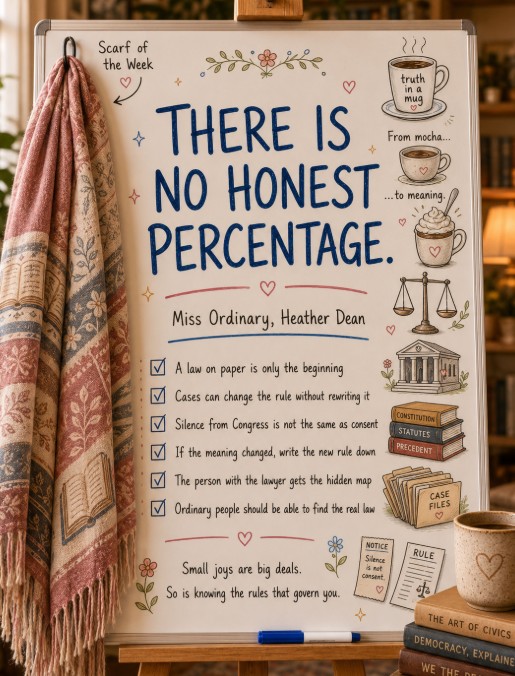
Write it as a sentence. Put it in the law where a person can find it, near the sentence it modifies. Let the legislators read it. Make them vote yes or no with their names attached. Let the rest of us see who decided that close enough was good enough.
Do not leave it distributed across four opinions involving three agencies and two statutes that have nothing to do with mine.
The judge who found the gap should say so, in writing, and propose the words. The higher courts should check the words. Then it should go to the people we elected, and they should have to answer.
They can say yes. They can say no. They can say it differently.
They should have to say something.
That is not an attack on judges reading statutes. They will always have to read statutes. It is asking that when the reading becomes the rule, the rule get written down where the governed can reach it.
The Man at the Next Table
He did not sound like a revolutionary. He sounded tired.
He kept coming back to that one sentence because the sentence was the only part of the whole apparatus he could actually see. Everything else required a lawyer, and a lawyer requires money, and by then the point had stopped being whether he was right.
They didn’t do what it says.
Maybe that was not enough, legally. But it should never be a foolish thing for a person to believe. Written law ought to mean roughly what its words tell the people living under it. When the words fail — and they will, that is what words do — the correction should become more written law. With an address. With a date. With the name of the judge who found the problem and the names of the people who voted on the answer.
It should not float across a chain of opinions available mostly to people who can afford to have someone go find them.
Otherwise we do not have one body of written law.
We have the law we voted on, and a second draft assembled quietly afterward by people doing their jobs correctly one case at a time.
The man without the cases gets the first draft.
The lawyer with the cases gets both.
My cup was empty by the time I worked that out. Not that the cream had gone anywhere. It was all still in there, changing everything, impossible to point at.
I ordered another one. It did not help.