Full Reform of Judicial Entry, Promotion, and Removal
John Marshall would not qualify for appointment to the Supreme Court under the system I propose.
Good.
Roger Taney would not qualify either.
Better.
Neither man arrived at the Court after establishing a record as a judge. Marshall came from military service, private practice, elected office, diplomacy, and the executive branch. Taney came from private practice, elected office, banking, and executive service. Both were accomplished attorneys and major political figures. Neither had spent a career demonstrating how he would exercise judicial authority before receiving its highest form.
Marshall gave us Marbury v. Madison and the working foundation of judicial review.
Taney gave us Dred Scott.
We tell the Marshall story as proof that a brilliant political lawyer can arrive at the Supreme Court and discover the constitutional structure the country needs. That is true, and it happened.
The same opening admitted a different brilliant political lawyer who discovered a constitutional right to own human beings.
No appointment process can admit Marshall while reliably screening out Taney when neither man has ever been measured as a judge. Both arrived through the identical door. A president selected an accomplished legal and political figure, the Senate approved, and the country handed over nearly irreversible power on the strength of a résumé and a guess.
A system that depends on lightning strikes will eventually be struck by the other kind.
I am comfortable losing both.
That is no attack on Marshall’s intelligence or his patriotism. It is a refusal to accept that a mature republic should depend on heroic improvisation by politically selected men.
And under the structure proposed here, Marshall would not have needed to invent judicial review. The Court’s authority to test a specific enacted line against a specific constitutional command would be written into the Constitution and into the judicial code.
The job would already have an address.
Mature institutions replace miracles with structure.
The Pipeline We Have Is Younger Than People Think
One objection arrives immediately: this would break with American tradition by restricting the Court to career judges.
The history does not support that objection in either direction, and it is worth getting straight.
None of the nineteenth-century chief justices — Marshall, Taney, Chase, Waite, Fuller — had any prior judicial experience. Only four of the eight chief justices appointed in the twentieth century had served as judges at any level below the Supreme Court. Of roughly forty justices appointed in the first seven decades of the twentieth century, seven came directly from a court of appeals, ten if you count those who had been federal appellate judges earlier in their careers. Across all 112 justices in American history, about sixty-eight had judicial experience of some kind and roughly thirty came from federal appellate courts.
The modern pattern — nominate a sitting circuit judge — is a recent development. It hardened within living memory, and nobody decided it. It drifted into place.
So the proposal here does not overturn an ancient practice. It takes a young, unexamined habit and asks whether it should become a rule with real requirements behind it, or be abandoned.
There is a reason to make it a rule with teeth rather than leaving it a habit. John Roberts served two years and three months as a federal judge before elevation. A brief appellate appointment can be arranged to furnish a credential without producing a record, and under the current soft convention that is enough. Under this proposal it would not be.
The requirement is not a title. It is a measured career.
The Problem Is Larger Than Nine Justices
The Supreme Court cannot be repaired by changing its size, imposing eighteen-year terms, or writing a stronger ethics code. Those ideas address real problems and leave the source untouched.
The Court is the political prize at the top of a judicial system that has almost no professional advancement beneath it.
A president may nominate an attorney directly to a federal appellate court. Another may elevate a judge after a brief period there. Senators evaluate nominees through ideological forecasts dressed as questions about judicial philosophy, and nominees answer with rehearsed promises to follow the law while declining to discuss the legal questions everyone knows drove the selection.
After confirmation, professional development gets confused with seniority, reputation, and political opportunity.
A good district judge does not rise through an established career process for having mastered the craft. A bad judge does not descend for repeated failure. A circuit judge is not promoted because a public record shows the capacity to supervise lower courts. A justice is not drawn from a pool created by decades of measured performance.
Every elevation is another political appointment.
What that produces is not independence. It is politics with a delayed fuse, and the fuse runs thirty years.
Fixing the Supreme Court therefore requires reforming judicial entry, training, evaluation, promotion, assignment, and removal. The Court cannot become trustworthy while it remains the final prize in a patronage system wearing professional robes.
This Is How Most of the World Already Does It
Before anyone calls this radical, look at what other functioning democracies built.
In most civil-law countries, judging is a career one trains for rather than a prize one receives. Candidates enter through competitive examination, usually young. Judicial schools run induction programs of two years or more, including apprenticeship in the courts. Austria, Finland, France, Germany, Greece, Italy, Japan, the Netherlands, Portugal, Singapore, Spain, and Sweden all use some version of examination and structured training to select judges.
Spain runs candidates through ten months of instruction, six months of internship, and six months of supervised work in a court under judicial school faculty.
Germany requires two state examinations with a two-year apprenticeship between them, after which a person chooses practice or the bench. Those who choose the bench begin work immediately — and serve a probationary period of up to five years before receiving appointment for life. German states maintain written profiles specifying the criteria for particular judicial positions, applied both in promotion and as an indicator for initial appointment. A German judge who disagrees with a professional evaluation can seek judicial review of it in the administrative courts.
Japan is the closest existing model to what this brief proposes. Candidates pass a national bar examination, are appointed as legal apprentices, and complete training at an institute administered by the Supreme Court and funded from the judiciary’s own budget. Judges who pursue a career depend on continuing education run by the Supreme Court. And the Supreme Court of Japan controls the initial selection of assistant judges and participates in reappointment and promotion.
A supreme court administering the judicial profession beneath it is not an invention. It is Tuesday in Tokyo.
Two honest observations about the comparison.
The results on integrity are strong. Japanese career judges operate inside a tight professional structure with formal and informal peer control, and by most accounts judicial corruption there is effectively unknown.
And the results on courage are contested, in exactly the way a skeptical reader would predict. Japan’s career judiciary draws sustained criticism for conformity and for deference to the state. That is the objection this brief takes up at the end, and it deserves to be met with the evidence rather than around it.
The American arrangement — a bench filled entirely by political appointment, with no career structure underneath — is the outlier. The outlier is what requires defending.
Law Must Become a Priesthood
I mean the word.
The law must become a profession like a priesthood.
Not because judges are holy. Not because attorneys are morally superior. Not because a robe turns ambition into wisdom.
A priesthood at its best is defined by formation, discipline, institutional memory, continuing study, and loyalty to something that has to survive the person temporarily entrusted with it.
That is what judging requires.
When the most powerful actors in a republic collide, somebody has to stand between them.
A president will explain why executive necessity requires the law to bend. Congress will explain why legislative purpose matters more than the language it actually enacted. A corporation will explain that billions of dollars and thousands of jobs depend on the desired reading. An agency will explain why its expertise deserves deference. A movement will explain that justice cannot wait for process. A state will explain that its sovereignty changes the question.
Every one of them may be persuasive. Some of them will be right.
The judge has to be the person whose first loyalty belongs to none of them.
Not to the president who nominated the judge. Not to the senators who confirmed. Not to the party expecting repayment. Not to the movement celebrating the outcome. Not to the newspapers drafting a legacy. Not even to the result the judge personally believes would improve the country.
The first loyalty runs to law. Text. Structure. Definitions. Jurisdiction. Record. Procedure. Constitutional boundary.
Most citizens should never be asked to live under that discipline. Citizens should campaign, protest, compromise, change their minds, pursue their interests, and argue passionately for the country they want. That is the whole point of being a citizen.
Judges choose something narrower. They choose to decide what the law is even when they badly want it to be something else.
That is the vow, and extraordinary authority should arrive only after the vow has been tested repeatedly against real pressure.
Yes, the Judiciary Should Be Insular
The first accusation will be elitism. The second will be that this creates an insular legal caste.
Correct on the second count, and the answer is yes.
The federal judiciary should be an insular profession — insulated from party fashion, campaign cycles, donor pressure, activist demand, presidential gratitude, and the recurring discovery that somebody’s favorite political lawyer would make an excellent justice.
We require professional insularity everywhere incompetence can destroy lives.
We do not hand a scalpel to an enthusiastic governor. We do not put a talented campaign manager in the left seat of an airliner because she gave a moving speech about aviation. We do not select nuclear engineers by how their reactor theories poll in Pennsylvania.
Every one of those fields demands education, apprenticeship, examination, supervised practice, and a record of competent performance, with authority increasing only after the practitioner has demonstrated the ability to exercise it safely.
Then we hand judges authority over liberty, property, family, elections, government power, and constitutional rights, and treat it as vaguely offensive to suggest that the highest judicial office in the country should require a judicial career.
The closed top of this profession is not the scandal. The scandal is a system whose highest office remains open to political parachutists, and which has convinced itself that this is a feature.
Insularity has to run in one direction only.
The entry doors should be wide. Federal judges should come from public defense, prosecution, civil rights work, labor law, rural general practice, administrative law, tribal law, military law, legal aid, and private litigation. From every community capable of producing a disciplined attorney, and from the ones currently producing almost no federal judges at all.
The ladder after entry should be narrow. Nobody reaches the top because a president knows the name.
Politics Gets Two Doors
Democratic government should keep a defined role in forming the judiciary and should not control the judicial career.
Politics enters through two doors and no others.
The first door is admission. The president nominates an established attorney to initial federal judicial service. The Senate examines the record and confirms or rejects.
Every entrant begins where law first meets facts: an administrative or trial bench. Nobody starts on a circuit court. Nobody starts on the Supreme Court. No governor, senator, attorney general, law professor, solicitor general, celebrity advocate, or presidential confidant skips the lower work on the grounds that everyone agrees the person is brilliant.
Brilliance is not a judicial record. The president and Senate decide who gets the opportunity to become a federal judge. They do not get to declare the entrant mature.
The second door is the Supreme Court. When a vacancy occurs, the president selects from a constitutionally defined pool of seasoned upper-circuit judges. The Senate confirms or rejects.
That preserves democratic involvement at the point of greatest national consequence, and it changes what the involvement consists of. The president chooses among judges whose work has been measured for years. The Senate examines a career instead of a personality assembled for a hearing.
Everything between those two doors belongs to the profession.
Politics admits. The profession trains and promotes. Politics selects the final justice from those the record has already proved eligible.
Appointment to the Profession, Not Ownership of a Chair
An initial appointment admits a person to federal judicial service. It does not convey permanent ownership of a particular courtroom, rank, or jurisdiction.
A judge can be promoted. Transferred. Given more complex assignments. A struggling judge can be sent for additional training. A judge whose performance no longer justifies the current authority can be reassigned or reduced in rank. A judge whose complete record establishes professional incapacity can be removed from the profession.
Germany already runs a version of this. Judicial candidates begin work immediately and serve a probationary period of up to five years before life appointment. The commission follows demonstrated competence rather than preceding it.
This requires constitutional change in the United States, and the brief says so plainly rather than hunting for a clever reading. Article III grants both Supreme Court and inferior-court judges tenure during good behavior, and the existing structure treats removal as an impeachment matter. Congress holds broad authority to establish and regulate the lower federal courts and significant authority over the Court’s appellate jurisdiction, but a complete professional promotion-and-removal system belongs in an amendment written openly rather than smuggled through contested interpretations of clauses that were meant to do something else.
There is also a transition problem worth naming. Roughly nine hundred federal judges currently hold commissions under the existing rules, and an amendment cannot fairly strip authority from people who accepted appointment under different terms. The workable answer is that sitting judges keep their commissions and their rank, participate in the record system prospectively, and become eligible for the new promotion track on the same terms as everyone else. The system fills in over a generation. Every structural reform in this series takes a generation. That is what building instead of legislating costs.
Judicial independence has to protect decisions from political retaliation. It should never convert an initial appointment into a lifetime entitlement to exercise the same authority regardless of subsequent performance.
A federal judicial career should be permanent as long as good professional service continues. Rank gets earned. Assignment stays reviewable. Independence and immunity from standards are different things, and the current system has confused them for two centuries.
The Newest Judge Still Has Power
Professional hierarchy must not reduce a new judge to ceremony.
Even the newest federal judge holds authority to identify an uncodified legal problem and propose the fix.
Trial and administrative benches occupy the place where written law first collides with actual human circumstance. They see the definition that does not fit the facts. They see two legal lines that cannot both be obeyed. They see a technology sitting outside an old statute. They see an agency process demanding a decision while supplying no rule capable of producing one. They see a citizen presenting a real legal injury with no codified remedy available.
That judge files the defect and writes the line, as described in the companion brief on the judicial loop. The line carries only the precedential weight the issuing court already carries. Appellate courts may affirm it, narrow it, relocate it, or reject it. The elected legislature ratifies, amends, replaces, or refuses.
The lower judge is a sensor. The appellate courts are quality control. The legislature makes the permanent values decision.
The wild idea may enter through the lowest courtroom in the country. It cannot become enduring law until it survives professional review and a recorded vote.
Every Judge Builds a Career File
Judges should be promoted on records rather than reputations.
Every federal judge maintains a public career file from the first assignment: completed cases, timeliness, written decisions, proposed legal lines, appellate treatment, workload, administrative performance, conduct findings, continuing education, and professional marks.
Raw reversal rates are intellectually lazy and would wreck the system if used directly. A judge may apply controlling law correctly and be reversed because an appellate court changed course. A judge may confront a genuinely unsettled question and choose one reasonable answer before a higher court chooses another.
The instrument has to diagnose the work rather than count wins and losses.
Three categories do that, and there is no fourth.
Craft Failure
The judge got law wrong as law.
The decision missed controlling statutory language. It ignored an inherited definition. It failed a mandatory cross-reference. It placed a proposed line at the wrong address. It extended a ruling past the case in front of it. It contradicted a provision the judge should have found. It violated settled constitutional law.
Constitutional error is not a mysterious separate category. The Constitution is written law. It is the highest written law, every judge swears to it, and it is more available than any statute in the code. A judge who violates a settled constitutional command has committed the most serious craft failure the profession contains.
Craft failure also includes avoidance. A judge who encounters an obvious gap and declines to identify it has not demonstrated judicial modesty. That judge left a defect buried for the next person to hit, and the next person is usually somebody without a lawyer.
Values Revision
The judge wrote a legally coherent line and the elected legislature chose a different policy.
That is not judicial error. The judge found an uncodified question and drafted a workable answer. The legislature decided the answer protected the wrong interest, drew the boundary in the wrong place, or imposed a consequence the public did not want.
No mark attaches. The judge performed craft. The legislature performed politics. A judge whose lines get revised frequently may be a judge who is unusually good at locating the places where the public needs to decide something.
Contested First Impression
The question was genuinely new. No enacted line and no controlling decision supplied an answer, and reasonable judges could disagree because the system had never met these circumstances.
No mark. This category has to exist or the instrument punishes judges for taking hard cases, and hard cases are where the gaps live.
Those three separate legal competence from ideological agreement. Without that separation, judicial scoring becomes another political approval system with numbers attached. With it, a legislature can reject a judge’s policy solution without declaring the judge incompetent, and an appellate court can identify genuine bad workmanship without pretending every disagreement is philosophy.
Congress Writes the Examination. The Court Grades It.
The Supreme Court does not invent the rubric.
Congress does, through line-addressed legislation, and it establishes what constitutes a craft failure, how errors are weighted, when a mark becomes final, how a judge may challenge a proposed mark, how later doctrinal change affects earlier decisions, how many scored years a promotion requires, what volume and range of work qualifies a judge for higher authority, what patterns require education or reassignment, and what record establishes professional unfitness.
The rules must be general, prospective, and publicly enacted. Congress may not write a scoring rule aimed at a named judge or retroactively redefine competent work to punish an unpopular decision. Every change to the rubric gets its own vote and stays visible at its address.
Congress writes the law governing the judicial profession because judges exercise public authority and the public’s representatives set the terms of public authority.
The justices enforce that law because the administration of judges has to stay outside ordinary party control.
Congress writes the examination. The Supreme Court grades it. Neither one gets to do both.
The Marks Must Have Weight
A misplaced statutory address is an error. A line violating settled constitutional law is also an error. Treating them as equivalent would make the whole file meaningless.
Marks scale with consequence.
A misplaced address draws a light mark. A missed cross-reference or inherited definition draws a moderate one. Ignoring controlling statutory law draws a heavy mark.
Writing a line that violates settled constitutional law draws the heaviest mark available, because that error operates at the issuing court’s precedential weight and governs real people until somebody with standing, money, and years successfully challenges it.
Weighting does more than calibrate punishment. It shapes behavior, which is the actual purpose.
A judge who knows that unnecessary breadth creates serious professional exposure drafts narrowly. A judge who knows that constitutional improvisation draws the heaviest scrutiny in the system identifies the precise constitutional command and the exact enacted line in conflict with it, and stops there.
And a judge who refuses to identify an obvious gap takes a mark for the refusal. Otherwise the safest career strategy becomes cowardice — see no defect, propose no repair, leave every hard question for somebody else, retire clean.
The scoring has to press from both directions.
Overreach is failure. Avoidance is failure. Careful work lives in the space between them, and that space is where the whole profession should be standing.
A Mark Is Not an Appellate Insult
A professional system destroys judicial independence if every disagreement from above immediately damages the judge below. The rules therefore matter as much as the marks.
A mark attaches only after ordinary professional review is complete. The judge receives written notice identifying the exact legal line allegedly missed or mishandled. The judge may respond. The reviewing court must classify the error under the congressional scoring code and say so on the record.
We disagree is not a diagnosis.
Work gets judged against the law as it existed when the decision was filed. A judge who correctly applied controlling doctrine takes no mark because the Supreme Court changed that doctrine eleven years later. A genuinely open question stays a contested first impression. A later values change never becomes a retroactive craft failure.
Germany already does the essential part of this. Judges there can seek review of a professional evaluation in the administrative courts, and promotion disputes and evaluation disputes are litigated together. An evaluation that cannot be contested is not an evaluation. It is a verdict.
The career file has to be rigorous enough to judge the judges. Otherwise it becomes partisan gossip with numbers attached, and everyone involved will know it within a year.
The Supreme Court Administers the Profession
No federal judicial promotion commission. No independent board sitting between Congress and the Court.
The Supreme Court administers the lower federal judiciary. Period.
The reason is the accountability chain. Every justice is nominated by an elected president and confirmed by an elected Senate. A commission traces back to nobody, and a body with no chain to a voter should not hold power over the people who decide cases.
Congress establishes the rules. The justices enforce them. Appellate courts conduct the first professional review of decisions beneath them, identifying potential errors and applying the scoring code. The Supreme Court audits the circuits, resolves disputed classifications, corrects inconsistent scoring, administers promotions and assignments, orders education or supervision or reassignment when the record requires it, and removes lower judges whose completed records meet the standards Congress enacted.
The justices become the senior faculty of the federal judicial profession. Professors grading papers whose consequences include liberty, property, and the limits of government power.
The metaphor is doing real work. Most of a justice’s time would go to reading how lower judges handled law, examining how circuit judges reviewed that work, and keeping standards consistent across the system.
If one circuit starts treating ordinary political disagreement as craft failure, the justices correct it. If another refuses to mark obvious constitutional violations, the justices correct it. If appellate judges manipulate scores to reward allies or obstruct rivals, that conduct enters their own files.
The Court does not write the grading rules and cannot soften them for friends or sharpen them for enemies. Its first duty is identical to every judge beneath it: apply the law Congress enacted.
And most of this apparatus already exists.
Under 28 U.S.C. § 331 the Chief Justice summons and presides over the Judicial Conference of the United States, twenty-six federal judges plus the Chief Justice, established by the Conference of Senior Circuit Judges Act of 1922. The Chief Justice selects the Director of the Administrative Office, chairs the board of the Federal Judicial Center, and appoints roughly two hundred members of the Conference committee system. Circuit judicial councils already oversee administration within each circuit and already review complaints of judicial misconduct. The Chief Justice already submits an annual report of Conference proceedings and legislative recommendations to Congress.
A national policy body chaired by the apex court, regional councils that evaluate judges, and a statutory reporting line to the legislature. All of it built, staffed, and running for over a century.
This proposal gives that structure a defined constitutional purpose and places final responsibility on the Court itself.
No commission absorbs the blame. The Court owns the administration.
State systems run in parallel. The Supreme Court has no authority over state judiciaries, and state supreme courts already hold administrative authority over their own court systems. Each state builds the same architecture with its own constitution as the constitutional layer.
Promotion Finally Becomes Promotion
A district judge seeking elevation does not start by finding a friendly senator.
The judge enters eligibility review based on the public career file: scored years of service, volume of completed work, complexity and variety of assignments, filed code defects, affirmance and correction history, craft marks and their severity, administrative competence, ethics, continuing training, and the ability to explain law clearly enough for lower courts and ordinary citizens to use it.
A judge whose record qualifies for appellate work enters the appellate pool. The Supreme Court fills appellate assignments from that pool.
A judge does not rise because a party needs a particular vote on a particular circuit. A judge rises because years of recorded work demonstrate capacity for greater authority.
The same process governs advancement within the appellate system, with one addition. An upper-circuit judge has to show mastery of law and the ability to evaluate other judges fairly, because promotion eventually leads to the group from which Supreme Court nominees are drawn, and the people scoring the profession need to be good at scoring.
A credential is a prediction. A record is a measurement.
This system stops pretending they are the same thing.
Removal Becomes Professional
The present system leaves an enormous gap between appellate reversal and impeachment, and almost nothing lives in it.
A judge may be repeatedly careless, unable to maintain a docket, persistently ignorant of controlling law, or simply incapable of the work, without ever committing an impeachable offense. That is professional unfitness, and it deserves a professional remedy.
Removal never begins with one mistake. The progression is corrective throughout.
A pattern of light errors produces education. Continuing problems produce supervision. Repeated heavy failures produce restricted assignments. Further failure may produce reassignment or reduction in rank. A sustained record establishing that a judge cannot reliably exercise federal judicial power produces removal.
Due process runs the entire length: written notice, access to the full record, an opportunity to respond, representation by counsel, a public decision, and identification of the congressional standards controlling the result.
The circuit builds the initial disciplinary record. The Supreme Court reviews it and enters the final professional judgment.
Congress keeps impeachment for corruption, bribery, treason, and grave attacks on the constitutional order. The Court administers professional fitness beneath itself.
No judge should be removed because a party hates an outcome. No judge should remain because a party likes one.
The Justices Are Different
Supreme Court justices remain appointed by the president and confirmed by the Senate. They remain life-tenured. They remain removable only by impeachment. They remain answerable to the Constitution, to the law Congress enacts governing the profession, to reputation, and to history.
That extraordinary insulation becomes more defensible under this system, not less, because nobody reaches the Court without first surviving the profession.
A nominee will have served at least two layers below the final office. Decided cases. Proposed legal lines. Received marks and corrected mistakes. Reviewed lower judges. Administered appellate work. The record will show whether political pressure changes this person’s legal analysis, because the record will contain years of decisions made under pressure.
The president does not manufacture a justice. The president selects one from a small pool of judges whose careers have earned eligibility.
The Senate stops examining predictions about future behavior and starts examining evidence about past behavior.
Once confirmed, the justice receives complete independence, because the professional testing is finished. What remains is impeachment and the judgment of history, and those are enough for somebody who has already spent twenty years proving what they do when it is hard.
The Supreme Court Does Not Hear Appeals
The Court should hear perhaps one or two constitutional cases in an ordinary year.
Those cases are never brought by a party to the lawsuit.
A citizen cannot petition for Supreme Court review. A corporation cannot purchase a path upward through years of appellate litigation. An advocacy organization cannot construct a test case and steer it toward nine selected justices. A state cannot demand an audience. The president has no emergency entrance.
A case reaches the Supreme Court only when a three-judge panel convened in the federal district court certifies that it cannot resolve a specific constitutional question without the Court’s instruction.
The parties bring their dispute to the trial court. The judges bring the constitutional question to the Supreme Court.
That distinction changes everything, and it is less novel than it sounds.
Three-judge district courts are already federal law. Under 28 U.S.C. § 2284 they convene when required by act of Congress and when an action challenges the constitutionality of congressional or statewide legislative apportionment. Appeal from a three-judge district court runs directly to the Supreme Court. Circuit courts do not review them at all, because the appeals process bypasses the circuit entirely.
That mechanism traces to 1911, and its original scope was far broader than today’s. Three-judge courts were once required for any application to enjoin enforcement of a federal or state statute, or an order of the Interstate Commerce Commission. Congress narrowed the provision substantially in 1976.
So the architecture proposed here is a restoration and a generalization. The country ran constitutional challenges to statutes through three-judge panels with direct Supreme Court review for most of the twentieth century, decided the docket had grown unmanageable, and cut it back rather than fixing the volume problem at its source.
Certified questions are already a statutory route to the Court as well, alongside certiorari. The channel exists and sits nearly unused.
The Three-Judge Panel Is the Gate
A single trial judge may identify a possible constitutional problem. That does not create Supreme Court jurisdiction.
Two additional judges join and form the panel. The panel examines the record and sorts the dispute into one of four kinds.
The enacted law is clear and constitutional. The panel applies it.
The enacted law is incomplete, ambiguous, or internally contradictory. The panel identifies the defect and sends it through the judicial loop to Congress.
Settled constitutional law already answers the question. The panel applies that law.
A specific enacted line creates a genuinely unresolved conflict with a specific constitutional command. Only then does the panel certify to the Supreme Court.
The certification identifies the challenged line, the controlling constitutional language, the material facts, the competing plausible readings, and the exact question the panel cannot answer.
Parties may argue before the panel. They do not own the certification and cannot appeal a refusal to certify.
Litigants have a right to lawful adjudication. Nobody has a right to commandeer the constitutional court.
The Court answers and returns the case. It does not take over the lawsuit, reconsider factual findings, or resolve procedural or statutory questions. It receives the certified issue, determines which enacted line is challenged, identifies the controlling constitutional provision, decides whether both can be obeyed, and if they cannot, states precisely what part of the line must yield.
Then it sends the answer back. The panel applies the instruction and resolves the case.
The lawsuit belongs to the district court. The constitutional answer belongs to the Supreme Court.
Congress already holds substantial authority over the Court’s appellate jurisdiction under the Exceptions and Regulations Clause, and the transition could begin under existing authority. The certification-only structure belongs in the constitutional reform itself, so the Court’s narrow role cannot be widened later by institutional appetite.
And there is no presidential express elevator. The executive argues before the same district court as everyone else. If the government loses, the professional appellate system reviews the work. If the dispute reveals an uncodified problem, Congress receives it through the loop. If the law grants insufficient executive authority, the president asks Congress to change the law, and if Congress refuses, that refusal is the answer.
A president cannot convert every adverse ruling into a constitutional emergency and demand that nine justices rescue a policy Congress declined to authorize. A president who refuses a lawful judicial order creates an enforcement problem and an impeachment problem. Not a new appeal.
One or two cases a year is not an idle Court. It is a Court finally doing its own work — administering the circuits, auditing professional scoring, deciding disputed marks, reviewing performance, directing education, correcting circuit-wide drift, assigning and promoting judges, reviewing removals, and holding standards consistent across the federal system.
Most disputes described as constitutional controversies are not constitutional questions at all. They are statutory ambiguities, administrative overreach, jurisdictional mistakes, conflicting legal lines, and political questions Congress has refused to answer. The three-judge panel diagnoses those before anyone invokes the Constitution.
The Court receives only the residue: a specific enacted line that cannot be reconciled with a specific constitutional command through any lesser means.
That rarity is the Court’s strength. The public stops seeing nine political figures issuing national policy every few weeks and starts seeing nine master judges maintaining a profession and speaking constitutionally only when the judiciary has exhausted every smaller answer.
The Court gains authority by refusing power that belongs elsewhere.
The Brown Objection
The serious criticism of this system is that it produces judges who are too cautious.
A profession that rewards fidelity to enacted law may resist breaking with doctrine, including doctrine that is wrong and causing extraordinary harm. A fully professionalized judiciary might not have produced Brown v. Board of Education in the form history knows.
That objection is real, and the comparative evidence supports it rather than dismissing it. Japan’s career judiciary produces almost no corruption and draws sustained criticism for conformity and deference to the state. Both of those things are true about the same institution, and anyone proposing this architecture has to carry both.
The design should not hide from that.
Here is the answer, and it is a wager rather than a refutation.
This architecture bets that a legislature compelled to confront a judicially identified injustice, on a clock, with a recorded vote and seats on the line, will do what an unforced legislature avoided.
The citizen brings the case. The trial judge identifies the contradiction between the written law and the facts. The appellate profession tests the workmanship. The Constitution supplies every protection actually written into it, enforced by a Court that does nothing else. The legislature receives the uncodified question and has to answer.
A judiciary that declines to invent values is the system working — but only when the political machinery is genuinely required to act. Strip out the forced vote and the empty-chair rule, and this design produces a cautious judiciary attached to a legislature that can still do nothing. That combination would be worse than what we have.
The pieces have to arrive together or not at all.
If Congress is compelled to vote and still chooses injustice, this system loses a safety valve the country has used more than once, and no heroic Court will arrive to rescue anyone from their own elected representatives.
That is the bet, stated plainly.
I take it, because the alternative was never a system guaranteed to produce Brown. The alternative is a system equally capable of producing Dred Scott, and we have the receipts on both.
Nobody gets to grant judges broad political power on the theory that only the good miracles count.
Insular Does Not Mean Secret
A judicial priesthood has to be professionally insular and publicly transparent at the same time.
Every scoring rule published. Every mark identifying its legal basis. Every promotion displaying the record supporting it. Every reduction in rank explaining the professional failure. Every removal identifying the controlling standard. Every proposed legal line carrying an address. Every appellate correction traceable.
Insularity cannot be permitted to become guild protection. Judges may evaluate other judges, and their conclusions have to rest on visible work measured against law Congress wrote.
The Supreme Court does not ask the public to trust that the justices know which judges are fit.
It shows the evidence.
A judiciary closed to political improvisation and open about its own books is not an aristocracy. Aristocracies do not publish.
Purity Is the Power
The law-bearing branch has to be pure like a church.
Not morally perfect. Churches are human institutions and they can be hypocritical, corrupt, and cowardly, sometimes for centuries.
The analogy is consecration to a limited purpose rather than holiness.
The legislature represents human desire. It should argue, bargain, compromise, answer to movements, and make the republic’s values choices. That is its work and it should do it loudly.
The executive acts. It should have the energy and authority to carry enacted decisions into the world.
The judiciary keeps the boundary, and its power comes from refusing powers that belong somewhere else.
When a judge tells a president no, the country has to believe the answer came from law rather than party.
When a judge finds legislation unconstitutional, the country has to be able to see the exact constitutional line violated and the exact enacted line that violated it.
When a corporation places billions of dollars in front of a court, nobody should be able to purchase a judge’s ambition with the prospect of future elevation.
When a citizen without money arrives alone, the court should be able to recognize the legal question without requiring a professional navigator to translate that person into jurisdiction.
That kind of trust cannot be manufactured in nine dramatic confirmation hearings. It has to be accumulated across entire careers, in public, one decision at a time.
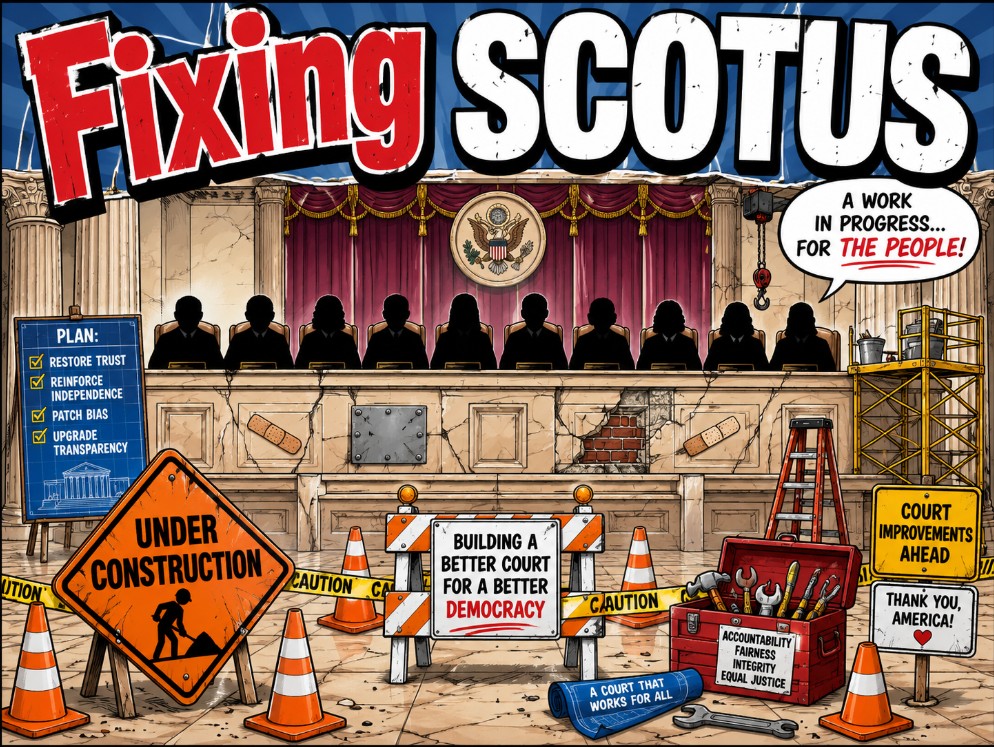
Fixing SCOTUS
The present system asks presidents to predict who will stay loyal after receiving life tenure. Presidents are not generally shopping for judicial independence. They are shopping for durable influence.
Senators are not examining mature records produced by a judicial career. They are trying to forecast how a nominee will answer political questions a decade from now.
The nominee denies having answers. The hearing becomes theater. The appointment becomes a national wager.
Then the justice serves for decades atop a system with no coherent method for distinguishing excellent legal craft from sophisticated political preference.
The replacement is not complicated.
Let elected government decide who enters federal judicial service. Make every entrant begin where cases and facts arise. Train them. Measure their work. Let even the newest judge identify uncodified problems and write the line. Let Congress write the scoring rules. Let the appellate courts build the record. Let the Supreme Court administer the profession. Promote through demonstrated mastery. Correct failure. Reduce or remove when a complete record establishes unfitness.
Let the president select Supreme Court nominees only from seasoned upper-circuit judges whose loyalty to law has been tested for years, and let the Senate examine the evidence.
Give the confirmed justices life tenure and total independence, because the testing is finished.
Then close the parties’ road to the Court. Let three district judges bring the rare constitutional question. Let the justices answer it and return the case.
John Marshall would not qualify. Roger Taney would not qualify.
And the republic would stop gambling on which one had arrived.
Congress writes the rules. The courts build the records. The Supreme Court administers the profession. The president and Senate choose the final justices from those the law has proved worthy.
Build the priesthood.
Then publish its books.