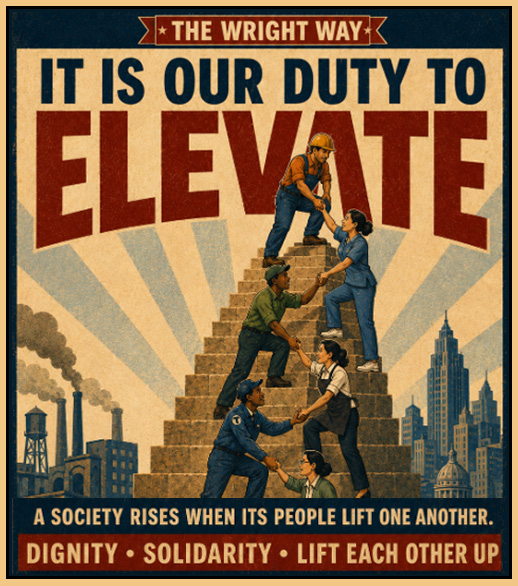
Shop Talk with Mr. Wright: On Noblesse Oblige
There’s a phrase been making the rounds lately. Noblesse oblige. French. Old. Sounds fancy.
It means this: when you’ve been given more than your share, you owe more than your share back. That’s the whole sermon. The fancy version of to whom much is given, much is expected.
Now — most folks who hear that phrase start looking up. Up at the boss. Up at the owner. Up at whoever’s got the helicopter and the rocket and the second house out in the country. They start arguing about those folks and what they owe and whether they’ll ever pay it.
Fine. Let ’em.
I want to talk to you.
Yeah, you. With the certification on the wall. The badge on the chest. The stripes on the sleeve. The license in the wallet. The toolbox that took fifteen years to fill and another fifteen to know how to use.
You. The medic. The electrician. The diesel mechanic. The structural engineer. The EMT. The line cook who’s been promoted twice. The Sergeant. The journeyman. The RN. The man on the rig who knows where every valve is and what each one does at three in the morning when nothing else works.
I’m here to tell you something my old man taught me, and his old man taught him: you got blessings. Real ones. And blessings come with bills.
Now I know the trick. The trick is they want you looking up.
They want you spending your evenings angry at the man with the rocket. Going to Mars. Floating in space. Spending what most of us couldn’t count to in a lifetime. They love it when you’re up there with him in your head, because while you’re up there — you ain’t down here. With us.
Brother — Mars is not your fight. Mars is so far from your life it might as well be a TV show. A working man’s not going to Mars next Tuesday. A working man’s going to work next Tuesday.
The fight you actually have is a whole lot closer than that.
The fight you actually have is whether you stand with the man on the stool next to you. The one who didn’t make foreman. The one whose back gave out at fifty-two and now he’s part-time on the loading dock. The one whose certification didn’t come through. The one who’s still on probation. The one whose English is still coming in. The general laborer. The reduced-capacity worker. The new kid. The cleaning crew that comes in after we go home.
Those are the folks your blessings put you next to. Not above. Next to.
And here’s where that fancy phrase earns its keep.
Noblesse oblige in this house — in our world, the one with the time clock and the lunch pail — means: I have been given some skill, some training, some standing, some stripes. I am going to count those blessings. And I am going to spend them helping the folks who didn’t get as much pile up some of their own.
That’s it. That’s the whole job.
It means when management tries to split the shop — skilled from unskilled, certified from uncertified, citizen from immigrant, full-time from part-time, abled from disabled, veteran from civilian — I do not split. I walk with my people. All of them.
It means when I sit down at the union meeting, I don’t speak only for the trades that look like mine. I speak for the cleaning crew, too. The cafeteria, too. The temp agency folks they hide in the corner of the org chart, too.
It means my paycheck and my pride and my certification are not a wall I stand on top of. They are tools I was lucky to get my hands on. And the rule with tools, Jack, is you use them to build — not to brag.
A. Philip Randolph — the man my father named me after — organized the porters. You know the porters? Black men carrying white folks’ luggage on the railways for a living. They got the worst hours, the worst pay, the worst respect. And Mr. Randolph stood with them. That was a blessed man — educated, eloquent, well-connected — and he stood with them. He didn’t talk down at them. He didn’t speak over them. He stood with them. Marched with them. Bargained with them.
That’s the example.
You want to know what noblesse oblige looks like in working clothes? It looks like a man with a blessed life walking into the room where the unblessed are getting it done, and saying — I’m with you.
Not I’ll speak for you. Not let me explain your situation. With you. Same shift. Same sweat. Same supper.
So when you hear that phrase floating around this week — and you will — don’t let it get used against you. Don’t let it become one more thing the suits argue about while we keep the lights on. Take it. It’s ours. It always was. The folks who built this country with their hands knew the meaning of that phrase before the word ever came over from France.
Count your blessings. Share them down. Walk with the man on the next stool. Stand for the worker the boss thinks doesn’t count. The owners can argue about their rockets — we’ve got a country to keep running.
Measure twice, act once. Respect is the first safety rule. And the rule above all the others, the one my old man set down before any of the rest of them —
we walk together, or none of us gets home.
Now you know, Jack.
— Mr. Wright