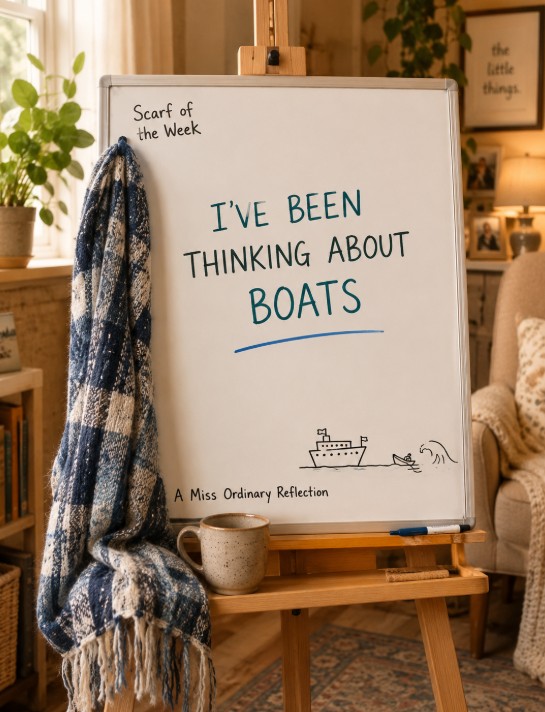
I’ve Been Thinking About Boats
I heard the phrase again this week. I won’t tell you where, because it doesn’t really matter where — you’ve heard it too. A rising tide lifts all boats. Somebody always says it in that warm, settled voice, the kind that’s already decided the conversation is finished. The idea is a comforting one, and I understand why people reach for it. You don’t have to worry about who’s getting left behind, because the water comes up under everybody at the same time. Build the big thing. Grow the whole economy. The smallest little rowboat rises right alongside the yacht, free of charge, no one even has to ask. The water does the lifting for you.
And then, almost every time, the same person says the second thing. That we’re living in the greatest moment to be alive in all of human history. That if you could pick which century to be born into, blindfolded, you’d want this one. And I want to be fair here, because I think they’re mostly right about that. We’ve beaten so much. The things that used to take whole families apart — fevers, winters, distances — we’ve mostly beaten those. The only things we haven’t really gotten the better of are how long a life lasts, and our own knack for undoing ourselves. That part is true, and it’s worth saying out loud over coffee, because it’s easy to forget how much softer the world has gotten in a lot of ways.
So I sat with the boat part. I don’t know much about boats. I grew up inland and I take my walks along the water, not on it. But I do know a little about water, the way anyone does who lives in a valley that remembers what water can do. And the thing about a rising tide is that how it rises matters at least as much as the fact that it does.
A tide that comes up slow and even — that’s the picture in the phrase. Everything floats a little higher, nothing spills, the dock just meets the boat at a new height by morning. That’s a gentle tide, and a gentle tide really does lift everybody, and I’d be glad to live inside that version of the sentence.
But that’s not the only way water rises. When it comes up fast, or comes up wrong, it doesn’t lift so much as heave. It sloshes. It changes the level faster than the boats can settle into it, and the whole harbor starts mixing — chop slamming into chop, things knocking loose, the surface no longer something you ride but something that rides you. And here’s the part that stayed with me while my coffee went cold: in that kind of water, the big vessels do just fine. They were built for it. They have the weight and the ballast and the depth to take a rough sea and barely notice. A rising tide that’s violent is still, to them, mostly a story they tell later.
It’s the small boats that suffer. The little one somebody patched together themselves on weekends. The one without much under the waterline, without a crew, without a sister ship to throw a line. When the tide comes up reckless, those are the boats that take on water and roll. Not because the water hated them — the water doesn’t hate anyone, it isn’t personal, it’s just level — but because they didn’t have what it takes to stay upright through that much, that fast.
That’s the part the phrase leaves out, and I don’t think it leaves it out on purpose, exactly. I think the people who love the phrase are usually the people whose boats were built to take it. Some of them inherited a hull that’s been in the family for generations. Some of them have a whole institution moored alongside, ready to bail them out before they’ve shipped much water at all. From up on a deck like that, every tide probably does feel like it lifts everybody, because from up there you can’t really see the little ones going under. You just see the water getting higher, and you call it good news.
I’m not against the tide coming in. I’d never wish the harbor stayed low forever — plenty of people are waiting on that water to rise, and they deserve to float higher than they do. All I’m saying, from my kitchen window with my hands around a warm mug, is that there’s a difference between water that lifts and water that overwhelms, and the difference is mostly speed and care. A tide that rises slow enough, and steady enough, really can carry the whole harbor. A tide that rises however it likes, as fast as it likes, will carry the ships that were already going to be fine — and it’ll quietly take the rest.
So when someone tells me the rising tide lifts all boats, I find I believe them. I just want to know how fast they’re planning to bring the water up, and whether anyone checked on the little boats first.
It’s not deep. It’s just something to think about while the kettle’s on.
-Heather Dean