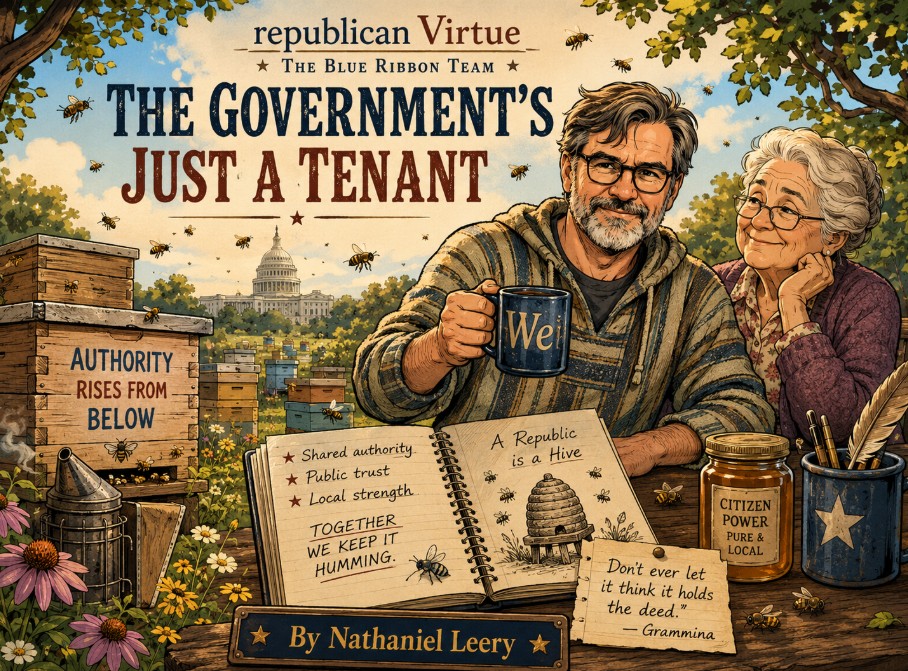
I keep bees, and most mornings before the coffee has cooled I stand at the hives to watch them work. People who have never kept bees believe the colony is ruled. They picture the queen at the center of it like a monarch on a throne, issuing her orders, and the workers carrying them out in fear or devotion. It is a tidy story. It is also entirely wrong. The queen commands nothing. She lays, and she is fed, and she is groomed, and when she begins to fail the hive raises a new one and lets the old go without ceremony or grief. The authority of a hive does not sit at the top. It is spread through every cell of the comb, held in common by ten thousand small workers who have never met and never will. The hive does not serve the queen; the queen serves the hive, or she is no longer the queen. Grammina kept bees before me, and I have come to think she understood governments better for it than most of the men who run them.
Because there is a difference — and it is the whole difference — between a government that rules a people and a government that belongs to them. In settled seasons you can hardly tell the two apart; both keep the roads paved and the courts open and the mail more or less on time. The difference shows itself when something goes wrong, the way a foundation only announces itself when the house begins to lean.
A dictatorship serves a man. Sometimes it serves a small circle around the man; sometimes it serves an idea that only a few are permitted to define, and woe to the citizen who defines it differently. A republic, when it is working as it was meant to, serves the people who make it. That is the entire wager of the thing, and it is a strange and difficult wager to keep.
I will be honest about the temptation, because I feel it too. Every centralized power makes the same promise, and the promise is seductive: that speed and security and order require decisions to be made at the top and obeyed below. There is truth in it — that is what makes it dangerous, not what makes it false. Top-down power is fast. It is decisive. It does not stop to ask permission, or to persuade the half of the room that disagrees, or to wait for a committee to find its quorum. On a hard week, when the news is bad and the problems are real, a part of me wants exactly that: someone to simply decide, and be done. Grammina would have named it. Appetite, she’d say, dressed up in liberty’s coat.
A republic moves the other way, and it moves slowly. Authority is supposed to begin at the bottom and rise; the people choose representatives, the representatives make laws, and the laws bind the government every bit as firmly as they bind the governed. Nothing in that process is quick, and nothing in it is clean. It is argument and delay and compromise and the particular frustration of watching an obvious thing take three years to do. We mistake that friction for weakness. Madison knew better. The friction is not a flaw in the machine; the friction is the machine. A republic is democracy with brakes — and a man who resents the brakes has usually never been down the hill.
That slowness is the price of legitimacy, and legitimacy is the only thing that lets a nation hold together without standing on its own people’s necks. This is the part that is hard to say plainly. A government resting entirely on obedience must keep proving it can compel obedience, season after season, generation after generation; and the proof always wears the same face — the watcher, the informer, the purge, the force turned not only against enemies abroad but against the population at home. A state built on command must, in the end, command. There is no other way for it to remain what it is.
A republic assumes something braver and less certain: that the people are not subjects but partners, that disagreement is the ordinary weather of a free place, and that loyalty can be grown from belief rather than driven by fear. When citizens feel the government is theirs, they will tolerate a great deal — delay, loss, a decision they hate — without walking away from the whole arrangement, because the arrangement belongs to them and they know it can be corrected without burning down the barn. That is resilience, and it is the one harvest a dictatorship can never plant.
And it is grown, like most durable things, from the bottom. In a healthy republic authority lives at every level at once — in families and towns and statehouses and courtrooms, in unions and juries and the stubborn citizen who shows up to the meeting nobody else attends. If one part fails, the others hold. If one leader is a fool, the structure does not fall with him. If a whole generation chooses badly, the next can choose again without a revolution to make room for the choosing. A top-down order has no such redundancy. Its stability is the stability of its center, and a center can be lost. When it weakens, the whole thing trembles; when it loses legitimacy, there is nothing underneath to catch it — which is precisely why such governments reach for force the moment the ground shifts. Enforcement is what remains when consent runs out, and enforcement is a creditor that always comes back for more: more control, more watching, more punishment, more fear.
So yes — a republic is harder to keep. It is slower to act and quicker to argue; it asks patience of its citizens and restraint of its leaders, and it gives neither of them the satisfaction of a clean victory. But it holds an advantage no strongman can purchase: its strength does not descend from the top. It rises. It rises from people who believe the government exists because they permit it to, and not because it has the power to make them kneel — from the old and radical idea that the law sits above the state as surely as above the citizen, and that our rights are not gifts handed down by authority but fences built around it. Adams put the whole republic in five words once: a government of laws, not men. When that conviction fades, the republic fades with it, whatever name it keeps on the door.
The test of a republic was never whether it could act in a hurry. The test is whether it remembers whom it was built to serve. A government that comes to serve itself has become something else; so has one that serves a ruler, or an agenda, or a faction certain that its own appetite is the public good. The republic lasts exactly as long as the people keep insisting that it belongs to them.
And not the other way around.
The hives will be at it again tomorrow, ten thousand citizens with no king and no master, each one tending a republic none of them will ever see whole. I think of Grammina out there among them in her veil, telling me what she’d decided old Jefferson must have meant. “The government’s just a tenant, Nathaniel,” she’d say. “Don’t ever let it think it holds the deed.”
She had the quote wrong, the way she always did. She had the meaning exactly right.