The Map That Became a Religion
Every animal that survives solves two problems before any others: when and where. When is the cold coming, when do the herds move, when does the river drop low enough to cross. Where is the food this month, where is the water, where did we find the good flint last time. A wolf solves it with a nose. A bird solves it with a magnetic sense we still barely understand. A human solves it with the one instrument that hangs over every campsite on the continent, looks the same from all of them, and can never be dropped or stolen: the sky.
This is the part the “temple” story skips. We look at Göbekli Tepe or the Indiana mounds and ask what people believed, as if belief came first. I think it ran the other way. The sky was a tool long before it was a god. A forager who could read the sun’s noon height knew the season and roughly how far north he stood, without a word of language. One who knew which stars rose at dusk knew the month. One who knew that those stars cleared that notch in the ridge knew which way to walk to reach the next valley before the game got there. Keep the sun high and you keep the warmth, the green, the food. The entire survival kit of a band on the move is a calendar and a compass, and both are printed on the ceiling for free.
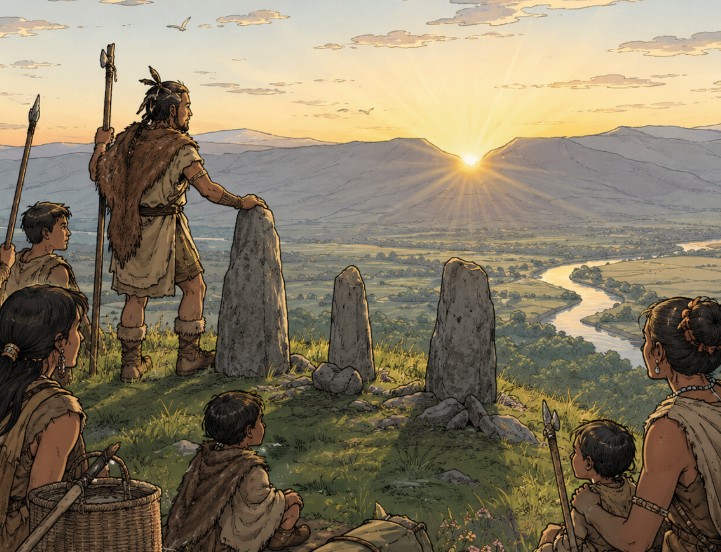
Now watch what happens when a band returns to the same gathering ground year after year. Someone notices that on the longest day the sun drops into one particular gap on the skyline, so they set a stone to mark it. The next generation lines up a second stone. Soon you have a fixed instrument: stand here, sight along this, and it tells you the day. But it does more than keep time. A stranger arriving — a cousin band, a trading party, a kid who got separated — can orient on it. The solstice line points down the river. The bright-star alignment points to the high pass. The monument is a signpost written in a language anyone living under the same sky can read. Which is exactly why these places sit where they sit: on migration routes, at river confluences, at the waystations where people already passed through. You don’t build the clock where nobody walks.
Göbekli Tepe is where this grows teeth. Its pillars are covered in animals — foxes, scorpions, vultures, bulls — carved with a care no one wastes on wallpaper. The conventional read is bestiary or totem. The read I’d bet on, and it’s a bet, is that some of those animals are constellations, the way ours are. If so, the stones aren’t art. They’re a star chart in rock, the sky pinned down at the moment the chisel touched it. And there’s a clean test: the sky moves. Precession drags the constellations slowly around the horizon over millennia, so the patterns those builders watched rise are not the ones we see. If the carvings encode real sky, the only way to line them up is to roll the heavens back roughly twelve thousand years — and they should click into place. Find that fit and you’ve found a dated photograph of the world as it stood the day the work stopped.
Here’s what makes me trust the wayfinding read over pure ceremony: the sites grew the way working landmarks grow, and the digging already proves it. The repeated cycle of backfilling and rebuilding is literally what piled up the rounded hill the locals named Potbelly — the mound is the residue of generation after generation re-monumentalizing one spot. The pillars were quarried, hauled upright, and sometimes reused when enclosures were rebuilt or buried, the repetition pointing to centuries of renewal. A signpost gets taller whenever the people who depend on it can afford the labor, because a higher marker carries farther down the trail. And the stones were demonstrably shuffled: at one enclosure, excavators found broken benches and pillar fragments no longer in their original positions, evidence of later intervention, while some outer pillars carry their carvings on the rear faces, away from the center, which the team reads as a sign they were re-used from somewhere else. A carved face turned to the wall is a stone cut for one job and set into another.
So my bet, the part still in the ground: the famous monuments are an overprint on something modest. The original was a few plain sighting stones on a low rise, placed to catch a solstice or aim down a valley, and an old dig that wasn’t looking for it would have logged those as rubble. If that’s right, three things sit in the deepest layer — unimpressive slabs near bedrock exactly where a working sightline would put them; big pillars standing in sockets first cut for something smaller; and, the tell that would make me believe it, the alignment surviving the upsizing. If they rebuilt a marker bigger but kept it on the same bearing, that’s people preserving a function they still understood. Find a plain slab at bedrock on the same solstice line as the giant above it and you’ve caught the instrument being promoted, one stone on top of the other.
The American case is the cleaner experiment, because the whole sequence runs late and compressed, so the fingerprints are fresher. The oldest hard evidence of people here, the White Sands footprints, now sits around 21,000 to 23,000 years old, putting humans in North America during the Last Glacial Maximum, far earlier than the long-assumed thirteen to sixteen thousand. And when the mound-builders raised permanent earthworks, they built sky instruments — the same instinct, reinvented from scratch by people who never heard of Anatolia. Go to Mounds State Park in Anderson, an hour up from where I grew up. The Great Mound was built by the Adena around 250 to 160 BCE and used into the Hopewell era to about 200 CE, and what is it? A calendar. The Great Mound’s embankment aligns to the winter solstice sunset, a companion enclosure marks the summer solstice sunset, and the circular mound orients to the equinox sunrises with post positions tracking star-risings like the Pleiades and Fomalhaut. Same two questions — when and where — answered with the same overhead tool, across an ocean and ten thousand years. That’s not coincidence. That’s a human universal showing its hand. ScienceDaily
So picture the scene. A band leader stands on the high ground at first light on the longest day. The sun climbs and climbs to its apex — higher than it will stand all year — and falls at dusk into the marked notch. He reads the signal his grandfather taught him: the season has turned, the southern country is greening, time to walk. From that watershed he needs no paper. He follows water. The White River feeds the Wabash, the Wabash the Ohio, the Ohio the Mississippi, the Mississippi spills into the Gulf, and the coast runs unbroken toward Central America. The mound told him when. The river tells him where.
And here’s the close, the part everyone gets backward. The easy story says these people had already settled into farming by the time they raised the permanent marker, so the thing was just ceremony, a monument to a habit whose job had ended. But the job hadn’t ended. It had changed. They were already farmers when they stopped expanding the site — and the site held its importance anyway, because a sun-clock that once said time to walk south now said time to put seed in the ground. The Adena who hauled those baskets of earth were already cultivators; even Göbekli, built by foragers, turned over in its final phase to farming before it was buried. The instrument never went idle. It survived the single most violent transition in human history — the one that ended walking — by switching which survival problem it solved. Migration timing became planting timing. The compass function lapsed; the calendar function only got more essential, because a farmer who misreads the season starves where a forager could have moved on.
That’s why the place stayed sacred instead of being abandoned. We keep treating the holiness as the cause and the calendar as decoration. It’s the reverse. The sacredness is the long shadow of a tool that never once stopped paying its way — that fed the band on the trail, then timed the first harvests, then outlived even that and kept being defended out of a reverence no living person could quite explain. The map didn’t fossilize into religion. It stayed a working calendar the entire way down, and we mistook its refusal to die for worship.