The following is a fringe conspiracy for thought experiment purposes. Treat accordingly.
Take the oil away. A thought experiment on the one piece of ground humanity has never, in fifty centuries, agreed to let go.
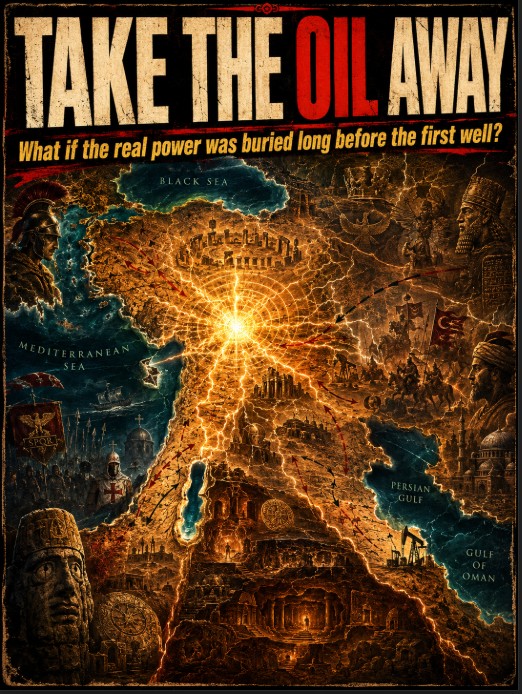
They will tell you it is about oil. Stand in front of a map in any policy briefing and someone in a good suit will point to the pipelines and the proven reserves and the shipping lanes, and everyone in the room will nod, because it is a comfortable answer and comfortable answers are the only kind that get funded. But I want you to do something the briefing never does. I want you to take the oil away. Drain it. Imagine the Gulf bone-dry of crude. And then ask yourself why Sargon of Akkad bled for this ground forty-three centuries before anyone struck a single barrel.
Because that is the part the textbooks walk past so quickly you almost miss the sleight of hand. The fighting did not begin in 1908 with the first Persian well. It did not begin with the Crusades, or with Rome, or with Alexander, all of whom we are told had their reasons and all of whom we are encouraged not to examine too closely. Thutmose marched into the Levant when iron was still a rumor. Cyrus wanted it. The steppe khans wanted it. The North African dynasties and the Persian dynasties and the half-dozen Greek conquests that took it and lost it and took it again — wanted it. Ramesses raised colossi over it to outlast time itself. Every single civilization that ever learned to put men in ranks and march them somewhere chose, at the first opportunity, to march them there. And mainstream history asks us to believe this is coincidence. A run of coincidence five thousand years long. I have never in my life met a coincidence that patient.
So let us be the ones to ask the forbidden question, the one the academy treats as a career-ending embarrassment: what if they were all going for the same thing?
Begin with what we are permitted to know, because even the permitted facts are stranger than the briefing admits. There is a hill in southeastern Anatolia. Beneath it, archaeologists found carved megaliths — deliberate, monumental, arranged with intent — and when they dated the deepest layers the number came back wrong. Not wrong by centuries. Wrong by millennia. Eleven and a half thousand years. Older than pottery. Older than the wheel. Older than the smelting of any metal. Older than writing by six thousand years. Built, we are assured, by simple hunter-gatherers who had not yet thought to plant a seed.
Sit with the impossibility of that. The official story of how civilization works runs in one direction only: first you farm, then the surplus lets you build cities, then the cities can afford priests and temples and gods. That is the sequence we are taught, and that hill detonates it. The temple came first. The sacred site predates the agriculture. Which forces a conclusion the discipline still cannot say out loud without flinching — that the founding act of organized human life on this ground was not the planting of wheat but the worship of something, and the farming came afterward, as a consequence, because you cannot feed a crowd that large gathered for that long unless you learn to grow grain. They did not build a temple because they had a civilization. They built a civilization because they had to feed the temple. Now I ask you: what were they feeding it for? What did they know, eleven thousand years ago, that was worth rewriting the entire trajectory of the species to stay near?
And here is the detail that should stop you cold. They did not build it and leave it. When that complex had served its purpose, someone buried it. Deliberately. Backfilled it by hand, ton after ton, sealing the carved stones under an artificial hill — and then the men who took the region after them did the same thing, over and over, for thousands of years. We have a word for these mounds. We call them tells, and the whole region is lumpy with them, dead city stacked on dead city stacked on dead temple. The official reading is mundane: people rebuilt where they had built before, for the water, for the road. Fine. But notice what every conqueror also did, the moment the looting was finished. They dug. The Babylonians copied tablets already ancient and unreadable to them. Nabonidus — the last king of Babylon — was, in everything but name, an archaeologist, excavating foundations laid by kings dead two thousand years before his birth, dating them, obsessing over them. Across five millennia the men who seized this ground share one compulsion the historians never connect into a pattern: dig down, recover, decode, find out what the ones before us knew. As though every tenant inherited the same suspicion along with the deed — that something was put down here, and the last occupant had not finished reading it.
Now I am going to do what the discipline will not, and follow the thread to where it actually leads instead of where it is safe to stop.
Suppose the signal is real. Not a metaphor — a node. There is a reason the holy keeps returning to a few hundred square miles. The lowest exposed point on the surface of the entire planet sits in that region, a wound where two continental plates are tearing apart, a sea so saturated with mineral that a body cannot sink in it, ground where sinkholes open as if the crust were dissolving over a hollow. We are asked to believe the location of the sacred is arbitrary, a quirk of which tribe happened to settle where. But what if the geology itself emits something — a field, a hum, a frequency below the floor of conscious hearing — and for ten thousand years a pattern-hungry primate brain has been reading that hum as the presence of God, and stacking its capitals and its altars directly on top of the source? The three great faiths that pour out of this ground are not, in that reading, competitors. They are three receivers tuned to the same transmitter, each clutching its handset and insisting the line connects to it alone. Why does the divine keep dialing the identical patch of dirt for five thousand years? If you were a message meant for all humanity, that is an insane delivery route — unless the place is not the address. Unless the place is the antenna, and the scriptures are only the overspill, the way a transformer sings on a wet night.
And the powerful — yes. Give them the cave. It is the cleanest story of all and it explains the part nothing else can. A chain of custody older than any flag, older than any nation, handed down priest to king to banker to whoever signs the satellite contracts now: a thing beneath the rock that confers the right to rule, and a standing agreement among the ones who know to make absolutely certain it is never, ever held by anyone outside the circle. It would account for the attention — a level of obsession wildly out of proportion to the barrels or the GDP. It would account for why peace is not merely difficult there but structurally impossible. You do not negotiate a settlement over a source of power. You only fight, endlessly, to be the hand that holds it.
But here is the turn, and it is the one that should genuinely cost you sleep, because it is the cheapest mechanism imaginable and there is no escaping it. Run the whole thing again with nothing in the ground. No node. No antenna. No artifact, no sleeping machine, no power in the rock. Strip it all out. What remains is this: a single conviction, planted once, in one spot, and never once allowed to lapse for ten thousand years. Every other sacred site humanity ever raised was conquered, converted, forgotten, paved over, let go. This one alone never went silent. Generation after generation, each binding the next, none able to release the claim — because to release it would be to betray every ancestor who died holding it. The dead reach forward and mortgage the living. It becomes the most over-determined ground on the face of the Earth, a standing wave of inherited certainty so deep that no person now alive can step out of it, because stepping out means spitting on five thousand years of graves.
Which leaves the most unbearable possibility of all. That the homing signal is us. That the artifact in the cave is the belief that there is an artifact in the cave — a reaction that went critical beneath that buried Anatolian temple and has been chain-reacting ever since, each empire arriving convinced it will finally lift the lid and see what is underneath, and finding instead its own reflection, armed, certain, already planting the standard for the next one to follow. You can excavate a machine. You can find the antenna, smash it, and go home. You cannot excavate a mirror.
So perhaps the powerful really do know the secret. And perhaps the secret is that there is no secret — that the lease renews forever regardless, and that to say either of those things aloud would end the one game our species has never, in fifty centuries, found the nerve to stop playing.