If we’re a migratory animal that out-navigated an ice age by reading the sky and walking toward the warmth, then the obvious follow-up should make you a little uncomfortable. What exactly are we doing standing still?
Run the thought experiment all the way out. Strip money from the picture entirely, because money is the thing that broke the old order and you can’t see the natural shape of human life while it’s in the frame. What does money actually do? It stores. It lets value sit in a vault while the thing it represents rots, gets eaten, or travels without you. Before money, you could not hold the harvest as an abstraction; you had to physically be where the food was, when it was ripe, with your hands. Labor followed the food because labor had no choice. The body went to the work. That isn’t poverty and it isn’t romance — it’s the physics of a world where you can’t wire value ahead of yourself. Money let us freeze. It let us sit in one box year-round and have the seasons’ bounty hauled to us in trucks, picked by somebody else who’s still living the old way out of sight. Take the money out and the logic snaps back: the work is where the crop is, the crop moves with the sun, so the people move with the sun. Not a utopia. A default we papered over.
And the uncomfortable part is that we never actually stopped. We hid it and made it shameful. There is a wave that sweeps north across the hemisphere every spring — ecologists call it the green wave, the flush of new growth and ripening that rolls poleward at roughly the speed of a walk as the sun climbs. Migrating herds surf it; geese and caribou ride its leading edge so they’re always grazing the tenderest new green. Humans surf it too, right now — the strawberry crews who start in Florida in late winter and follow the ripening front up through the Carolinas, the mid-Atlantic, New England, with peaches and apples and everything else behind them, a human migration tracking a solar one with absolute precision. We’ve simply assigned that life to the people we pay least and respect least, stapled it to a visa, and told ourselves the rest of us are sedentary by nature. We’re not. We outsourced our own migration and called the outsourcing progress.
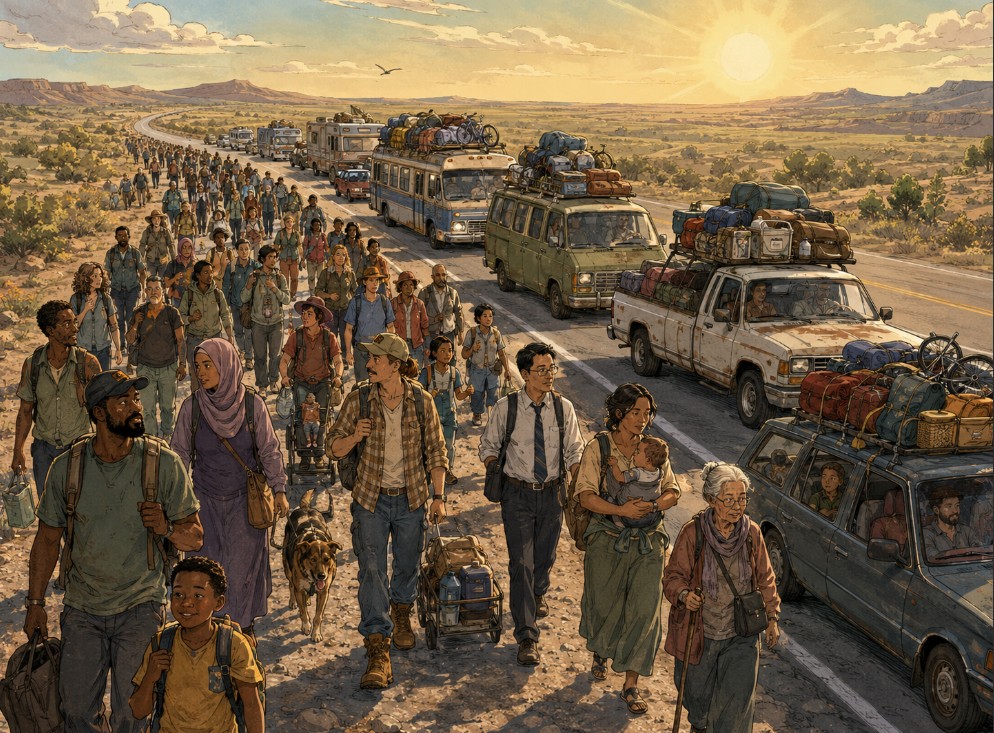
Now flip the status. Imagine the green wave isn’t the bottom rung but the rhythm — the thing most people did, with dignity, by design. Picture the species pulsing up and down the latitudes with the year like blood through a circulatory system. Summer in the high country, north and up, long days, everyone where the light is fattest and the work is thickest. Then as the sun rolls south, the whole population eases down behind it, into the shoulder seasons, into the warm country, and the northern cities go still under the snow not because they failed but because that’s what they’re for half the year. We already run a clumsy, class-stratified version: retirees snowbirding to Arizona, digital nomads chasing weather and wifi, the festival circuit, transhumance herders in the Alps and the Caucasus who never stopped walking their flocks up the mountain in summer and down in fall. The pattern survives in fragments scattered across the very rich and the very precarious, never integrated, never honored. The pitch is just: integrate it. Make the circuit the norm instead of the exception or the punishment.
Because look at what sitting still does to the body, and this is the part you feel without being told. We like longer days — not as a preference but as wiring. Light governs mood, sleep, chemistry; half the northern world goes dim and heavy every winter and we treat it as a disorder to medicate rather than a signal to obey. A migratory creature could simply follow the long day, living in something close to perpetual high summer by moving with it, the way the body was built to. And we get restless when we don’t move. Bored, twitchy, a little unhinged — cabin fever isn’t a metaphor, it’s an animal in the wrong enclosure. Pack a human into the same few square miles for sixty years and watch what grows: the world shrinks to the size of the town, the town shrinks to the size of the grievance, and the mind shrinks to fit. Sedentism breeds the small mind the way still water breeds mosquitoes. Every provincialism, every closed-loop suspicion of the stranger, every dead-end certainty that the way it’s done here is the way it’s done everywhere — those are diseases of staying. You don’t cure them with a lecture. You cure them by making the stranger someone you’ll be camped beside in three weeks, the far town a place you’ll pass through, and the wider world a thing you’ve stood in rather than read about.
That’s the hidden payload, and it’s bigger than the agriculture. A species on the move can’t ossify. Ideas cross-pollinate because everyone meets everyone. The brilliant kid born in the dying mountain town isn’t trapped there; the circuit carries her out and carries the world to her. Culture stops being a hundred thousand sealed jars slowly going sour and becomes one enormous, churning, argued-over commons. The small town stops being a place you escape or rot in and becomes a node — a waystation everyone passes through and nobody is stuck in. You’d lose the suburb as a life sentence, the thirty-year mortgage as a leash, the identity built entirely on a zip code. You’d lose the idea that the accident of where you were born is supposed to be the whole map of where you’re allowed to stand.
The seams are worth naming, because in a thought experiment the seams are where it gets interesting rather than where it collapses. What about the very old, the very young, the sick — the ones who can’t ride the wave? The deep past already answered that. Some moved and some held the node. The mound-keepers stayed. The bands flowed through. There was always a hybrid: a tended center and a moving population, the fixed marker on the high ground and the people who navigated by it. You don’t need everyone walking. You need the culture to be migratory, with anchors deliberately kept, so that staying is a role rather than a fate, and the ones who hold the center are honored as the keepers of the light rather than pitied as the ones left behind. And attachment — the love of a place — doesn’t disappear. A second kind grows beside it: love of the route, the return, the known camps, the seasonal reunion. Snowbirds already feel it. Pilgrims always have. The place you come back to every year can hold you harder than the place you’ve never once left.
So here’s the whole pitch in a line, and it’s the same line the standing stones have been making for twelve thousand years. We are not a species built to sit. We are the animal that survived the ice by reading the sun and walking toward the warmth, and we raised monuments to remember how. We spent the last ten thousand years — an eyeblink — talking ourselves into the chair, and we are restless and provincial and seasonally depressed and faintly unhinged in precisely the ways you’d predict of a migratory creature that forgot it could move. The green wave still rolls north every spring. The herds still ride it. The long day is still up there, traveling, the way it always did.
The pitch is just: get up. Follow it. We used to know how, and the directions are carved in stone.