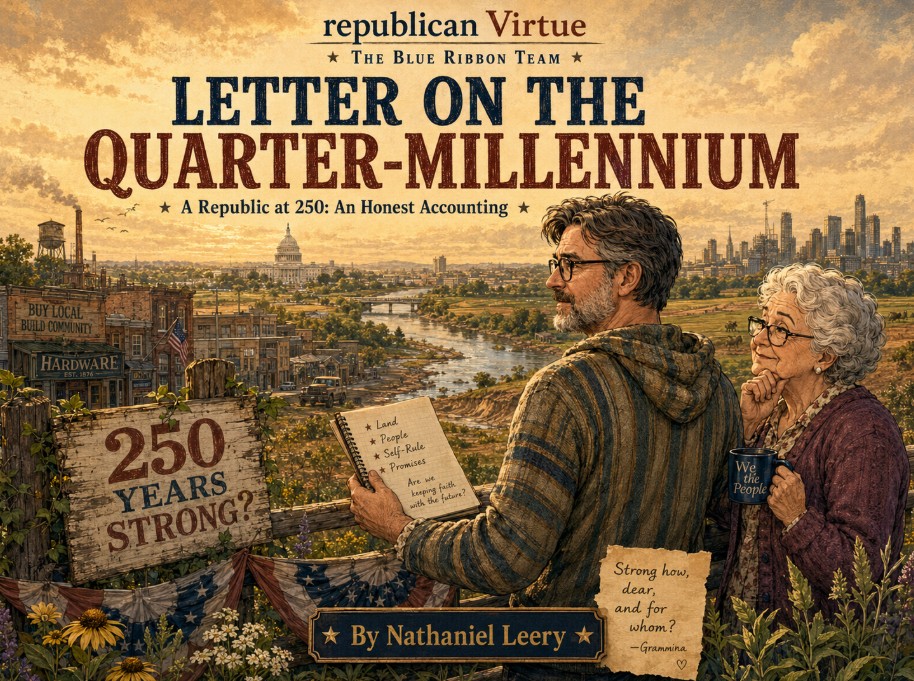
The bunting is going up in town. Plastic now, mostly — red, white, and blue ribbons stapled to posts that used to hold real flags, on streets paved over fields that used to hold real wheat. The hardware store has put a small sign in its window: 250 Years Strong. Grammina, if she were still here, would have read it twice, set down her coffee, and asked the air, strong how, dear, and for whom?
It is a fair question for a quarter-millennium. A republic, like a farm, can be appraised. You walk the fence line; you look at the soil; you ask the hands what they were paid; you count what was carried off the place and what was put back. Two hundred and fifty years is long enough for an honest accounting.
So let us be honest.
We did not inherit this continent. We took it — by treaty when treaty served us, by conquest when it did not, and by the slower violences of disease, displacement, and broken paper when neither was efficient. The peoples who were here when we arrived had laws, languages, councils, and forms of self-governance older than Parliament; the Haudenosaunee were studying federalism while London was still arguing about kings. We did not learn from them. We removed them. The land we then called ours had belonged to someone else for ten thousand years, and the lie that it had been empty was a lie we had to keep telling ourselves to make the next two centuries bearable. That is the ground beneath everything else, and any honest accounting of the republic begins with what the soil remembers.
The covenant we wrote on top of that ground was, even so, the best thing then on offer in the world: that the legitimate ends of government were the safety and happiness of the people; that all men were created equal; that just powers came from the consent of the governed. We were warned — in essays and letters and quiet conversations between men who knew their own appetites — that faction would be our gravest danger, and that virtue, not slogans, not flags, not parades, was the only thing that would keep us a republic at all.
Two hundred and fifty years on, the rivers run warm and thin. The soils blow off the fields in spring. The forests, where they remain, are managed for board feet. The covenant has been amended in practice, if not on paper: just powers now come from the consent of the donor class, and the people are consulted chiefly in the form of an audience.
I do not write this in bitterness. I write it the way a son writes about a father who has not become what he promised. The disappointment is real because the affection is real.
⸻
Consider the land.
Jefferson, for all his terrible blindnesses, understood that a republic of free citizens required a relationship to ground — that a people who did not till, tend, or know their place would become tenants in their own country. He was wrong about much, but he was not wrong about that. We have, in 250 years, become a nation of tenants. We rent from corporations the food we eat, the water we drink, the air we breathe; we rent from banks the houses we sleep in; we rent from algorithms the attention we used to give freely to one another. The soil our great-grandparents broke is now an extractive asset on a spreadsheet in a city most of them never visited. A republic that does not steward its ground is not a republic. It is a quarry with a flag on it.
⸻
Consider the people.
The founders’ republican vision — flawed, partial, hypocritical, but real — was that government would derive from the common, not the crowned. That no man would inherit the right to rule another. That titles of nobility were forbidden because titles, in any form, are the seeds of aristocracy. And yet here we sit, two and a half centuries on, watching dynasties form in the open: the heirs of fortunes who govern the policies that protect those fortunes; the second and third generations of senators; the sons of presidents; the donors whose names appear on hospitals built with money that should have been paid as wages. We did not crown a king. We did something more thorough: we built a hereditary aristocracy and called it meritocracy, and we taught the working people of this country to admire the men who own them.
We did some of this to ourselves on purpose. The original design of the Senate — chosen by state legislatures, anchored in federalism, deliberately insulated from the passions of the hour — was undone in 1913 in the name of democracy, and it delivered aristocracy instead. A senator who once answered to a state legislature now answers to whoever can fund a six-year statewide campaign. We replaced an imperfect federalist check with a flawless oligarchic intake valve and called it progress. Madison would have recognized the trade instantly. The Seventeenth Amendment was not the only such wound to the architecture, but it was among the deepest, and we have been bleeding from it for a century.
I am one of those working people in this aristocrat’s republic, and I admire the aristocrats too, sometimes, despite myself. The corrosion goes that deep.
⸻
Consider the people we govern but do not let govern themselves.
A republic that believes in self-rule should be expanding self-rule. Peacefully. Continuously. Wherever the conditions exist and the people consent. Instead, we have spent the last century telling four million of our own citizens that the franchise belongs to someone else. Puerto Rico has been an American possession for 127 years; its residents are American citizens; they have no senators, no voting representative, and no voice in the elections that determine their wars, their tariffs, and their hurricane response. The District of Columbia, whose population exceeds Vermont and Wyoming, has paid federal taxes for two centuries without a vote in the body that levies them — the original American grievance, preserved in amber on the doorstep of the Capitol. The Northern Mariana Islands, Guam, American Samoa, the Virgin Islands: places where the republic has decided, year after year, that self-rule is for someone else.
A nation that built itself on the principle of no taxation without representation should have settled this in a single generation. We have had five. A republic that will not extend its franchise to those already inside it is not, in any honest reading, still expanding. It is contracting, by neglect, and calling the stillness stability.
⸻
But it is the failure beneath this one that I think Grammina would have wanted me to name without flinching, because she taught me that polite silence about injustice is its own contribution to it.
In 1852, Frederick Douglass stood before a hall in Rochester and asked what, to the slave, was the Fourth of July. The answer was a sermon, and it was an indictment, and it should have shamed the republic into action within the year. It did not. Emancipation came thirteen years later only because half the country forced it on the other half at the cost of six hundred thousand lives. Reconstruction lasted a decade before it was abandoned to terror. The promises of the Fourteenth and Fifteenth Amendments were swallowed by Jim Crow for ninety years. The Civil Rights Act and the Voting Rights Act, won at the cost of more blood than any decent country should require of its descendants of slaves, are now — within my own lifetime — being unmade in the courts and the statehouses, piece by piece, with the placid satisfaction of men who believe history will not remember them.
This is the part where calmness fails me, and I let it fail. A turtle’s pace would have been honorable. A turtle, at least, moves forward. What we have done, repeatedly, is the slower thing: we have given ground we had already won, and called the retreat a return to first principles. There are children alive today whose grandparents could not vote without risking their lives, and whose own right to vote is being eroded by the same political descendants of the same political grandfathers. Two hundred and fifty years is long enough to have done better. It is long enough to be ashamed.
I am ashamed. Grammina would want me to say so.
⸻
There is also the matter of what we did to our common moral life, and I want to be careful here, because both loud sides of this argument are wrong in different ways.
We are not, and have never been, a Christian nation. The Constitution mentions God once, in the dating convention; the founders, half of whom had ancestors who fled established churches, took particular pains to forbid one here. That is settled, and it should remain settled.
But somewhere in the second half of the last century, the courts read the Establishment Clause as a requirement that religion vanish from public life altogether — that a prayer at a graduation was a state church, that a monument on a courthouse lawn was a state church, that a citizen speaking from his faith in a town meeting was a state church. It was not. It was a citizen presenting himself in the public square in the moral clothing he happens to wear, and a republic worthy of the name lets citizens do that. The overcorrection produced exactly what overcorrections produce: a counter-faction that now genuinely believes the country was founded to be Christian, and is busy trying to make it so. We made the believers into a tribe by treating them like a contaminant, and now we have a culture war we did not need to fight.
The republican answer is the old one. Establish nothing. Banish nothing. Let the Christian present herself as a Christian, the Jew as a Jew, the Muslim as a Muslim, the atheist as an atheist, the agnostic as the agnostic, and let them argue with one another in the open, like citizens. The public square is not a sterile chamber. It is a meadow with a fence around it; the fence is the law, and the meadow is where we work out, in argument and accommodation, what we owe each other.
Grammina, who was Reformed Dutch and prayed in three languages, would have put it more briefly: no one’s faith is the country, dear, but everyone’s faith is welcome at the table.
⸻
So what does the quarter-millennium require of us, if we still call ourselves a republic?
It requires, first, that we stop pretending. A republic is a form of government in which power flows from the common to the office and is returned to the common at the next election, with the office held in trust and surrendered on schedule. We do not have that. We have something else. We can keep the name only if we are willing to do the work of becoming it again.
It requires that we tend the ground as daily practice — that we restore the rivers, rebuild the soils, and govern the extraction industries the way the founders governed the navy: with a clear-eyed understanding that what is not stewarded will be stolen.
It requires that we abolish, in fact and not just in law, the aristocracy we built. Inheritance taxed like the unearned advantage it is. Campaigns funded by the public, not the patron. Antitrust enforced. Titles of nobility recognized in whatever clothing they currently wear. And it requires that we look, with sober eyes, at the structural choices that produced the aristocracy in the first place — the Seventeenth Amendment among them — and ask whether democracy without architecture is, in fact, the freedom we thought we were buying.
It requires that we finish the expansion we abandoned. Statehood, or full sovereignty, or some genuinely chosen third thing, for every citizen now held in colonial waiting. The republican answer is self-rule.
It requires that we keep faith with the people to whom we have most consistently broken it. The descendants of the enslaved, who were promised forty acres and given a hundred and sixty years of conditional citizenship. The first peoples of this continent, whose treaties are still being violated by the same government that wrote them. The working poor of every color, who have been told for half a century that their wages cannot rise because the economy is fragile, while the economy delivered record after record to men who do no labor.
And it requires that we put the public square back in working order — that we let belief and unbelief sit at the same table, that we stop policing the moral clothing of our neighbors, that we remember a republic is the place where conviction is held in common and worked out in the open.
These are not radical demands. They are republican Virtue, in its small-r, capital-V form. They are what the founders said — when they were saying their best, which was not always, but often enough to matter — they meant by the word republic.
⸻
Grammina used to say — and I think she had this one from Cicero, by way of a midcentury textbook and her own loose translation — a country, dear, is only as old as its youngest promise kept.
By that measure, we are not 250 years old. We are much younger than that, and much older. We are as old as our last act of stewardship, and we are as old as our last betrayal. The republic does not have an age. It has only a current condition, and a choice about what to do next.
The bunting will come down at the end of the week. The hardware-store sign will be replaced by something about back-to-school. The rivers will keep running warm and thin until we decide otherwise.
I do not know if we will decide otherwise. I know only that the choice is ours, that it has always been ours, that calling it anyone else’s is the first lie an aristocracy tells.
A republic is only as free as the promises it is willing to keep.