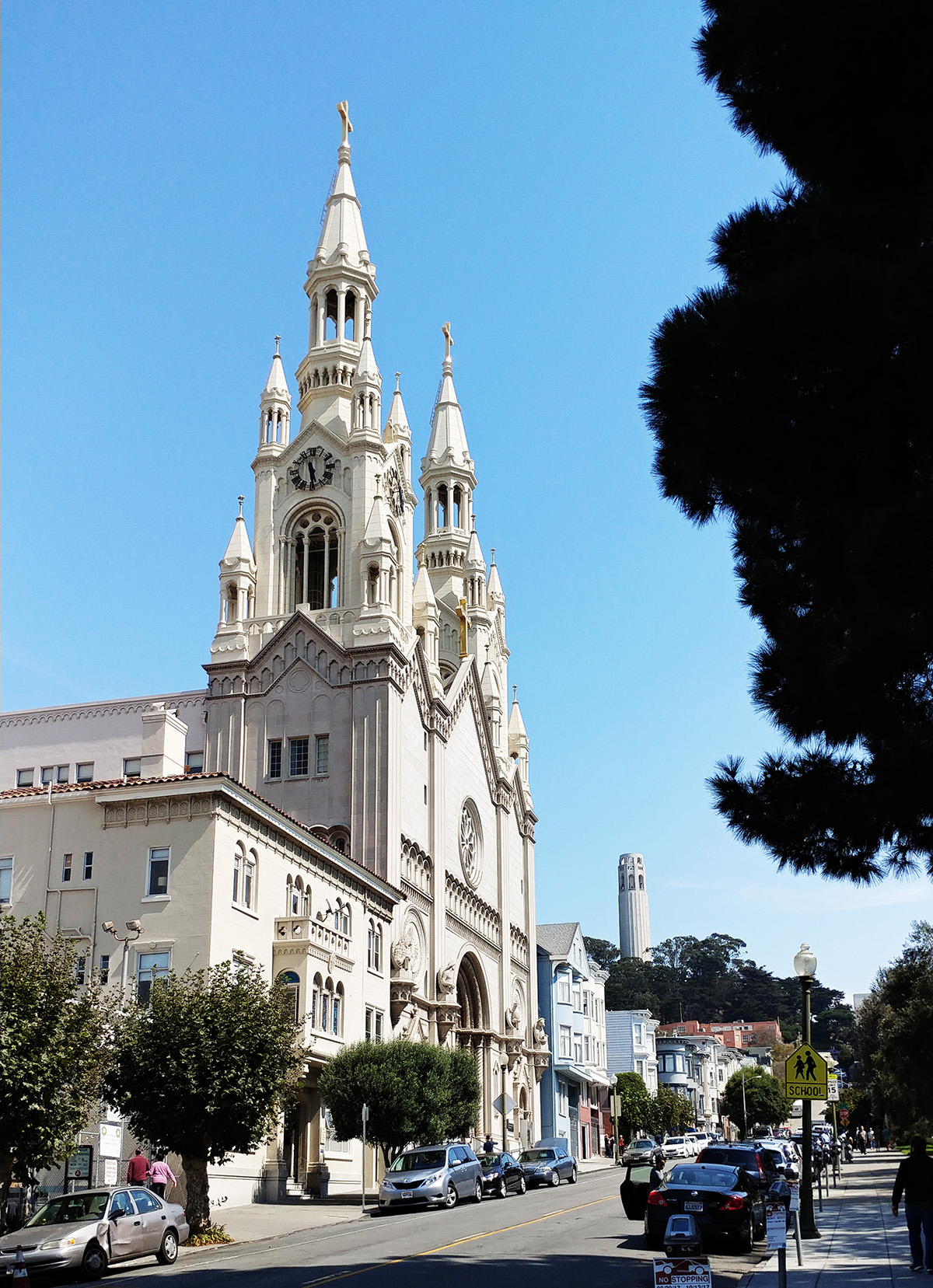
Photographed September 2017 — Saints Peter and Paul, 666 Filbert Street, North Beach, San Francisco
You find it the way the whole city finds it, by the two white towers standing up over the low roofs of North Beach with Coit Tower set on the hill behind them. The church faces Washington Square across a short run of grass, and the towers can be seen from the top of Lombard Street and from the slope of Telegraph Hill and from a good many windows that look the right direction. There is no beach in North Beach and has not been for a long while. The name comes from the 1850s, when the bay still reached up into the low ground and the district was a stretch of shore. The water withdrew. The name stayed on past the thing it named, the way names will.
The parish is older than the building. Italians coming off the boats in the 1880s made this district their own, and in 1884 they raised a first church a few streets over, at Filbert and Grant. In 1897 the Salesians of Don Bosco, an order founded in Italy a few decades before, were given the care of the parish, and they have kept it ever since. Then in 1906 the earthquake came, and the fire that walked through the city after it, and the first church went down with most of the neighborhood around it. A people who lose their church will tell you what they are by what they do next. These laid a new cornerstone in 1913 and worshiped in borrowed rooms through the long stretch in between, and they did not see the work finished until 1924. Eleven years. The cost of the church and its school came to something near eight hundred thousand dollars, which in those years was the wealth of a small country town, gathered a little at a time from people who worked with their hands.
The man who drew it was Charles Fantoni, and he gave it the old manner of Italy, the round Romanesque arch and the pointed Gothic spire set together in one face. The two towers rise a hundred and ninety-one feet. Across the three front doors the builders set a line of Dante, from the opening of the Paradiso, that the glory of the One who moves all things shines through the whole of creation. It is a large sentence to carve over a doorway, and it has stood over the comings and goings of a hundred years of ordinary people who passed under it without slowing down, which is its own kind of testimony.
Inside, the building is a hundred feet across and a hundred and sixty long, and the nave climbs sixty feet overhead, and the pews will seat seven hundred and twenty. There are a hundred and thirty-eight windows of stained glass, and they were not bought from a catalog. Glassmen were brought over from Italy for that work and nothing else, and they made the windows here, on the spot, and the glass of the chandeliers besides. Gold leaf is laid on so much of the surface that a person notices it the way he notices weather. And at the front of it all stands the altar, which is the thing in the building I would walk across a city to see. It is Carrara marble, a hundred and twenty-five tons of it, cut and carved in Italy and then sent the slow way around, down past Cape Horn in the hold of a ship, where for the better part of a year it rode as ballast — dead weight in the dark, holding a vessel steady against the sea. It reached San Francisco in 1926 and was hauled up the hill and stood on end, and the lowest cargo a ship can carry became the one object in the church that everything else is built to face.
There is more, and it is worth the looking. A carved copy of Michelangelo’s Pietà stands to the right of the high altar. At the back, near the doors, the builders made a small grotto after Our Lady of Lourdes, so that a person coming in off the street meets a quiet cave before he meets the great room. The confessionals are carved wood, worked as carefully as furniture meant to be loved. A pipe organ by the Schoenstein house sits at the fore of the nave. And in a clever stroke the top two floors of the whole structure were built as a parochial school, set in a horseshoe that wraps the church below, so that the children learned their letters in the same walls that held the marble and the glass.
The building has had to be defended as much as admired. In 1926 and 1927 it was struck by a string of bombings, five of them, set by anarchists who wanted to make a statement against the Church and chose this church to make it on. It stood. The ground has shaken under it more than once since. The towers had their inner steel made sound again not many years ago, a job that ran past two and a half million dollars, which is the part of devotion that draws no crowd. A church of this kind is a long obligation in the shape of a gift, and the keeping of it is the harder and the more faithful work, and almost no one sees it done.
The people change and the building gathers them anyway. A boy named Joseph DiMaggio was carried in here to be baptized, and stood on these steps in a good suit on a wedding morning, and was carried in a last time to be buried in 1999, and between those days half the neighborhood was christened and married and mourned under the same roof. The Italians have mostly moved on to other cities and other work, the way the children of immigrants do, and the church did not empty behind them. The Mass is said now in English and in Italian and in Cantonese, and the building has outlived the very people who raised it and taken in a new people to fill it.
The old bell sits at the back of the church now, in a room rather than a tower. A machine does its ringing. But they kept the bell, and it carries on its side the year it was cast, which is 1906 — the year the first church burned. They saved out of the fire the one voice that had called the old congregation to prayer, and they have carried it, silent and honored, through everything that has happened since. That is most of what faithfulness is: to keep the worn thing, and to go on keeping the roof over it, long after the praise has moved along to something newer.