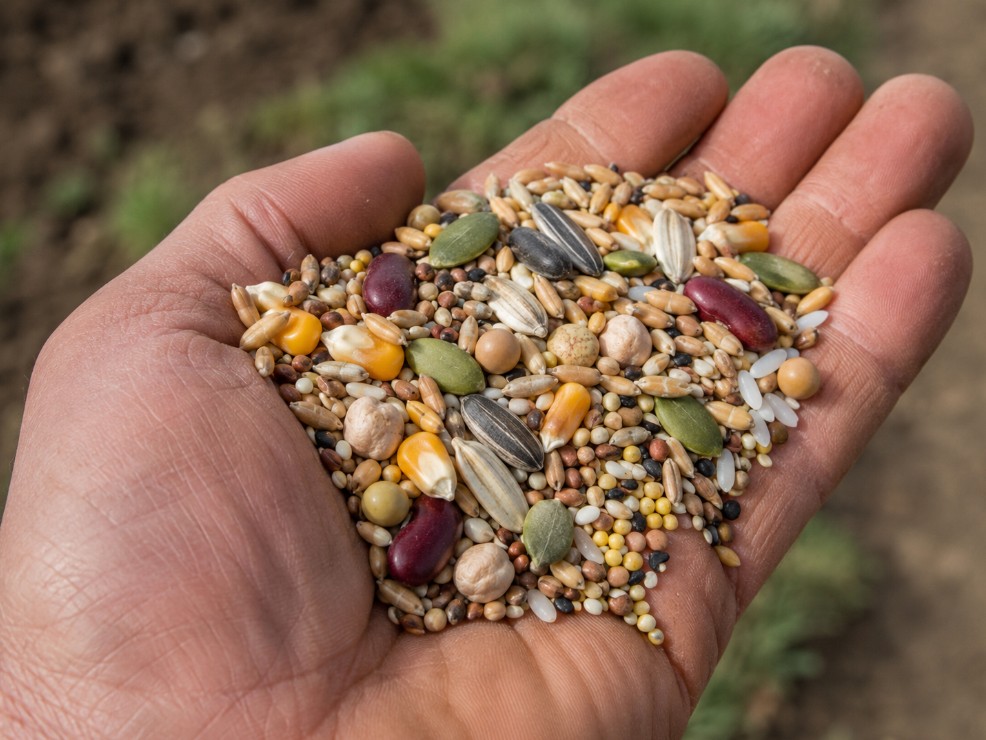
There is a handful of seed I want you to hold in your mind. Saved corn, kept back from the crib. A double handful of beans set aside in a paper sack on a shelf in the barn. Wheat poured off into a bin against the spring. It does not matter much which. What matters is the gesture, which is older than any nation and older than money: a person takes the best of one harvest and holds it back from the table so that there will be another harvest, and then another after that. For something close to ten thousand years that gesture was the whole foundation of settled human life. The people who made it asked no one’s permission and paid no one a fee. They were doing the plainest work there is, which is the work of keeping faith with the year to come.
I want to talk about what we have done to that gesture, because we have made it a crime.
A patent on a seed is a strange thing once you say it out loud. The owner of the patent has not invented the seed. He has altered, in some particular, a living line that was handed to him by ten thousand years of farmers he will never thank. Having altered it, he claims as his property every seed that seed will ever become. And here is the part worth sitting with. The seed makes its own copies. The farmer puts it in the ground, and the sun and the rain and the seed’s own ancient competence do the rest, in the farmer’s field, by the farmer’s labor, on the farmer’s afternoon. The harvest that comes up is charged against him as theft. The offense, stated honestly, is that the grain made more grain. We have built a law that treats the fertility of a plant as the trespass of a man.
Consider what the patented line actually is. Every crop we eat is an inheritance. Maize did not fall out of the sky; it was coaxed up out of a wild grass across centuries by people who chose the best ear and planted it and chose again, a million unrecorded acts of attention compounding down the generations until the thing on your plate existed. Wheat, rice, the bean, the squash, the apple — each one is the accumulated and unpaid labor of the dead, handed forward as a gift to people they would never meet. That is what a seed is. It is a bequest. The modern variety, with its one clever alteration, is the most recent small addition to a vast estate that the alterer did not build and does not own. He has put a porch on a cathedral and filed a deed for the whole works.
A few years ago the law of this country was settled in plain view. A farmer in Indiana named Vernon Bowman wanted a cheap crop for a risky late-season planting, so he went to the grain elevator and bought a load of ordinary soybeans — commodity beans, the kind sold for feed and oil, poured together from a hundred farms. He planted them, as men have planted gathered seed since the beginning. Most of the crop that came up carried a patented trait, because most of the beans in that region do. He saved some back and planted again. For this he was sued, and the highest court in the land ruled against him without a single judge dissenting. The doctrine that says you own the thing you buy was held not to reach the copies the plant makes of itself. So the law’s position, set down in writing, is that Bowman owned the bean he purchased and the patent owner owned the bean’s children. A man bought a sack of beans, did the oldest thing a farmer can do with a sack of beans, and was made a criminal by the act of planting.
There is a second cruelty folded into the first, and the farmers feel it in their bank accounts every spring. The proprietary seed is bred to be sold alongside a proprietary chemical. The famous case is the seed engineered to survive a particular weedkiller, so that the field can be drenched in the poison the same company sells. The two are a matched set, and the farmer is locked into buying both, season after season, with no end to it, because saving his own seed is forbidden and the seed he is permitted to buy performs only inside the chemical regime it was designed to advance. The farmers I know did not choose chemical agriculture from a free and open menu. The other doors were closed and welded while they were looking the other way. A man who once kept his own seed and answered to the weather now keeps an account with a corporation and answers to it. We have taken one of the last independent tradesmen in America and made him a sharecropper on his own land.
I will not tell you what God makes of this. The farmers who feel it most deeply seem to feel it as something near to sacrilege, a violation of an order older than the law, and I will leave that testimony to them, since the land and its long covenant are more theirs than mine. I can tell you only what I see, and what I see offends me to the root. Three things are stacked in that handful of seed. It is food, which is to say it is the floor under life itself, the thing no one can decline. It is alive and self-renewing, so that the value claimed at the moment of the so-called theft is made by the plant and the man and the field, with the claimant nowhere in sight. And it is a lineage, a living thread running back through all those generations of attention to the first person who ever knelt and chose. To put a tollgate across that — to charge admission to the reproduction of the food of the human race — is a thing I do not have a soft word for.
I am not against a man being paid for his work. A good variety can be a decade of patient labor, and the breeder who gives that decade has earned a living from it, the same as any honest tradesman earns a living. My quarrel was never with his wages. It is with the two abuses that ride in alongside the wages: the permanent enclosure of a self-renewing line, and the monopoly that enclosure is built to become. Pull those two out and the wages can stand.
Here is what I would put in their place. Give the breeder five years of exclusive sale. For five years he alone may sell active seed of his variety, and he may make his living and recover his decade in peace. What he never receives is a claim on the plant once it has left his hands and gone to work in another man’s field. The farmer who buys that seed and keeps back his best for the spring is clear, in the first year and the fifth and forever, because the restriction falls on the commercial rival trying to multiply and undersell, and on no one else. After five years the line rejoins the common stock it grew out of and belongs again to everyone. Under such a rule the whole sorry business of the Indiana grain elevator simply evaporates, because that man was never selling seed. He was growing a crop, and growing a crop from saved seed is the birthright of every farmer who ever lived.
And I would weld a second valve onto the first. The moment any variety crosses some modest share of its market — call it fifteen percent — the exclusivity lifts early and anyone may multiply and sell it. The point of the protection was to keep a breeder solvent and keep the field full of living products that compete. It was never to hand one seed line the whole dinner table. The only road past that ceiling is to be so far ahead of every rival that you keep winning with no legal protection at all, and that is the one kind of dominance worth a thing, because the seed earned it in the ground and no lawyer earned it on paper.
Run both dials together and they hold each other up. If the share cap comes too fast to recover the decade, the five years of sale carry the man. If five years is too short a runway, the share he captured in the window carries him off the line. Either way the reward survives, the enclosure dies, and the monopoly meets a hard limit it cannot cross. That is the shape of a thing I could honor: protection as a courtesy with an end on it, and the lineage going home.
I have spent these pages on the seed because the seed is where this whole question shows its face most plainly. The same logic that puts a gate across the harvest puts gates across a great many things now, all of them claims to own a pattern and to charge the rest of us for the act of copying it with our own hands and our own materials. The seed is only the case where the copying machine is alive and the copy is your supper, so the strangeness cannot dress itself up. We did not make the seed. We were handed it, across an unimaginable depth of time, by people who saved the best and passed it on and asked nothing. The decent response to a gift like that is to keep it and pass it on in turn. Propagation over possession. That is the old farmer’s faith, and it built everything we have. I would like us to remember it before the last man who knows how to save his own seed is told that he may not.