An American Foursquare with Queen Anne manners, dressed for October
Some houses keep their faces to themselves. This one looks right at you.
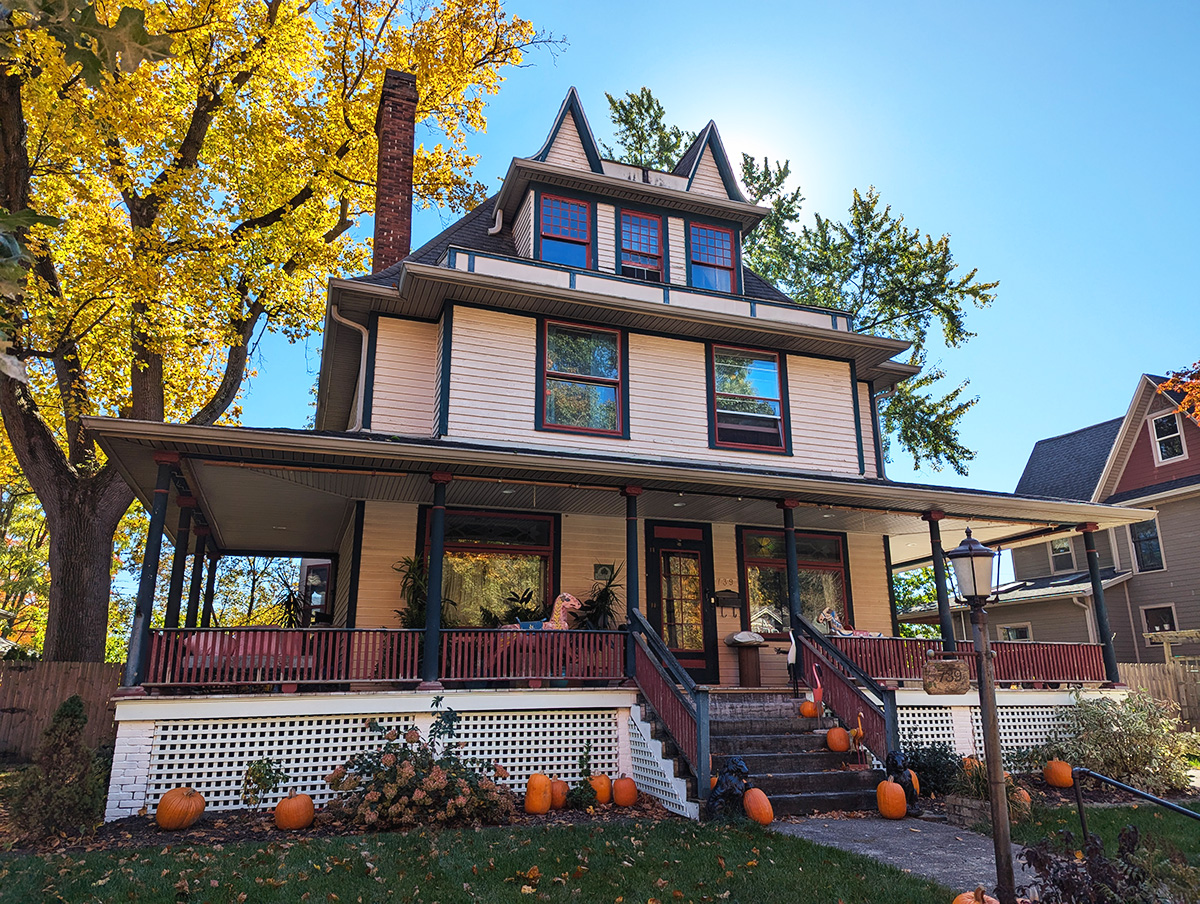
Two dormers ride the top of the roof like raised eyebrows, peaked and attentive, and the whole front of the house arranges itself underneath them into something close to an expression — pleased, a little surprised, glad you came up the walk. A preservationist would call them what they are: twin front-gabled dormers set into a finished attic, the half-story that makes a house like this two-and-a-half stories in the listings. The true eyebrow dormer is a different creature, a low curved eyelid of a thing with no sides; these stand up straight and steep, and the eye reads them as a brow anyway, lifted in welcome above three floors of cream clapboard and oxblood sash.
What you are looking at is an American Foursquare wearing Queen Anne manners — the kind of house the field guides sometimes file under Free Classic. The bones are Foursquare: a tall, boxy, nearly cubic mass under a hipped roof with deep eaves, the plan inside running to four big square rooms a floor. The dress is late Victorian: the steep gabled dormers, the polychrome paint, the wide porch turning the corner. Houses like this went up across the Midwest’s streetcar suburbs in a tight window, roughly 1900 to 1915, as the turned spindles of high Victorian gave way to the squarer, plainer columns you see holding up this porch. Those boxed posts are the tell. They date the place to the hinge years when Victorian loosened its collar and the Foursquare and Colonial Revival walked in.
Read the rest and the date holds. The upper window sash carry a grid of small panes over a single large light below — the cottage-style Queen Anne sash that turns up around the turn of the century. A tall brick chimney rises along the left wall, an internal flue for the main rooms. The siding is true clapboard, lapped and painted, the body a warm cream, the trim in bottle green, the sash and accents in oxblood red — a restorer’s painted-lady scheme laid over honest early-1900s woodwork.
The dormers are the grace note. The porch is the argument.
It runs the full front and turns both corners — a true wraparound, deep enough to live on, squared off so the roofline holds a clean horizon. Square boxed columns in green carry it, their caps and feet picked out in red; a red balustrade runs the rail; white lattice closes the foundation between the porch piers and gives the swallows somewhere to be. A wrap porch like this is a room that forgot to grow walls. It belongs to the house and to the street at the same time, which is the whole trick of the form.
And because it wraps, the day has somewhere to go. Morning coffee finds the east rail while the sun is low and gold in the ginkgo. By afternoon the shade has slid around to the deep middle, where the rocking horse and the potted things keep their company. Evening hands the west corner a long warm light, and you move your chair to meet it. One porch, and you can follow comfort all the way around it from first light to last. That is the promise a wraparound makes, and the reason people type those words into a search bar at eleven at night: somewhere you would want to be at any hour.
Right now somebody has lined the whole skirt of it with pumpkins. They run the foundation, climb the steps, gather at the newel post like they are waiting their turn, and they turn the house’s good bones into an event. Flamingos and a carousel horse keep them honest. This is a porch that gets dressed for the season, because the people inside still hold that the front of a house is worth dressing — that the street deserves a show, and that hospitality starts out at the property line where the sidewalk can see it.
We built houses like this when life faced outward. The porch did real work then: it was where you cooled off, courted, shelled beans, watched the block, and got watched over in return. It was the smallest unit of public life a person owned. Most got screened in, torn off, or shrunk to a concrete stoop. This one is kept — painted, swept, loaded with squash — and a kept porch is a small civic act. It says the household is still willing to be seen, and to see.
By the street and the housing stock, the photograph came out of Lafayette, Indiana — one of those old streetcar neighborhoods where the lots run narrow, the trees outrank the cars, and a Foursquare was built to last a hundred years and greet everyone who passed for all hundred. Number 739 has the look of a place that has kept that bargain.
A house that faces the street is making a promise. This one — eyebrows up, columns square, porch full of pumpkins — looks like it means to keep it.