A Reason for the Curve: The Eisenhower Boulevard Bridge
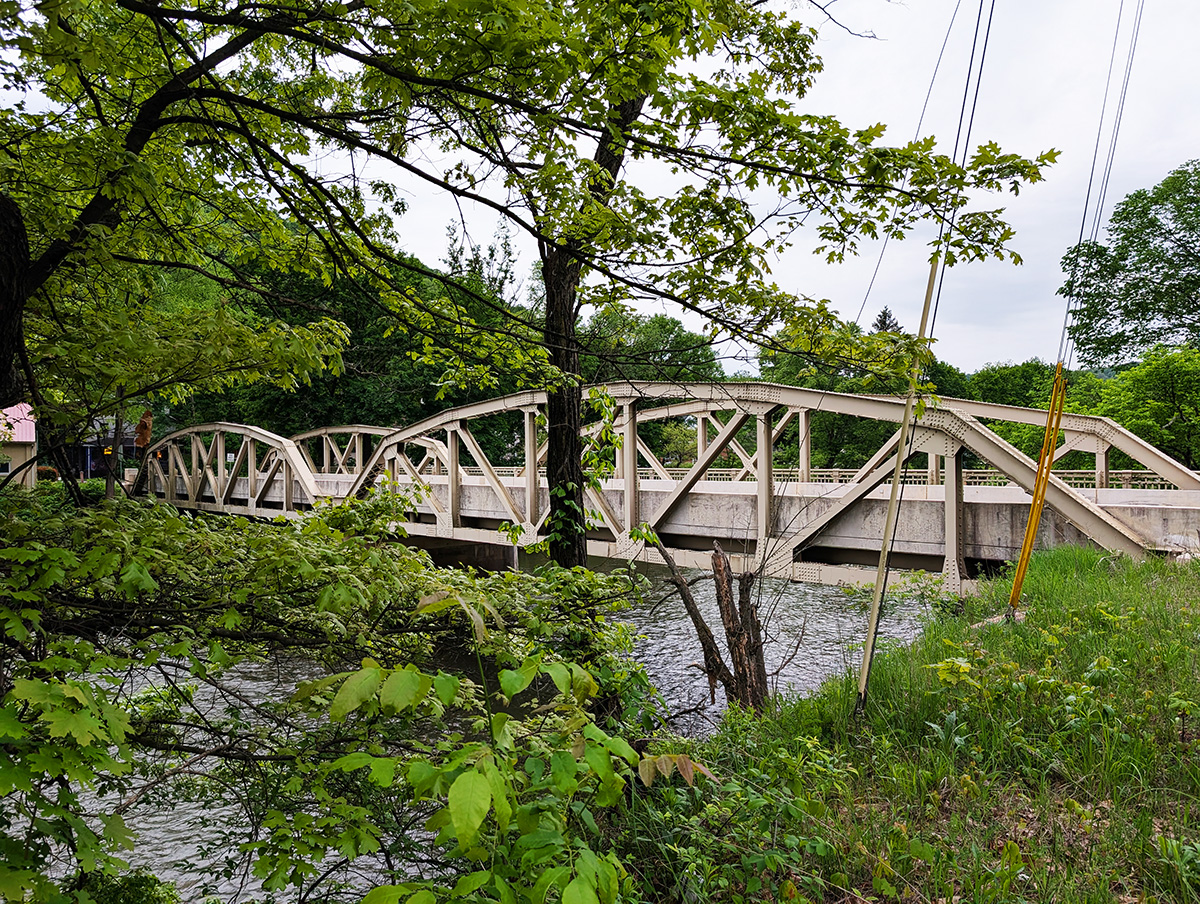
Cross the Stonycreek on Eisenhower Boulevard, where Ferndale hands you off to Riverside, and you pass over a piece of steel that arches up out of the riverbank like it’s flexing for the camera. From the bank it reads as graceful, almost ornamental — a pale tan bow strung across the green. The pleasure of it is that the grace is structural. Every curve in that thing is the bridge telling you, out in the open, exactly how it carries its load.
What you’re looking at is a Parker pony truss, built in 1937 by the Altoona Construction Corporation to a Pennsylvania State Highway Department standard plan — two riveted spans, 232 feet end to end, the long reach crossing 113 feet of water. “Parker” is the name for a Pratt truss whose top chord has been bent into a polygon instead of run flat, and that bend is the whole trick. A loaded span wants the most material at its middle, where the bending is worst; by raising the top chord toward the center, the Parker design puts the greatest depth of the truss where it’s most needed and saves material everywhere else. The curve isn’t styling. It’s an economy measure you can read from the road. Heritage BridgesN.C. Department of Transportation
“Pony” is the other half of the name, and it’s a confession of limits. A pony truss carries its deck down on the bottom chord with the two trusses standing up on either side and nothing tying them together overhead — no portal, no sky-high cross-bracing, just open air above the lane. That’s what makes it feel light and friendly to drive. It’s also what keeps it modest. The top chord runs in compression and badly wants to buckle sideways, and with no top bracing to stop it, the bridge leans on the stiffness of the chord itself and the little half-frames at each panel to hold the line. Push a pony truss too long and that compression chord folds. So it’s a moderate-span animal by design — which is exactly the job a creek-to-river crossing asks of it.
Here’s the part I like best. The thing arches like an arch, and it is not one. A real arch works in pure compression and shoves outward on its footings. This bridge is a beam wearing an arch’s clothes: the curved top in compression, the straight bottom chord in tension, the diagonals shuttling the shear between them, the whole assembly behaving like one deep, honest girder. It looks like it’s pushing. It’s actually bending.
Now go west and meet its cousin. In Poland, Ohio, in Mahoning County, the Main Street bridge carries Route 170 over Yellow Creek, and it is the same breed — a Parker pony truss, built in 1904 by Huston and Cleveland of Columbus, Ohio. Same logic, same curved top chord, same open lane. But the two of them sit on opposite banks of a big change in how America built bridges. The Poland span came from a small private firm marketing its own design to a township, back when companies like the King Bridge Company of Cleveland and the Massillon Bridge Company sold their designs to cities and townships. The Eisenhower span, three decades later, came off a state standard plan — engineered once in Harrisburg and reproduced wherever the Commonwealth needed a crossing of that size, part of the wave in which many states developed standard-plan truss bridges. One bridge is a salesman’s drawing. The other is a government spec. One is a single short reach over a creek; the other is a two-span haul across a working river. Same family resemblance, two different worlds of who decided what got built and how. LOC + 2
The engineer’s note, and it matters: the reason this bridge looks neat is that it isn’t hiding anything. The curve is the bending moment drawn in steel. The open top is the load limit made visible. Nothing on it is there for show, and that is precisely why it’s worth showing. A structure that wears its math on the outside is the rarest kind of beautiful — the kind where, once you see what you’re looking at, you can never again call it plain. It’s a cool bridge. It looks neat. And it looks neat because it’s true.