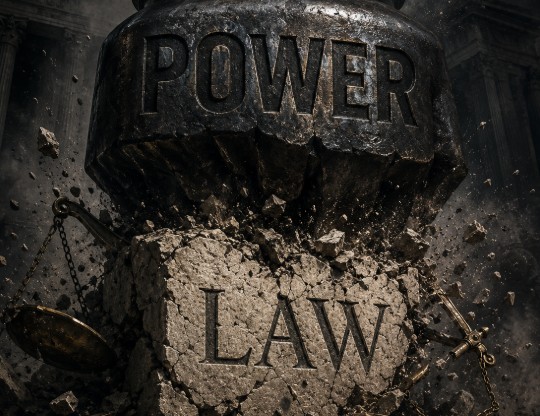
I used to believe the rule of law and the rule of power could be reconciled. I thought that was the whole project of a constitutional republic: take power, which is ancient and hungry, and put it inside law, which is written and public, so that the strong and the weak read from the same page. I believed that for most of my life. I believed it in uniform. I believed it filing grievances. I believed it standing in front of managers and administrators and hearing officers.
The error ran deeper than I understood. The error was believing in the rule of law at all.
The rule of law, as we actually live it, is an oral tradition. It is a story we tell each other in support of the law of power. The story says: the rules are the rules, they apply to everyone, and if you follow the process you will get a fair hearing. The story is repeated in civics classes, courtrooms, and press conferences, and it is repeated most fervently at exactly the moments when it is least true. Power tells the story because the story is cheaper than force. A population that believes it lives under law polices itself.
You want proof? Don’t read the philosophy. Read the clocks.
Every legal system runs on time limits, and the time limits are where the system confesses. Strip away the preambles and the Latin and the flags behind the bench, and ask one question of any statute: who does the clock protect? Ask it enough times and a pattern emerges so consistent it stops looking like accident and starts looking like architecture.
When you have a claim against power, the clock is short. Brutally, surgically short.
I can speak to this firsthand. Take a veteran with a merit board claim against a federal agency — a claim under a law Congress passed, with speeches and handshakes, specifically to protect people who served this country. That veteran gets sixty days. Sixty days to recognize that a violation occurred, understand which regulation was violated, understand that a remedy exists, understand which body hears that remedy, and file correctly. Miss it and the claim is dead. Forever. The merits never matter; the truth never gets weighed; the door simply closes.
Now stack the deck the rest of the way, because the sixty days does its real work in combination. That same veteran, as a new federal employee, is on probation for ninety days — at-will, disposable, one complaint away from the street. The union that might explain his rights won’t touch him for that same ninety days; he pays into a system that is contractually forbidden from helping him during the exact window when the clock is running. And the regulations being violated? The agency holds those. The pay manuals, the handbook provisions, the internal instructions that would tell him he’s been wronged — they live in systems he can’t access, interpreted by the very people who benefit from his ignorance. The law assumes he knew or should have known. The agency ensures he couldn’t have.
So walk through it honestly. A law exists to protect veterans. The window to invoke it closes before the veteran can safely speak, before he can get representation, and before he can even see the rules being broken. Every one of those conditions was designed, drafted, reviewed, and enacted by people who understood exactly what they were building. Why is the window sixty days? Because power said so. Because the agency writes its own procedures, lobbies its own oversight, and prefers a world where the protective statute exists on paper — for the speeches — while remaining functionally unreachable in practice. The law is real. The protection is theater.
Now turn the telescope around. Look at the clocks that run when power has a claim against you.
Criminal statutes of limitations start around five to seven years for ordinary offenses, and they only get longer from there. If I backhand a manager for stealing from me — I am not a violent man, but I do enjoy a noisy example — and leave a bruise, the state can sit on that for years and formally charge me when the witnesses have scattered, the security footage is gone, and my own memory of the afternoon has dissolved. I then get to reconstruct a defense from vapor while the state, which has been keeping the file warm the whole time, walks in with its case fully preserved. And for serious crimes there is no limit at all. The clock never runs. The state’s grievance against you is immortal; your grievance against the state expires in weeks.
Sit with that asymmetry. The individual, with no investigators, no legal staff, no institutional memory, and no leverage, must act within sixty days or forfeit everything. The state, with all of those things in infinite supply, gets seven years, or ten, or eternity. The party that needs time gets none. The party that needs none gets all of it. If the rule of law were real — if the point were truth, fairness, the accurate resolution of disputes — the clocks would run the other way, or at least run the same. They don’t, anywhere, ever, and that tells you what the system is actually for. Time limits are load-bearing walls in the architecture of power. They exist to extinguish claims from below and preserve claims from above.
And when the clock hasn’t already killed you, money finishes the job. The wealthy defendant treats an eternal statute of limitations as an inconvenience; he hires the delay, buys the experts, exhausts the prosecution, negotiates the plea down to a press release. The poor defendant facing the same immortal charge takes whatever deal is offered, because the alternative is bleeding out over years he cannot afford, against an opponent whose budget line is called “the treasury.” From there the conveyor runs straight into a private prison industry that bills the public per occupied bed and lobbies, openly, for policies that keep the beds full. There is a word for a system that extracts labor from people it has legally stripped of options, and the Thirteenth Amendment names the exception in plain text: except as a punishment for crime. The queue is the point. It was always the point.
None of this requires a conspiracy. That’s what makes it durable. No smoke-filled room decided that veterans get sixty days and prosecutors get forever. Each clock was set by whoever held the pen at the moment of drafting, and the pen is always held by power, because power is what a legislature is made of. Agencies draft the regulations that govern claims against agencies. Prosecutors’ associations advise on the statutes that empower prosecutors. Every individual decision looks technical, reasonable, procedural. The pattern only appears when you keep notes — when you dig through the timelines side by side and watch every single deadline lean the same direction, like trees on a coastline that all grew bent by the same wind.
The rule of law survives as a belief because most people never have to test it. They pay their taxes, avoid the courthouse, and consume the story secondhand. The tradition passes down intact. It’s the people who actually pick up the tools — who file the claim, cite the statute, meet the deadline, follow every rule the story told them to follow — who discover what the tools are made of. Ask anyone who has litigated against an institution from below. There is a specific moment, and everyone who’s been through it knows the moment I mean, when you realize the process was never a path to the remedy. The process is the remedy’s replacement. You are given procedure instead of justice the way a crying child is given a pacifier instead of food.
So what do we do, if the law is a feckless servant of whoever holds it?
Here’s the thing the clocks accidentally teach you: the law has no power of its own. It never did. It is a tool, and a tool obeys the hand that grips it. Right now that hand belongs to a very small number of people, and my cases are just my cases — one man’s file folder. Multiply it by every worker who lost a claim to a deadline built to be missed, every tenant who couldn’t afford the filing fee, every patient buried in an appeals process designed to outlast them, every soldier who came home to an agency that hid the rulebook. That’s not a stack of individual misfortunes. That’s a census. We are the majority of this country, and we are being governed by procedures written to keep us from noticing each other.
So notice each other. That’s step one, and it’s the step power fears most, because every mechanism I described in this piece — the short clocks, the probation windows, the union lockouts, the hidden regulations — works by isolating you. It works one claimant at a time. It has no answer for a crowd.
The law bends to power. Fine. Then become the power it bends to. Working people have done this before, in living memory, and the tools are still on the table:
Show up. School boards, county commissions, township meetings, union halls. Power counts heads, and an empty room is a signed permission slip. Fifty working people in a room where three usually sit changes what gets said at the podium before anyone speaks.
Keep the ledger together. I keep notes on my cases; you keep notes on yours. Now imagine those notes shared — a public record of every deadline trap, every buried regulation, every retaliation, cross-referenced by the people living it. Power depends on each of us thinking our case is unusual. Ten thousand identical cases in one open file is evidence of design, and evidence of design is politically radioactive.
Vote in the boring elections. The presidency is theater; the clocks are set in statute, and statutes are written by legislators most people can’t name, elected in midterms and primaries most people skip. The sixty-day window exists because nobody who suffers under it has ever made a state rep or a congressman sweat over it. Make them sweat. Every incumbent who ever voted for a procedural trap should have to defend it in public, in plain language, to the people it was aimed at.
Organize where you stand. A union, a tenants’ association, a veterans’ cohort, a church committee — the shape doesn’t matter. What matters is that you stop arriving alone. Every asymmetry in this piece assumes an individual facing an institution. An institution facing an institution is a negotiation.
And spend like it counts, because it does. The private prison bed, the union-busting consultant, the lobbying budget — all of it is funded by dollars that pass through our hands first. Money is the one vote we cast every single day.
None of this is fast. Power spent generations setting these clocks and it will not reset them because we asked politely. But the same oral tradition that props up the rule of law contains a promise power made and must keep repeating: government of the people, by the people, for the people. Power needs that story. It cannot govern without it. Which means the story is a debt — and a debt can be called.
The law will balance this society on the day, and only on the day, that ordinary working people make imbalance more expensive than fairness. That day is built out of small acts: a meeting attended, a record kept, a ballot cast in an election nobody watches, a coworker who doesn’t have to stand alone. My cases are only my example. You have yours. Bring it.
The clocks were set by hands. Hands can reset them. There are more of us than there are of them — that has always been true, it will always be true, and the entire architecture I’ve described exists for one purpose: to keep us from acting like it.
Act like it.