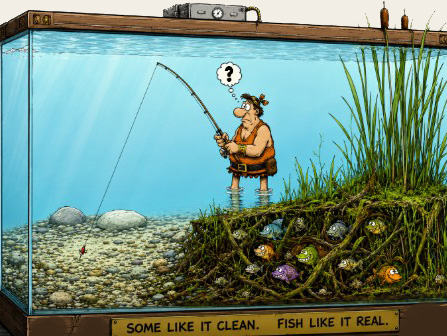
Design Notes from the Weedy End of the Lake
I did not come to fish through glass. I came to fish through a fishing rod.
I grew up fishing. I had friends who kept aquariums, but that was a luxury I didn’t have — so the fish I knew were the ones on the end of a line. I always liked them anyway, and I always wanted to learn more about them. That was enough to start with. And this is the part that matters for everything that follows: a fisherman spends decades learning where fish actually want to be. Not where they photograph well. Where they go when they have the choice.
And I am here to tell you, they choose the muck. The weediest, snaggiest, most littered ground in the lake, thick with fallen timber and undercut bank and drowned brush, the water stained and the bottom soft. That is where you cast, because that is where they live. Open, clean, well-lit water is where a fish goes to get eaten. Every prey species knows it in its lateral line. A fish suspended in bare water is a stressed fish scanning for the shadow that ends it, and a fish tucked into structure is a fish that can finally get on with the business of being a fish — feeding, holding territory, courting, ambushing. Cover is where behavior lives. The clean water is just the commute.
Keeping aquaria came later, once it stopped being a luxury and started being a thing I could finally do for myself. Aquaponics came later still, through homesteading and permaculture, and when I stumbled into it the recognition was immediate and a little embarrassing: the way I had always kept fish was aquaponics with the food system left off. I had been running the front half of a farm for years without harvesting anything but behavior.
The idea that snapped it into focus was Bill Mollison’s seven-layer forest. A mature forest fills every vertical niche at once — canopy, understory, shrub, herb, groundcover, root, and vine — so that no light, no water, and no nutrient falls through unused. Every layer is a different organism doing a different job in the same volume of space, and the yield of the whole is enormous precisely because nothing is left idle. That is the design lesson permaculture beat into me: fill all the niches, and let natural process do the work in each one for your gain. An aquatic system is the same principle turned on its side and run through water. Surface, water column, substrate, biofilm, root zone — each is a layer, each wants an organism, and every layer you leave empty is a job you’ve reserved for yourself. Bolting the growing on completed a circuit I had been idly holding open my whole life. That recognition is the root of what I can only call my worship of these living systems — the fish came first, the food came back around, and the loop closed on years spent pulling dinner out of the weeds.
So these are design notes from that lineage. They apply to a ten-gallon on a dresser and they apply to a remediation greenhouse, because the physics and the biology do not care about scale.
Start with the war, because every aquarist online is drafted into it eventually. One camp keeps laboratories: bare bottoms, surgical filtration, parameters logged to the decimal, every surface siphoned on schedule. The other camp keeps jars of pond: dirt, decay, no filter, intervention treated as violence. Both camps produce healthy fish. Both produce disasters. Both spend remarkable energy explaining the other’s wrongness. My regular readers know I walk the middle path here as everywhere, but the middle path is a discipline with actual architecture, and the notes below are that architecture written down.
First note, addressed to the naturalists. Your tank is a mechanical system. It has inputs, outputs, a nitrogen budget, gas exchange, flow, and a failure curve, and it deserves to be monitored and documented like the lab it secretly is. A sealed glass box on a shelf resembles nothing nature ever built, and it will not self-correct the way a watershed does — a watershed has an upstream and a downstream and yours has a lid. Methodical wins whenever the stakes are living animals. Own the instrumentation. Keep the log.
Second note, addressed to the clinicians, and this one runs longer because it is the one my fishing years qualify me to write. Every piece of equipment on your rack is a mechanical impression of a natural process. The filter is a riverbed. The heater is a latitude. The water change is a rain. Useful impressions, all of them, and every one cruder than the original — because the real productivity of a natural system lives at its edges, the zones where multiple stages of life intermingle. Fry graze biofilm off the mulm you would have siphoned. Infusoria bloom because something died and something smaller ate it. Detritivores turn waste into food two trophic levels before you notice. These edge interactions maximize productivity in ways we are only beginning to map, and when you sterilize the edges out, you volunteer to perform every job they were offering to do — by hand, forever. Your maintenance schedule is a payroll. Nature was standing there with a work crew and you sent them home.
And while we are on the clinical tank: even if you keep it spotless — which is a legitimate art form, and I mean that — build in hides and structure aplenty. This is where the fisherman overrules the aesthete. The bare, bright, minimalist display that photographs so well is, from the occupant’s side of the glass, the open water where things get eaten. The instinct doesn’t switch off because the predators did. Wood, rock, plant thickets, caves, shadow — structure is welfare equipment, as load-bearing as the heater. A fish with cover shows you its actual behavior. A fish without it shows you vigilance, washed-out color, and the long slow tax of stress. If you learned fish through a rod instead of a pet store, you already knew this: nobody casts to the middle of the lake.
Third note, the synthesis, and the one that governs how I actually build. Engineer the boundaries; let the interiors go wild. In practice this means modularity. My systems are built from individual task components standing in a common pool — discrete planters rather than one continuous grow bed, staged vessels rather than one mixed flow. The reason is control, and control means failure isolation: a monolithic bed can infect all at once, while a single planter gets pulled, inspected, treated or tossed, and the system barely registers the surgery. Any component is replaceable with little surrounding impact. That is lab thinking and it is correct.
But each module, inside its engineered boundary, is a biological unit running multiple cooperative and sometimes competing functions at once. A planter is simultaneously a nutrient sink, a microbial reactor, a fry refuge, and a grazing surface. The functions compete for the same water and cooperate on the same waste, and the mess inside the boundary is where the yield comes from. So the design rule compresses to this: draw hard lines, then let everything inside them get complicated. Build like an engineer. Populate like a river.
A river is the whole argument in one object — a machine made entirely of living parts, staged from headwater to mouth, every reach a module, every eddy an edge, every snag holding a fish. I spent my younger years learning to read that machine with a rod in my hand, and everything I build now is an attempt to write it back down in plumbing and glass. The fish taught me the design language before I knew it was one. They vote with their bodies, and they always vote for the weeds.