There is a magic date on the calendar of every Indiana swimming hole, and it is the day school starts. On that day, every waterfall in the state undergoes a transformation that scientists have yet to fully explain: the minivans vanish, the coolers vanish, the guy with the Bluetooth speaker playing classic rock at cliff-face volume vanishes, and what remains is, of all things, a waterfall.
Lower Cataract Falls in Owen County is where I learned this.
In July, the place is a scene. And honestly, fair enough — it’s a great swimming hole, Indiana summers are basically a dare, and the plunge pool below the falls has been cooling off Hoosiers since before anyone thought to charge for parking. But go in July and the falls are wallpaper. Background scenery for four hundred people having a perfectly nice time on top of each other.
Go in September and the proportions flip.
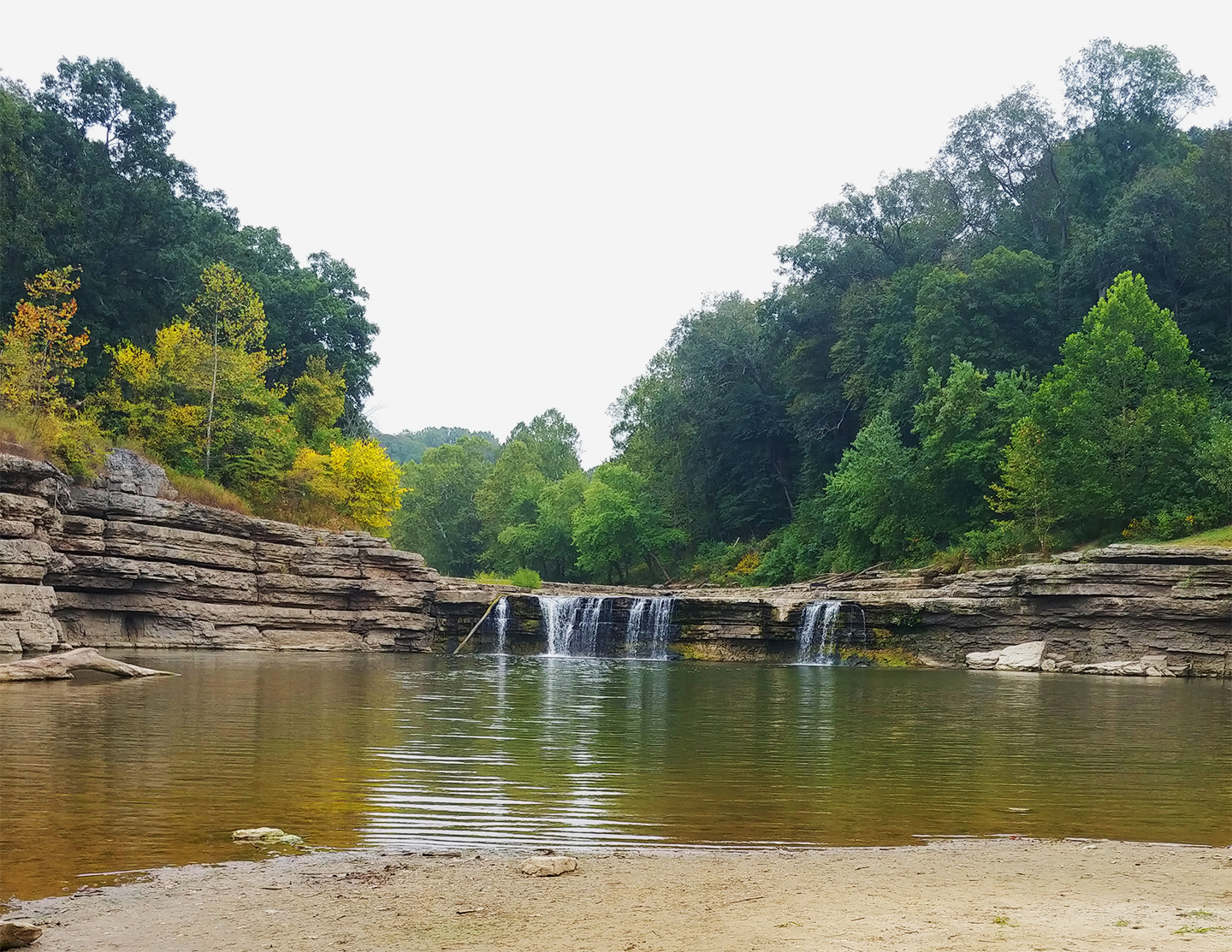
By then Mill Creek has spent its spring budget. The falls that come over the ledge in April as one continuous brown roar — a genuinely alarming amount of water, the kind that makes you take one respectful step backward — have relaxed into a handful of white ribbons, each one picking its own notch in the rock and minding its own business. The pool goes glassy. The sandbar below, which spends half the year underwater, spreads out wide and dry, and you can walk right down to the edge and stand there with the whole stone amphitheater to yourself.
And it is an amphitheater. That’s the part the swimmers never look at. The falls pour over layered ledges of rock stacked like a pallet of patio pavers assembled by someone with 340 million years and no deadline. Shelf after shelf, each one a former sea floor, curving around the pool on both sides. The creek carved the whole arrangement one flood at a time and is still at it, on a schedule that makes geologists happy and would get anyone else fired.
The first yellow always shows up early on one bank — a few overachieving trees turning while everything around them is still committed to green. That’s the version of the place I keep in my head: low water, glassy pool, green going gold at the edges, and a silence deep enough that you can hear individual ribbons of the falls arguing with individual rocks.
The visitors thin down to the specialists. A fisherman. A photographer. An older couple who clearly figured all this out decades ago and are politely not telling anyone. Nobody swims. Nobody hollers. The falls just run, the way they ran before any of us and the way they’ll run after, which is either humbling or relaxing depending on what kind of week you’re having. For me it was always relaxing. The rock is older than your problems. The creek does not care about your schedule. There’s real comfort in being that thoroughly ignored.
Lower Cataract is the smaller half of Indiana’s largest waterfall system by volume, and its reputation runs on spring, when the big water puts on the big show. I’ll take the off-season every time. A waterfall in September has stopped performing and gone back to just being — and it turns out that’s when it’s worth watching.
Go on a weekday after the buses start running. Bring nothing. Stay past the point where staying makes sense.
The falls don’t keep office hours. Best thing about them.