The Big Beautiful Bill, One Year Later
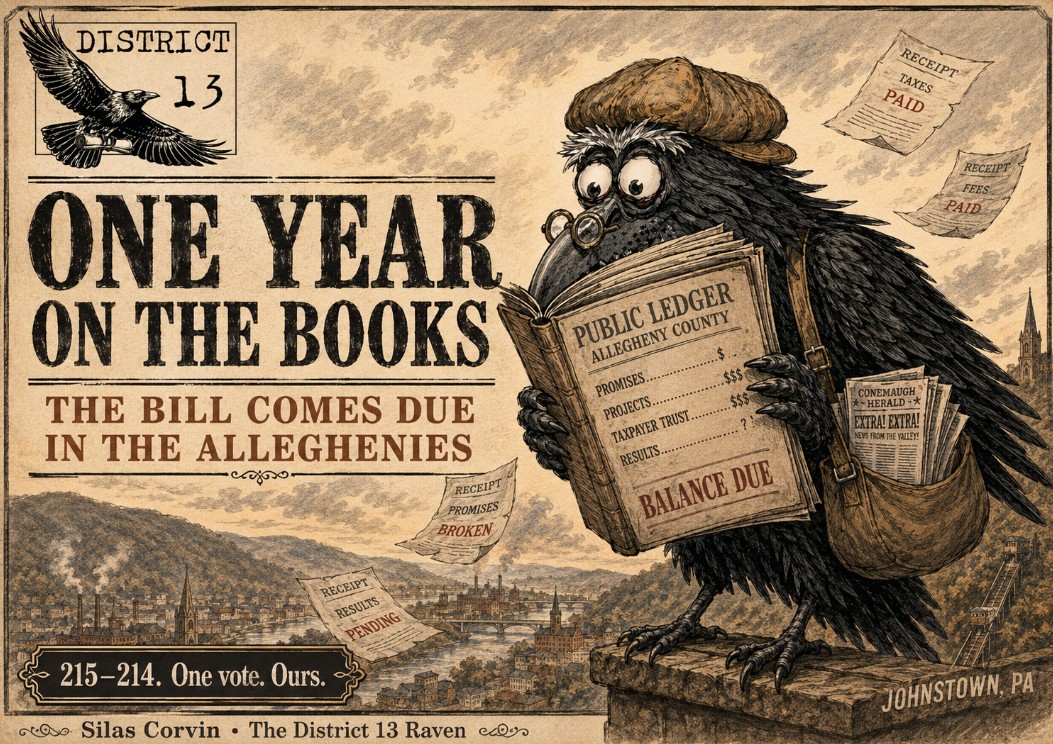
ONE YEAR ON THE BOOKS: THE BILL COMES DUE IN THE ALLEGHENIES
This bird keeps a ledger. Been keeping it since July 4, 2025, the day they signed the One Big Beautiful Bill into law. One year now. Time to read it back.
Start with the arithmetic they’d rather you forget. The House passed that bill 215 to 214. One vote. Any single congressman could have stopped it cold. District 13 sent one of the 215. John Joyce. A doctor, mind you. Put that in your notebook and underline it, because everything below flows from it.
THE HOSPITALS
Here’s what a year bought us. Three million Pennsylvanians — 23 percent of the state — carry Medicaid. More than 737,000 of them live in rural counties, which is a polite way of saying counties like ours. Harrisburg’s own accountants figure the state loses about $20 billion in federal Medicaid money over ten years starting in 2028. WESAWESA
State health officials say about 25 rural Pennsylvania hospitals could close in the next several years because of it. The hospital association ran its own numbers: a dozen more facilities gone in five years without help. Fewer than half of Pennsylvania’s hospitals have the margins to survive long-term. Their word for what’s at risk: access. Montgomery County PAWESA
In this district that word has an address. Conemaugh. Biggest employer in Cambria County, 2,457 paychecks, and it runs on Medicaid reimbursement. Rural hospitals here already eat a loss of 26 cents on every Medicaid dollar. Cut the reimbursement and you’re not trimming a program — you’re taking a hacksaw to the county’s payroll.
And when a rural hospital can’t make the math work, it doesn’t announce bankruptcy. It goes quiet one department at a time. Services get cut, and patients get longer drives and longer waits. Franklin County already knows the tune — no pediatric admissions at Chambersburg since 2023. Kids ride to another county or across the Maryland line. In Bedford and Huntingdon the nearest ER can be a 45-minute proposition on a good night. The bill didn’t invent that problem. It poured concrete on it. Spotlight PA
THE CONSOLATION PRIZE
Washington heard the squawking and tossed back a “Rural Health Transformation” fund. Sounds grand. Read the fine print like this old crow did. Pennsylvania asked for $200 million the first year and got $193 million. Direct payments to providers are capped at 15 percent of the money — and the funds explicitly can’t be used to stabilize rural hospitals. The state’s own Medicaid agency says the dollars won’t fill the gap. One national health foundation adviser called the whole program a consolation prize. The bookkeepers at KFF figure the average rural American sees $157 in benefit from it. Rural Pennsylvanians: $78 a head. Half a consolation prize. Northcentral Pennsylvania + 3
THE PREMIUMS
Now the part that hits the folks who never took a nickel of Medicaid. The bill’s authors let the enhanced ACA tax credits die, and die they did on January 1, 2026 — after a 43-day government shutdown fought over exactly that, which ended without an extension. PhillyVoice
The receipts came due fast. Pennie — the state’s own insurance marketplace — reports average premiums up 102 percent for 2026. Doubled. Nearly one in five enrollees dropped their coverage rather than pay it. By June, enrollment was down 160,000 from last year — roughly a third of everybody who had a plan in 2025, gone. The state exchange director gave an example: a 60-year-old couple paying $500 or $600 a month in 2025 now looking at $2,000 to $3,000. Pennie’s own words: families are choosing between health coverage and rent, food, and utilities. ACA Signups + 4
Who buys on Pennie out here? Farmers. Self-employed. Small shop owners. The people who were told this bill would stop a tax hike. Their insurance bill doubled instead. Call it whatever you like — this bird calls it a tax with worse paperwork.
THE GROCERIES
The ledger’s got a food column too. Two million Pennsylvanians use SNAP — more than 713,000 children, 697,000 seniors. The bill wrote new work requirements: adults now have to document 20 hours a week, and the requirement now runs up to age 65, with the exemption for parents cut off once a kid turns 14. The state figures around 144,000 Pennsylvanians stand to lose benefits — many not because they stopped qualifying, but because they can’t get the right piece of paper processed at the right time. The Pew Charitable Trusts + 4
And every dollar of it drains out of local registers. Grocery stores, farm markets, the trucker hauling to both. SNAP puts nine meals on the table for every one meal a food bank manages. The pantries in this district were already stretched when the shutdown froze benefits last November and the lines went around the block. There’s no charity operation in the Alleghenies that can multiply loaves times nine. Community Legal Services
One more entry: the bill shoves costs onto Harrisburg — an estimated $810 million a year in new state SNAP costs once the phase-in lands, money the governor says the state doesn’t have. Which means the next cut comes with a Pennsylvania postmark, but it was mailed from Washington. Times Leader
THE BOTTOM LINE
One year. Hospitals on the brink, a relief fund that can’t legally relieve them, insurance premiums doubled, a third of the marketplace walked away, food assistance tangled in paperwork designed to fail, and the state left holding a bill it can’t pay.
215 to 214.
One vote. Ours.
The gentleman from District 13 called it a bill to strengthen Medicaid. This bird’s been watching the Alleghenies a long time. Knows the difference between strengthening something and picking it clean.
Dr. John Joyce is hurting our Congressional District. The Voters can stop him.
ONE YEAR ON THE BOOKS: THE BILL COMES DUE IN THE ALLEGHENIES
This bird keeps a ledger. Been keeping it since July 4, 2025, the day they signed the One Big Beautiful Bill into law. One year now. Time to read it back.
Start with the arithmetic they’d rather you forget. The House passed that bill 215 to 214. One vote. Any single congressman could have stopped it cold. District 13 sent one of the 215. John Joyce. A doctor, mind you. Put that in your notebook and underline it, because everything below flows from it.
THE HOSPITALS
Here’s what a year bought us. Three million Pennsylvanians — 23 percent of the state — carry Medicaid. More than 737,000 of them live in rural counties, which is a polite way of saying counties like ours. Harrisburg’s own accountants figure the state loses about $20 billion in federal Medicaid money over ten years starting in 2028. WESAWESA
State health officials say about 25 rural Pennsylvania hospitals could close in the next several years because of it. The hospital association ran its own numbers: a dozen more facilities gone in five years without help. Fewer than half of Pennsylvania’s hospitals have the margins to survive long-term. Their word for what’s at risk: access. Montgomery County PAWESA
In this district that word has an address. Conemaugh. Biggest employer in Cambria County, 2,457 paychecks, and it runs on Medicaid reimbursement. Rural hospitals here already eat a loss of 26 cents on every Medicaid dollar. Cut the reimbursement and you’re not trimming a program — you’re taking a hacksaw to the county’s payroll.
And when a rural hospital can’t make the math work, it doesn’t announce bankruptcy. It goes quiet one department at a time. Services get cut, and patients get longer drives and longer waits. Franklin County already knows the tune — no pediatric admissions at Chambersburg since 2023. Kids ride to another county or across the Maryland line. In Bedford and Huntingdon the nearest ER can be a 45-minute proposition on a good night. The bill didn’t invent that problem. It poured concrete on it. Spotlight PA
THE CONSOLATION PRIZE
Washington heard the squawking and tossed back a “Rural Health Transformation” fund. Sounds grand. Read the fine print like this old crow did. Pennsylvania asked for $200 million the first year and got $193 million. Direct payments to providers are capped at 15 percent of the money — and the funds explicitly can’t be used to stabilize rural hospitals. The state’s own Medicaid agency says the dollars won’t fill the gap. One national health foundation adviser called the whole program a consolation prize. The bookkeepers at KFF figure the average rural American sees $157 in benefit from it. Rural Pennsylvanians: $78 a head. Half a consolation prize. Northcentral Pennsylvania + 3
THE PREMIUMS
Now the part that hits the folks who never took a nickel of Medicaid. The bill’s authors let the enhanced ACA tax credits die, and die they did on January 1, 2026 — after a 43-day government shutdown fought over exactly that, which ended without an extension. PhillyVoice
The receipts came due fast. Pennie — the state’s own insurance marketplace — reports average premiums up 102 percent for 2026. Doubled. Nearly one in five enrollees dropped their coverage rather than pay it. By June, enrollment was down 160,000 from last year — roughly a third of everybody who had a plan in 2025, gone. The state exchange director gave an example: a 60-year-old couple paying $500 or $600 a month in 2025 now looking at $2,000 to $3,000. Pennie’s own words: families are choosing between health coverage and rent, food, and utilities. ACA Signups + 4
Who buys on Pennie out here? Farmers. Self-employed. Small shop owners. The people who were told this bill would stop a tax hike. Their insurance bill doubled instead. Call it whatever you like — this bird calls it a tax with worse paperwork.
THE GROCERIES
The ledger’s got a food column too. Two million Pennsylvanians use SNAP — more than 713,000 children, 697,000 seniors. The bill wrote new work requirements: adults now have to document 20 hours a week, and the requirement now runs up to age 65, with the exemption for parents cut off once a kid turns 14. The state figures around 144,000 Pennsylvanians stand to lose benefits — many not because they stopped qualifying, but because they can’t get the right piece of paper processed at the right time. The Pew Charitable Trusts + 4
And every dollar of it drains out of local registers. Grocery stores, farm markets, the trucker hauling to both. SNAP puts nine meals on the table for every one meal a food bank manages. The pantries in this district were already stretched when the shutdown froze benefits last November and the lines went around the block. There’s no charity operation in the Alleghenies that can multiply loaves times nine. Community Legal Services
One more entry: the bill shoves costs onto Harrisburg — an estimated $810 million a year in new state SNAP costs once the phase-in lands, money the governor says the state doesn’t have. Which means the next cut comes with a Pennsylvania postmark, but it was mailed from Washington. Times Leader
THE BOTTOM LINE
One year. Hospitals on the brink, a relief fund that can’t legally relieve them, insurance premiums doubled, a third of the marketplace walked away, food assistance tangled in paperwork designed to fail, and the state left holding a bill it can’t pay.
215 to 214.
One vote. Ours.
The gentleman from District 13 called it a bill to strengthen Medicaid. This bird’s been watching the Alleghenies a long time. Knows the difference between strengthening something and picking it clean.
Dr. John Joyce is hurting our Congressional District. The Voters can stop him.