The River Refugium Project: A Complete Reader’s Map
Everything we’ve published on nutrient pollution, aquaponics, and the River Refugium Project — organized so you can actually follow it.
We’ve been building the River Refugium Project in public for years now, one article at a time. The upside of that is that nothing is locked in a proposal waiting for funding — it’s all readable, right now, for free. The downside is that “read all of it in publication order” is a bad way to understand it. New readers land in the middle of a conversation that’s been running since 2024.
This is the fix. One page, both sites, arranged the way the idea actually builds.
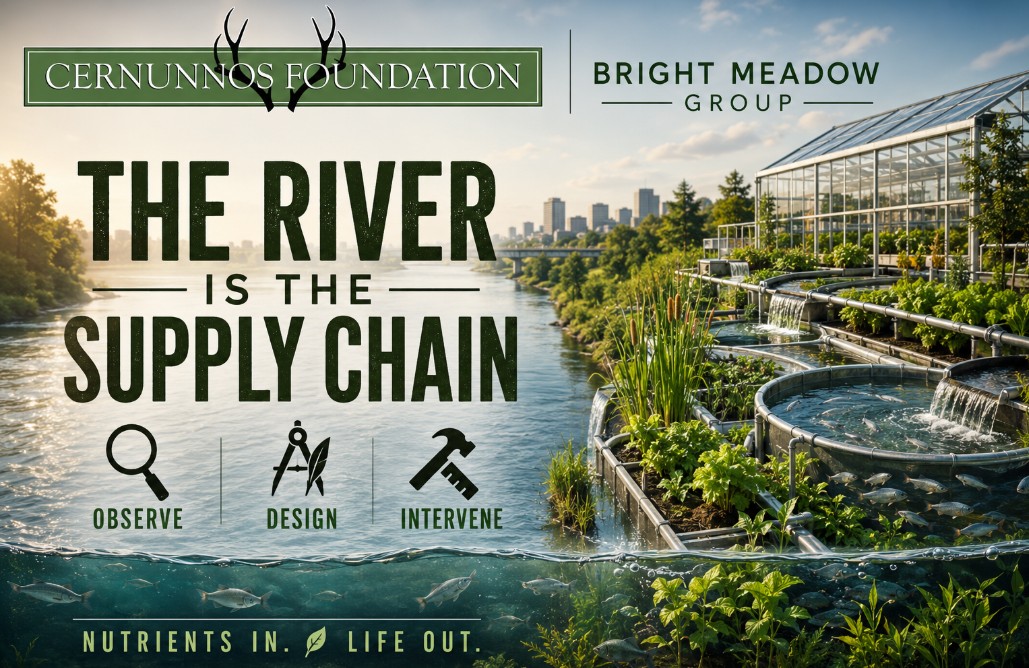
The short version: rivers carry enormous loads of dissolved nitrogen and phosphorus — fertilizer runoff, treated sewage, industrial discharge. When that nutrient load hits the sea, it feeds algae blooms that rot, strip the oxygen out of the water, and create dead zones where nothing can live. Everyone treats those nutrients as pollution. We treat them as feedstock. Run the river’s nutrient load through engineered aquaponic and wetland systems and it becomes food, soil, biomass, and clean water on the way out — plus fuel and industrial feedstock through thermochemical processing. The river stops being a waste stream and becomes a supply chain.
How the two sites divide the work:
- cernunnosfoundation.com/rrp is the standing index and archive — the foundational explainers, the original dead-zone series, and the official document suite (whitepaper, Version 2.0, flow chart, asset updates).
- The Blue Ribbon Team Aquaponics feed is where the working publication happens — new systems examples, operator briefs, applied case studies, and the Bright Meadow Group design notes get published here first.
If you only read three things to start: River Refugium Project – simplified, then The Loop That Feeds You, then The River Is the Supply Chain for the current v2.0 framing.
1. Start Here — The On-Ramps
Plain-language introductions. Read these first if the project is new to you.
- River Refugium Project – simplified — the cleanest one-sitting explanation.
- Introducing the River Refugium Project — the Bright Meadow Group overview.
- The River Refugium Project — the original foundation statement.
- What if I told you? — the reframe in one move: pollution is a resource in the wrong place.
- “just” Aquaponics — why this is more than backyard fish-and-lettuce.
2. The Problem — Dead Zones and Why They Matter
What we’re actually trying to solve, and why it should matter to you even if you never see the Gulf.
- Explaining Dead Zones — the mechanism, start to finish.
- 2024: The Dead Zone — the year’s numbers.
- Gulf of Mexico Dead Zone is basically New Jersey — scale, made tangible.
- Arkansas and the Gulf Dead Zone — how far upstream the cause reaches.
- TOP 100 pollutants in Mississippi River — what’s actually in the water.
- Selfish reasons the Dead Zone matters — the case for people who don’t care about ecology on principle.
- Lake Erie’s Green Slick — the same problem in a freshwater lake, closer to home.
3. How It Works — The Science and the Core Mechanism
The engine of the whole project. This is where the aquaponics fundamentals live.
- Lessons from the Aquarium – The Nitrogen Cycle — the biology everything else rests on.
- The Refugium — the part of aquaponics most systems get wrong, and the concept the project is named for.
- Reconsidering Aquaponics — scaling the idea from tank to river.
- River Refugium Flow Chart — the whole system on one page.
- The Evaporation Greenhouse — the greenhouse component explained.
- Cleaner rivers mean smaller dead zones — connecting the treatment to the outcome.
- River water = algae = fuel — the thermochemical / HTC side: nutrients into biofuel.
- Using COTTON to fix the environment — an unexpected filtration crop.
The “Fixing the Dead Zones” build-out series
The original step-by-step construction of the argument. Read in order:
- Fixing the Gulf of Mexico dead zone (the origin) → Part 2 → Part 3 → Part 4 → Part 5 → Part 6 → Part 7 → Part 8.
4. The Official Documents — Version 2.0 and the Full Suite
The formal framework. If you’re an evaluator, engineer, or partner, this is the material to pull.
- The River Is the Supply Chain — introduces the RRP Operator Brief and releases Version 2.0.
- River Refugium Project — Version 2.0 Release & Development Update
- River Refugium Project V2 Update
- River Refugium Project – Whitepaper — the official document.
- RRP Early Feedback Q&A — the RRP0002 supplement answering technical, financial, and operational questions.
- Asset Update: River Refugium Project — where the document suite stands.
5. Applications — Where This Actually Gets Built
The project isn’t one facility. It’s a pattern that fits many sites. Each of these is a worked example.
- The Loop That Feeds You — a fish tank, a room of bacteria, and living soil producing food twelve months a year.
- Fish Farming Solutions — lifting the invisible constraint every fish pond runs into.
- Expanding the Margins of Pond Production — a greenhouse wetland loop on a 2-acre pond (BMG systems example).
- Your Neighborhood Pond is GROSS! — turning a retention pond into a production system.
- Low Nutrient Polluted Water Solution — the Orange Creek problem: RRP applied to acid mine drainage.
- RRP is not just for rivers — reservoirs and other still water.
- Real Farm to Restaurant — the loop as a farm-restaurant-television format.
- Making waste water ready… — the intake/pre-treatment stage.
- Talking sh!t — sewage as a legitimate feedstock, said plainly.
- RRP Example Project — a concrete proposed site.
- A proposal for clean water — an early full write-up.
- Learning from Swamps — letting the bayou teach the design.
- Thoughts on natural landscaping — cutting nutrient runoff at the source.
- Everything has a season. Let’s use them. — designing with natural cycles.
6. The Economic Case
For readers who need the money to make sense before the ecology does.
- Money flowing in the River — how cleaning rivers generates real value.
- Another Capitalist Argument — the nutrients wasted in the Gulf, priced out.
- Another RRP business model — a different revenue configuration.
- Fighting Dirty (pollution) — the biofuel angle for an oil importer.
- River Refugium Project Grant — the funding question, taken seriously.
7. Global Reach and Crisis Response
The framework scaled up and stress-tested against real emergencies.
- River Refugium Project – Global Edition — nutrient pollution into energy, ecology, and opportunity, worldwide.
- When the Supply Chain Breaks, the Soil Remembers — the duckweed-chicken-compost loop as fertilizer independence during a supply shock.
- Aquaculture Musings — design notes from the weedy end of the lake.
- Reimagining the Mississippi River Valley — the whole-valley thought experiment.
- THE RIVER OF WASTE — why America must stop discarding its industrial future (RRP series lead).
8. Local — Johnstown and the Conemaugh Valley
The project applied to home ground.
- Rivers of the World Aquarium and Conemaugh Conservatory — a proposal for an attraction Johnstown doesn’t have yet.
9. Why We Give It Away — The Philosophy
The part that explains the rest: why every bit of this is public.
- Why are you giving it away? — old men planting trees whose shade they’ll never sit in.
- The Third Ethic — why permaculture’s founding principles require technology, not refusal (Cernunnos Foundation position paper).
- We Can Fix This — So Let’s Get In It — the working stance.
- Earth or Mars? Nah, it’s AND. — fixing this planet is not a lesser ambition.
- The City on the Hill We Build Together — the larger vision.
- Where did the idea come from? — the origin story.
10. Get In It — Test, Fund, Discuss
The project only works if people pick it up and run with it.
- Prove the Fix – RRP — a direct call to farmers, pond owners, tinkerers, DNR shops, and university labs to run tests.
- The World’s Greatest Kibitzer — a note from the desk for anyone whose build got stuck.
- Help shrink the dead zone! — how to pitch in.
- Cernunnos Foundation Forum — where the conversation continues.
The River Refugium Project is an open-source aquaponic soil-generation and ecological-restoration framework. Full documentation lives across the Cernunnos Foundation and Blue Ribbon Team websites. Take it. Test it. Build it. That’s the whole point.