Fair Winds, Old Girl: Saying Goodbye to USS Nimitz (CVN-68)
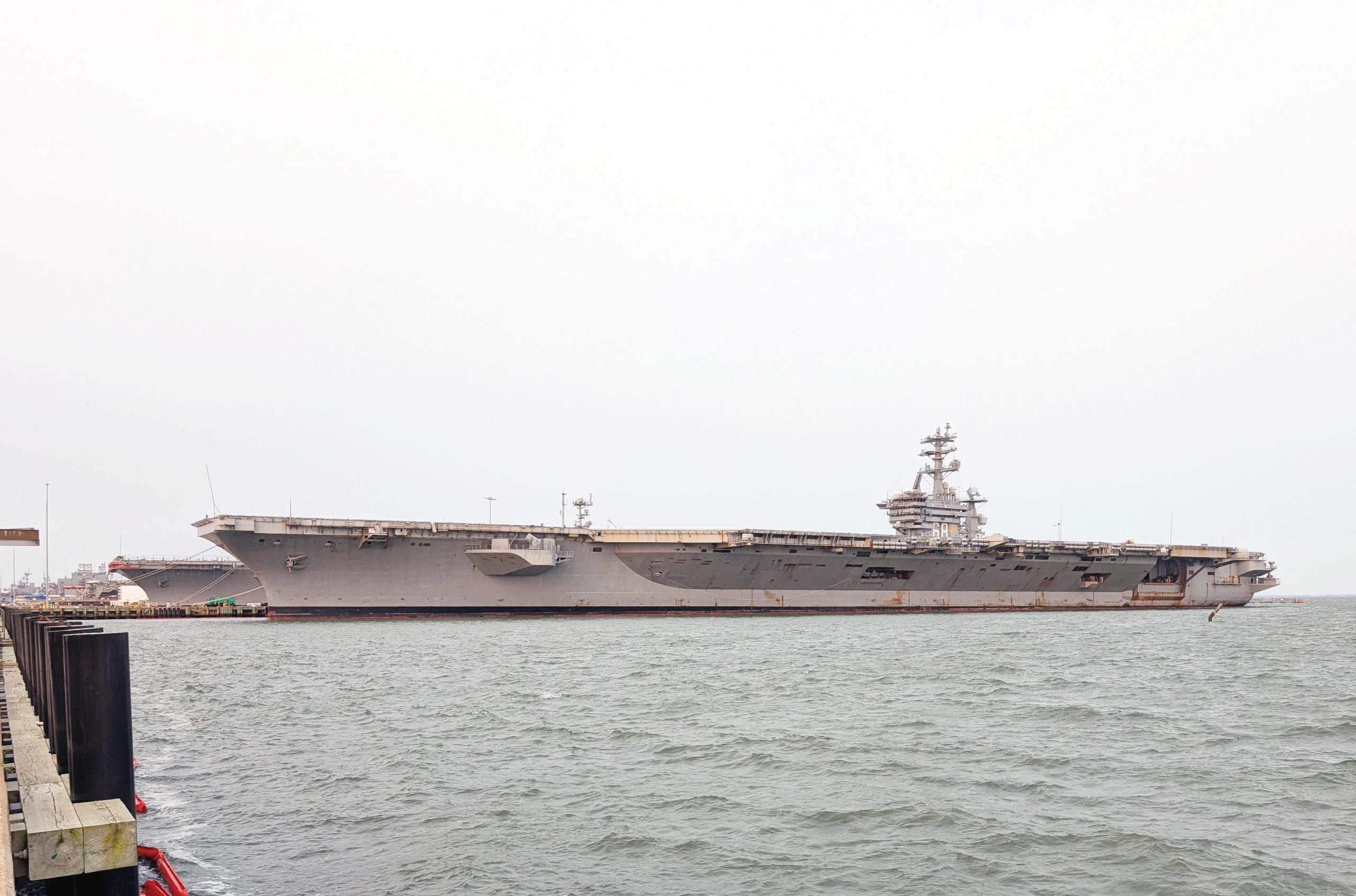
The photograph doesn’t flatter her, and that’s the point. This is USS Nimitz at a Norfolk pier on a gray day in July 2026, hull streaked with rust, flight deck empty, fifty-one years of ocean behind her and a scrapyard’s patience ahead. Man Made honors the geometry that holds us up, and there has never been a bolder piece of geometry than this one: 1,092 feet of welded steel, roughly 100,000 tons displaced, two A4W nuclear reactors driving four shafts, a floating city that housed over five thousand people and threw seventy aircraft into the sky on demand. She was the largest warship on Earth when she was commissioned, and the class she fathered held that title for four decades.
I know her personally. I served aboard her from July 1993 to July 1994, and I will tell you plainly she was my most hated command. That admission and this tribute live comfortably in the same paragraph, because hating a duty station and respecting a machine are two different issues. She was a fine system of machines and humans — the machines rarely failed, and the humans followed orders.
Her story starts where it ends. She was commissioned at Norfolk on May 3, 1975, first of her class, named for the fleet admiral who ran the Pacific war during World War II. Her first Mediterranean deployment came in 1976. In April 1980 she was the launch platform for Operation Eagle Claw, the attempt to rescue the hostages in Tehran — the mission failed in the desert, but the helicopters flew off her deck. In August 1981 her F-14 Tomcats shot down two Libyan Su-22s over the Gulf of Sidra in the first air-to-air engagement by American forces since Vietnam. That same year she suffered one of the worst flight deck accidents of the modern era, when an EA-6B Prowler crashed on landing and killed fourteen sailors — a reminder that the most dangerous four and a half acres in the world earned the title honestly. Hollywood even borrowed her for The Final Countdown in 1980, sending her back in time to Pearl Harbor, which remains the only deployment she ever got to skip the paperwork on.
In 1987 she rounded South America to take up station on the West Coast, and the Pacific became her ocean for most of the rest of her life. The early nineties were the grind years — post-Desert Storm patrols, Persian Gulf rotations enforcing the no-fly zone over southern Iraq. That was my Nimitz: Operation Southern Watch, endless flight ops, endless watches, a young Radioman finishing his 4 year stint, first in the Persian Gulf followed by six months in the yards. In 1996 she made history again, leading her battle group through the Taiwan Strait during the missile crisis — the first American carrier transit of that water in two decades, a statement written in tonnage.
From 1998 to 2001 she went into Newport News for the first refueling and complex overhaul ever performed on her class, essentially a rebirth at midlife. She came out the other side into a different world. After September 11th she cycled through the long wars: Iraqi Freedom in 2003, repeated Fifth Fleet deployments, strikes against ISIS in 2017, a standoff posture off Syria in 2013. In 2020 she absorbed the pandemic’s cruelest assignment (now overshadowed ny the nightmare of the Lincoln, being kept at sea for a full year for political decisions)— a deployment stretched past ten months with almost no port calls, the longest carrier deployment since the Vietnam era, her crew sealed inside their steel city while the world outside shut down.
Her final combat deployment ran nine months through 2025, covering the 3rd, 5th and 7th Fleets and, in her captain’s words, more than two-thirds of the planet — including a summer sprint to the Middle East when the region caught fire. Then came the farewell lap. In March 2026 she left Bremerton for the last time, bound for Norfolk the long way, circumnavigating South America on the Southern Seas 2026 deployment. In late June she anchored a twenty-six-ship, fourteen-nation formation off the Carolina coast for FLEETEX 250, and she sailed into New York Harbor for the International Naval Review during the nation’s 250th, her sailors spelling out “I ♥ NY” on the flight deck as she departed. She tied off the loop in July, returning to the same Norfolk waterfront where she was commissioned fifty-one years earlier. The Navy has extended her service life to March 2027, after which Newport News will spend the better part of a decade defueling her reactors and taking her apart.
I went down to say goodbye. A great friend of mine served aboard her the same year I did, and we stood on the pier together and looked at her the way you look at an old boss at a funeral — complicated, but present. And here I have to put the crew on report: she’d been back in port less than a week when we visited, and that hull was already wearing more rust than a first-in-class lady deserves for her final receiving line. Half the fleet has scraped and painted that hull. She has one last stretch of pier-side dignity coming to her, and needle guns are cheap. Square her away.
Fifty years is the design life they gave her in 1975, and she beat it. She carried presidents’ messages, launched rescue attempts, fought air battles, kept sea lanes open, sat off hostile coasts as a hundred-thousand-ton argument for calm, and trained generations of sailors — including one who cursed her daily and drove hours decades later just to see her one more time. That is the mark of a great machine: it earns your respect whether you offer it or not.
So unless she pulls a KISS and books a dozen farewell reunions, this is it. Rest well, old girl. Others have the watch.