Grid Stability with Salt: The Case for Distributed Sodium-Ion Storage
A Bright Meadow Group Concept Paper
The Premise
The American grid has a timing problem. Generation happens when it happens. Demand happens when it happens. The two rarely agree, and the entire architecture of the grid — every conductor, every transformer, every substation — is sized for the worst few hours of disagreement per year. We build for the peak and idle through the valley. That is an extraordinarily expensive way to move electrons, and the bill for it is written in copper, aluminum, silver, and steel.
There is now a battery chemistry cheap enough, safe enough, and abundant enough to change that math. It is made of salt.
Observe: What the Grid Actually Costs
Transmission and distribution infrastructure is metal-intensive by nature. Conductors are sized for peak current, and peak current is a function of the highest simultaneous demand the line will ever see. A line that carries its maximum load for forty hours a year is built, purchased, and maintained at forty-hours-a-year specifications for all 8,760 of them. Meanwhile copper trades at historically elevated prices, aluminum follows, and the specialty metals in switchgear and transformers face procurement backlogs measured in years. Every utility in the country is waiting on transformers.
At the same time, demand is climbing at a pace the grid has not seen in a generation. Data centers are hammering regional grids, electrified heating is spreading, and industrial reshoring is adding load whether the wires are ready or not.
The conventional answer is to build bigger wires. The better answer is to make the wires we have work harder.
Observe also what has happened to battery chemistry while the transmission planning offices were busy with conductor studies. CATL — the world’s largest battery manufacturer — unveiled Naxtra, the first mass-produced sodium-ion battery, in April 2025, and the rollout since then has been relentless. By February 2026 the first mass-production sodium-ion passenger vehicle was unveiled with Changan, headed for market by mid-year. CATL’s December 2025 supplier roadmap named four sodium deployment fronts for 2026 — battery swapping, passenger vehicles, commercial vehicles, and energy storage — and the company has since introduced the first sodium-ion battery purpose-built for grid-scale storage, targeted for commercial deployment before the end of 2026. The grid unit’s specifications: roughly 160 Wh/kg, 97% round-trip system efficiency, an operating window from –40°C to 70°C, and a cycle life exceeding 15,000 charge-discharge cycles while retaining 80% capacity.
Read that last number again. Fifteen thousand cycles. A lithium iron phosphate cell is respectable at half that. A grid asset that cycles daily for four decades without replacement is a battery in name only. It is infrastructure.
The economics follow the chemistry. Sodium is the sixth most abundant element in the earth’s crust. There is no sodium cartel, no brine geopolitics, no mine permitting fight on another continent. Sodium-ion cells already price significantly below their lithium equivalents, and with lithium costs rising again the gap is widening in sodium’s favor. The chemistry is also intrinsically safer — sodium cells tolerate abuse, temperature extremes, and full discharge in ways lithium chemistries never will, which matters enormously when the proposal is to park megawatt-hours inside populated service territories. A storage facility the volunteer fire department can drive past without a hazmat plan is a facility that clears zoning.
And this is no longer a Chinese-only story. Peak Energy has announced America’s first factory dedicated entirely to grid-scale sodium-ion storage: a $71 million, 183,000-square-foot plant at Sacramento’s Metro Air Park, supported by a $10.5 million CalCompetes tax credit, expected to create roughly 240 jobs and produce up to 4 GWh of battery systems annually — enough to supply around four million households — with first shipments in the first quarter of 2027. The order book is the tell: more than 6 GWh already under contract from industrial buyers before the factory exists, roughly a year and a half of full production sold in advance. This follows the company’s August 2025 pilot, which connected a sodium-ion pyrophosphate system directly to the American grid — the largest operational deployment of that chemistry anywhere — and a 3.5 MWh installation in Watkins, Colorado, one of the country’s biggest sodium-ion systems, with further projects lined up with RWE Americas, Jupiter Power, and Energy Vault for AI data center storage.
Two of Peak’s design claims deserve particular attention. The company states its systems cut the cost of energy storage by 20% and carry a 99% guaranteed uptime. And the systems are passively cooled — no fans, no liquid pumps, no mechanical cooling components of any kind. Consider what that means for an installation sitting in a field for twenty years. Fans fail. Pumps leak. Every moving part is a maintenance invoice waiting for its date. Strip them all out and long-term operating cost collapses along with the failure modes. Passive thermal design is only possible because sodium chemistry runs cool and tolerates heat; it is the safety advantage converted directly into an economic one.
Design: Storage as Capacitance
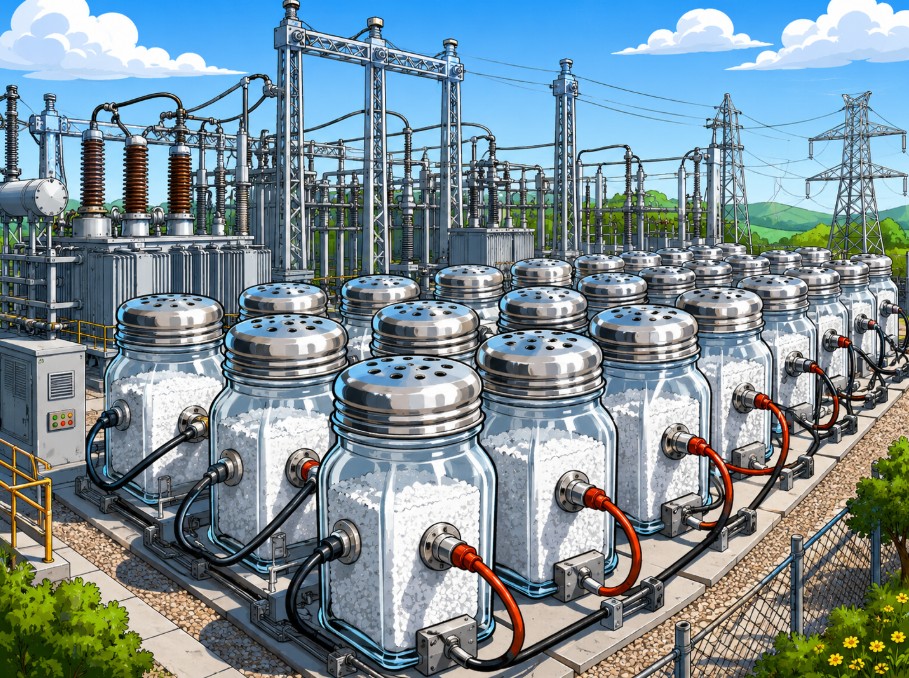
Here is the design insight, and it is the whole paper: distributed sodium-ion storage facilities, sited at substations and along distribution corridors, function as capacitance for the grid.
In an electronic circuit, a capacitor sits near the load and smooths the difference between what the supply delivers and what the load demands, moment to moment. The supply line can then be sized for average draw rather than instantaneous peak. Every competent circuit designer does this reflexively. The grid, astonishingly, mostly does not.
Place cheap, safe, long-cycle storage at the regional and neighborhood level and the transmission line feeding that region no longer has to carry the peak. It carries the average. The storage node absorbs energy during valley hours and discharges through the peak, and the line between generation and load runs at steady, constant flow near its efficient operating point around the clock.
The consequences cascade.
A line sized for average flow instead of peak flow is a smaller line. Smaller conductor, less copper and aluminum, lighter towers, narrower right-of-way. In existing territory, the lines already in the ground gain effective capacity without a single trench being dug — the storage node is the upgrade. Utilities call this class of solution a non-wires alternative. Sodium-ion at commodity pricing turns it from a boutique option into the default.
Constant flow is stable flow. Frequency regulation, voltage support, ramping reserve — the ancillary services that keep the grid from wobbling — are precisely what fast-responding distributed storage provides best. Every node is simultaneously an energy asset and a stability asset, stacked revenue on the same steel rack.
Redundancy comes free. A region with a charged storage node rides through an upstream fault the way a laptop rides through a flicker of the lights. Islands of stored energy, distributed across the network, give the grid shock absorbers it has never had.
And the chemistry match is exact. Grid storage does not care about energy density — the facility is a building, and buildings do not need to be light. Grid storage cares about cost per cycle, calendar life, safety, temperature tolerance, and maintenance burden. Those are the five categories where sodium wins outright and lithium’s advantages evaporate. Ninety percent of humanity lives in the sun belt; cheap sodium soaking up cheap midday solar and returning it at night is the base-case future of the grid on most of the planet. On pure economics — no ideology required — renewables paired with storage of this kind outcompetes everything else on the menu.
Intervene: What Should Be Built
First, utilities and grid operators should treat sodium-ion storage nodes as the default alternative in every transmission and distribution upgrade study currently on the books. The question in each interconnection queue and each conductor-replacement proposal: does a storage node at the load end beat new metal in the ground on lifetime cost? At current and projected sodium pricing — cells cheaper than lithium, 15,000-cycle lifespans, passively cooled systems with no moving parts to service — the answer will increasingly be yes.
Second, state regulators should establish rate treatment that lets distribution utilities own or contract storage-as-wires. The current regulatory model rewards capital spent on conductor and penalizes the cheaper solution. Fix the incentive and deployment follows.
Third, regions with aging industrial grid infrastructure — and Pennsylvania knows something about those — should recognize what they are holding. Legacy substations, brownfield acreage with existing interconnection, rail access, and industrial zoning are precisely where storage nodes want to live. A community that hosts one hosts grid stability, local resilience, tax base, and permanent skilled positions, all inside a building with no smokestack, no water draw, no rotating machinery, and no fire risk worth the name.
The metals crisis in grid buildout is real, and it will not be mined away on any useful timeline. But the constraint was never really copper. The constraint was our insistence on moving every electron the instant it was generated. Store it in salt near where it is needed, run the wires steady, and the grid we already own grows larger without adding an inch of line.