On endurance, entropy, and the strange peace of knowing you will lose.
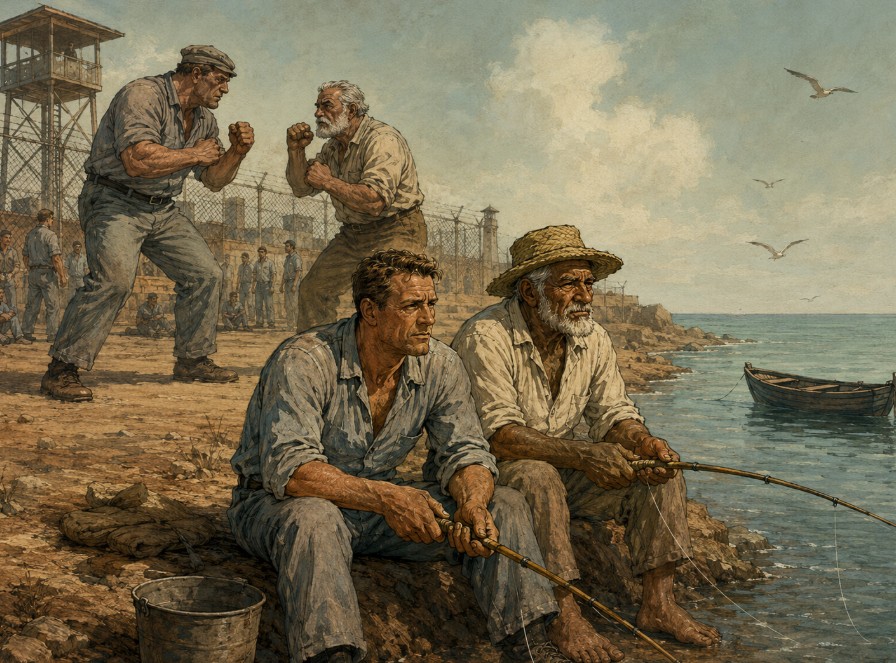
My favorite book and my favorite movie are the same story. On the surface that claim looks absurd. The Old Man and the Sea is a Cuban fisherman alone in a skiff, eighty-four days without a catch, hands cut to ribbons on a line. Cool Hand Luke is a Florida chain gang, a fifty egg bet, and a man who keeps getting up when everyone in the yard is begging him to stay down. One story is water and sky and silence. The other is dust, fences, and a captain with mirrored sunglasses explaining what we have here.
The critics have both stories mapped, and the maps are good ones. Luke was written as a Christ figure and the film barely hides it — the crucifixion pose on the table after the egg bet, the disciples in the bunkhouse, the betrayals, the death that turns into legend. Hemingway, for his part, gave us Sisyphus with a fishing line: the task that consumes everything and delivers nothing, taken up again anyway. I know those readings. I’m not arguing with them. But when I sit with these two stories, let my mind go quiet, set the ego down, and ask the question they’re both actually asking — what is the point? — I come out somewhere else.
The point is the struggle. Full stop. The struggle itself is the point.
Start with what the two men are up against, because structurally it’s the same opponent. Santiago faces the sea; Luke faces the institution. Neither adversary hates them. The sea doesn’t reward Santiago’s forty years of skill or punish his pride — it produces a marlin and then it produces sharks, by the same indifferent process. The camp doesn’t hate Luke either, whatever the bosses feel personally. It’s a machine for producing compliance, and it grinds toward that output the way water runs downhill. Both men are competent. Santiago is a master of his craft; Luke reads every system he’s dropped into and beats most of them. They don’t lose through ignorance or weakness. They lose because the thing they’re engaged with is the struggle of life itself.
And they do lose. This matters. Santiago rows home lashed to a skeleton. Luke dies in the back of a state car while the man with no eyes watches. Neither story blinks at the end or slips its hero a consolation prize. If meaning depended on outcome, both stories would be arguments for despair.
They’re the opposite of that, and here is where the readings I inherited stopped short for me. The Christ allegory says Luke’s death purchases something — redemption, myth, the story Dragline tells with that beautiful smile on his face. The Sisyphus reading says we must imagine Santiago happy, that the scorn of the rock is enough. Both readings still keep one foot in outcome. One redeems it; the other defies it. What I found when I got quiet enough is that outcome simply isn’t there.
Everything in both stories is interdependent and impermanent. The marlin’s magnificence exists only in relation to the man who catches it; the sharks that strip it are the same ocean that raised it; the skeleton on the beach is already becoming tide and sand and tomorrow’s tourists’ curiosity. Santiago’s great victory and his great loss are the same event viewed from two moments. Luke’s rebellion exists only in relation to the walls he throws it against — take away the camp and there is no Cool Hand Luke, just a decorated veteran cutting the heads off parking meters for no reason he can name. Every triumph either man achieves is dissolving as it happens, and so is every defeat. Ask which one “won” and the question falls apart in your hands, because there is no fixed point where winning could be measured from. There’s no shore where the fish stays whole. There’s no morning where Luke remains free and alive.
What remains, once outcome dissolves, is the only thing that was ever solid: the engagement itself. Santiago holding the line through the second night, talking to his cramped hand like a colleague, wishing the fish well while he kills it. Luke grinning up out of the ditch — what we got here is a man they cannot make stop being himself. Neither man fights entropy. Entropy is the medium they move through, the way the sea is the medium of the fish. What they do is participate — completely, with full attention and full expenditure — in a process that will take everything from them on a schedule they don’t control. Both stories understand this as the human condition rather than a special curse laid on fishermen and convicts. Bodies age. Institutions outlast us. Effort dissipates as heat. From the beginning, life is suffering, as the old teaching goes, and the teaching offers no exit — only a way of inhabiting the condition without being corrupted by it.
Santiago gets there through acceptance. He never curses the sea. He calls her la mar, the feminine, the beloved, even while she ruins him, and by the last page he has arrived at something past resignation: he goes to sleep and dreams about the lions on the beach, which are the dreams of his boyhood, which means the struggle has returned him to himself. Luke gets there through collision — testing every wall until the walls answer, absorbing each consequence, and arriving at the same place by the opposite road. When he stands in the rain shouting at a God who won’t shout back, he’s asking the question directly. The answer he gets is the same one Santiago gets: nothing. No verdict. And in both cases the nothing is the answer, because it hands the whole matter back to the man. There will be no ruling from outside. What you are is what you do inside the machine, and that identity is the one thing the machine cannot produce, confiscate, or grind down. They can kill Luke. They never once make him someone else.
So the two stories converge on a single hard-won piece of knowledge, arrived at through nature in one case and institution in the other. The struggle can’t be won and can’t be avoided, and it doesn’t need to be either of those things, because it is itself the entire content of a life. Everything else — the fish, the record, the escape, the legend — is impermanent weather passing through it. A man destroyed and a man defeated turn out to be different things, and the difference lives nowhere in the outcome. It lives in how he was present for the fight.
That’s why Santiago sleeps and Luke smiles. Both of them, at the end, have stopped arguing with existence. They spent themselves completely on something that was always going to take everything, and found out that the spending was the point — the only point there ever was, and enough.
That is the answer from one hard case to another.