An ODI brief on single-issue codification
Observe
In January, Rep. Bryan Steil introduced H.R. 7008, the Stop Insider Trading Act. It barred members of Congress, their spouses, and their dependent children from buying individual stocks. Ninety-three members signed on as cosponsors, among them John Joyce of Pennsylvania and two Democrats, Ed Case of Hawaii and Josh Riley of New York.
Six months later, in the week before the August recess, House Republicans attached a provision requiring photo identification at the polls in federal elections — a piece of the SAVE America Act, which has failed on its own merits every time it has been tried. The attachment came ahead of the floor vote. The bill passed 232-198 on July 22. Thirteen Democrats joined every Republican.
Consider what happened to Case and Riley. They put their names on a proposition. Months later that proposition had become a different object, and they were required to vote on the object. The thing they sponsored no longer existed as a thing anyone could vote on.
Every outcome from the moment of attachment forward served whoever ordered the attachment. A member voting no can be described as defending congressional stock trading. A member voting yes has voted for a polling-place ID requirement. If the bill dies in the Senate, the sponsors keep the campaign material. If it survives, they get a provision that could not survive alone.
The commentary treats this as a story about partisanship, or about those thirteen members, or about the Speaker’s floor management. All of that is downstream. The event that made it possible happened before any of it: two unrelated propositions were permitted to occupy a single vote.
That permission is the subject of this brief.
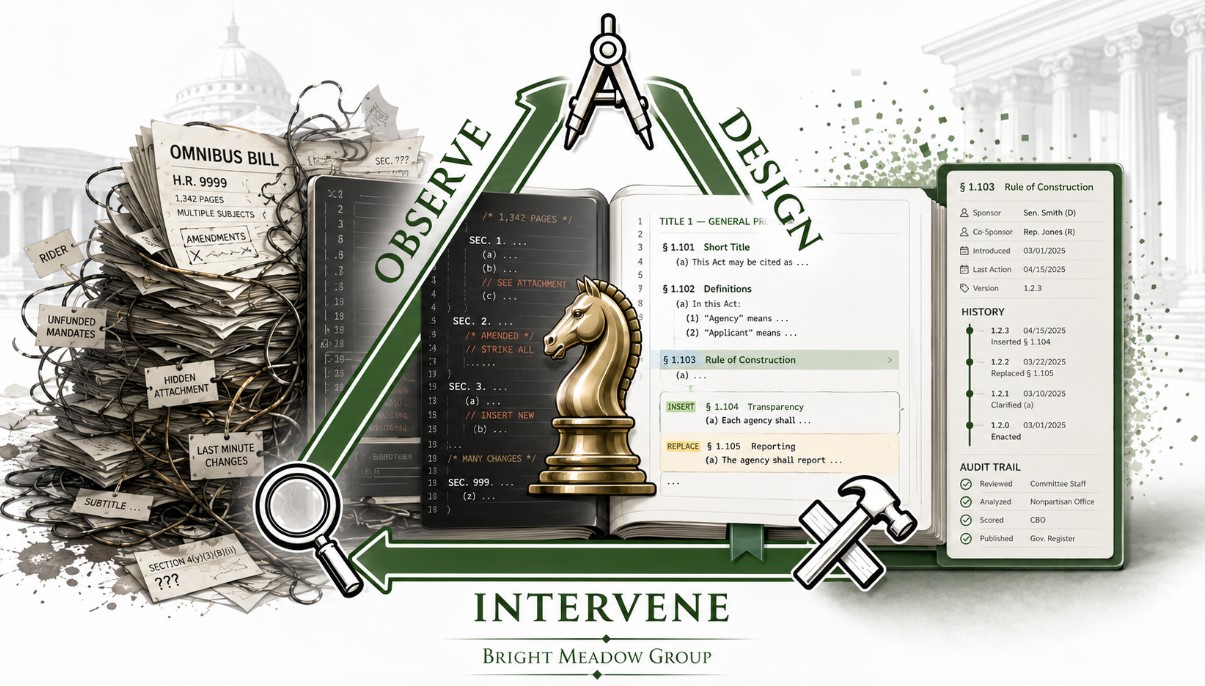
Bundling is the ordinary operating mode of American lawmaking rather than a defect in it. A modern public law routinely contains hundreds of distinct propositions — obligations, prohibitions, definitions, appropriations, sunsets, exemptions carved for single firms — enacted through one recorded vote and one signature. The vote records a member’s position on the package. It records nothing about the member’s position on any proposition inside it, and that ambiguity is the product being purchased.
Four costs follow, and they compound.
The legislative cost. A vote on a package is an unresolvable signal. Constituents cannot determine what their representative supported. Neither can the representative’s colleagues, or the courts later trying to reconstruct intent, or the agencies writing rules against it. The record exists and says nothing.
The judicial cost. An adversarial system determines truth by reducing a dispute to its narrowest contestable elements and testing each one. Every piece of American trial procedure — elements of a claim, separate counts, special verdicts, issue preclusion — exists to force that reduction. Then the system reaches for the statute and finds propositions that were never separated, never independently debated, and never independently ratified. Courts spend enormous effort reverse-engineering an atomic intent out of a document assembled to avoid producing one.
The civic cost. A citizen who wants to change one thing must find a vehicle, attach to it, survive everything else attached to it, and accept whatever else rides along. The cost of entry is a lobbyist. This is how ordinary people are removed from lawmaking. It requires no conspiracy. It requires only a unit of enactment too large for anyone without staff to handle.
The maintenance cost. A bundled provision is hard to repeal for the same reason it was easy to pass. It sits inside a structure whose other parts have constituencies. Bad law accumulates because the accumulation is load-bearing.
Design
The proposal is a change to the unit of enactment.
The terminal node becomes the law. American law already has an addressing system. Title 26, Subtitle A, Chapter 1, Subchapter A, Part I, Section 1, subsection (a), paragraph (1), subparagraph (A) is a complete address, and every state code has an equivalent. The structure is a classification scheme in the same family as a Dewey call number or a military technical manual: a subject hierarchy where position carries meaning and any node can be found by anyone who understands the scheme.
Congress does not currently legislate into that structure. It passes session law — a narrative document, Public Law 119-something — and the Office of the Law Revision Counsel afterward classifies its pieces into the Code. For roughly half the titles of the U.S. Code, the classification is evidence of the law rather than the law itself; the session law remains authoritative. The organized version is a finding aid.
Single-issue codification inverts that. The Code becomes the law. Legislation becomes an edit to the Code at a specified address: insert this line here, strike that line there, replace this line with this one. Each edit carries a sponsor, a vote record, an effective date, and a permanent history. Any citizen looking at any line of law can see who put it there, when, and by what count — the way a mechanic reads a revision block on a drawing.
One line, one proposition. The definitional question is where state single-subject rules have historically failed. Forty-odd state constitutions require that an act embrace one subject, and courts have been unable to enforce them because “subject” expands to fit whatever the legislature calls it. An act relating to state government is one subject.
Granularity has to be defined structurally rather than topically. A workable test: a line states one operative proposition — a single obligation, prohibition, permission, grant, definition, threshold, or amount — expressible as one declarative sentence with one subject class and one verb. Definitions live at parent nodes and are inherited by everything beneath them. A provision that needs a definition cites its address instead of restating it, which also ends the practice of redefining a common term inside one program to produce a result nobody voted for.
Dependency is declared, not concealed. Some provisions genuinely require others. Under a line system, a line may declare a condition on its face: effective only upon enactment of §X. Coalitions still form. Trades still happen. A member who will vote for the mine cleanup only if the severance tax passes can still make that trade — the trade becomes a recorded conditional at a public address instead of an invisible weld between two paragraphs. Logrolling survives. Concealed logrolling does not.
Throughput. The volume objection is the first one anyone raises, and it is a tooling problem rather than a problem of principle. Uncontested lines move on a consent calendar in batches. Any single member can pull any line for separate recorded vote, and that pull is itself a public act. Both chambers already run something close to this for minor business. What the current system calls efficiency is the deliberate destruction of information, and the resulting record is unreadable because unreadability was the objective.
Appropriations. The genuine hard case. A funded program is at least two propositions: the authorization to do the thing, and the amount. The authorization/appropriation distinction already exists on paper and has largely collapsed in practice. Under a line system, authorization is permanent code and appropriation is a term-limited line with an expiration date on its face. Continuing resolutions become a batch of dated lines rather than a single hostage.
The judicial loop
The second half of the reform addresses what happens when a court confronts a question the code does not answer. The full mechanism is the subject of a companion brief; the design position is stated here.
At present the court decides — someone has to — and the holding functions as law indefinitely, binding within its jurisdiction, without ever receiving a legislative vote. Whether one calls this activism or gap-filling depends mostly on whether one likes the outcome. The structural feature is the same either way: a rule of general application enters the legal system through a channel with no ratification step and no clean amendment path.
The proposed structure keeps judicial decision-making and adds the missing step. When a court resolves a question not answered by codified law, the holding is drafted as a proposed code line, or set of lines, at a specific address. It takes effect immediately, because the parties in front of the court need an answer. It also enters a legislative docket automatically, addressed to the committee with jurisdiction over that title. The legislature then has a defined window to codify the line as written, modify it, replace it, or reject it.
If the legislature does nothing, the line codifies. Silence ratifies.
This matches what already happens — legislative silence already leaves a holding standing — and adds three things the current system lacks: an address, a docket entry that forces the question onto a calendar, and an ordinary amendment path. The alternative, where silence voids the rule and the question reopens, hands legislatures a way to nullify by declining to act. That is a policy outcome achieved without a vote, which is the disease this brief is trying to treat. The instrument being built here is a record, and a system that produces outcomes through inaction defeats it.
One boundary has to be explicit: this loop covers statutory gap-filling and common-law development. It does not cover constitutional holdings. A ruling that a line violates the constitution cannot be codified around by ordinary legislation.
Intervene
The Presentment problem is solved by the design. The Line Item Veto Act died in Clinton v. City of New York (1998) because it let the President cancel parts of a bill after enactment — the executive editing law unilaterally. Single-issue codification does the opposite. Nothing is edited after passage. The separation happens before presentment, and the President signs or vetoes each single-line bill whole. The Presentment Clause requires that bills be presented. It says nothing about how large a bill must be.
Most of this requires no amendment. Each chamber sets its own rules. A chamber can require by rule that measures be reported at line granularity, and can require its Legislative Counsel to return anything failing the granularity test. The Byrd Rule has stripped extraneous matter from reconciliation bills for forty years. The mechanism is proven. The scope is the question.
The federal substrate is a project already underway. Positive-law codification of the remaining U.S. Code titles is slow, technical, and uncontroversial. The Office of the Law Revision Counsel has been at it since 1926. Nobody legislates against a code until the code is the law. Anyone serious about this reform should be funding that office rather than writing manifestos about it.
States go first. State codes are smaller, most state constitutions already carry single-subject language that could be sharpened from a topical test to a structural one, and a state that adopts positive-law codification plus line-level enactment becomes a working demonstration instead of an argument. Pennsylvania’s consolidated statutes project is an available starting point.
Emergencies
A hurricane does not wait for a consent calendar, and a system that cannot move in a week will be abandoned the first time it needs to.
The answer already exists in the FEMA financing model, where ordinary appropriations discipline suspends under statutorily defined triggers. A line system extends that logic. Under conditions defined with legal precision in advance — declared disaster, attack, specified emergency findings, and nothing broader — the granularity rules suspend and a package moves as a package on a single vote.
The suspension buys time. It does not buy permanence.
Every line inside an emergency package carries a mandatory individual recorded vote within sixty days of enactment. Not a review, not a report, not a committee referral that dies in a drawer — a recorded vote on each line, at its address, on the floor. Lines that survive enter the code. Lines that do not survive expire on the sixtieth day and take their funding with them.
The enforcement has to have teeth or the sixty-day requirement becomes another deadline Congress ignores. The proposal is forfeiture: a member who fails to appear for the emergency codification votes loses the seat. The same discipline extends to ordinary business, where a member whose participation falls below a defined share of recorded votes on a rolling basis — measured after an initial grace period following seating — forfeits the seat as well.
That mechanism raises real constitutional questions and deserves its own treatment. It is developed in a companion brief. What matters here is the principle: the emergency exception is a delay in individual accountability, never a substitute for it. The emergency omnibus is where the worst permanent law in the United States has historically been buried, and any exception written into this system has to close behind itself.
What this does not fix
A single-line system inside a captured legislature produces captured lines. The reform removes a specific instrument of concealment while leaving the interest in concealment fully intact, and the pressure will move to the next available surface — most likely the granularity rules themselves, attacked the same way state single-subject rules have been attacked for a century. The schema is the attack surface, and whoever administers it holds real power.
The code will probably get longer. Separating propositions that were previously fused adds words. What it gains is navigability: a citizen who can read a manual can find the line that governs a dispute, read it, and see its history. That is the difference between a system that requires an attorney and one that permits self-representation.
Where this lands
The dysfunction described in the companion piece is a design output. Two unrelated propositions were permitted to occupy a single vote, and every distortion downstream followed from that permission — the theater, the trap, the unreadable record, the two Democrats who cosponsored one thing and were made to vote on another, the thirteen who took a provision they opposed to get one they wanted.
Remove the permission and the maneuver has nowhere to live.