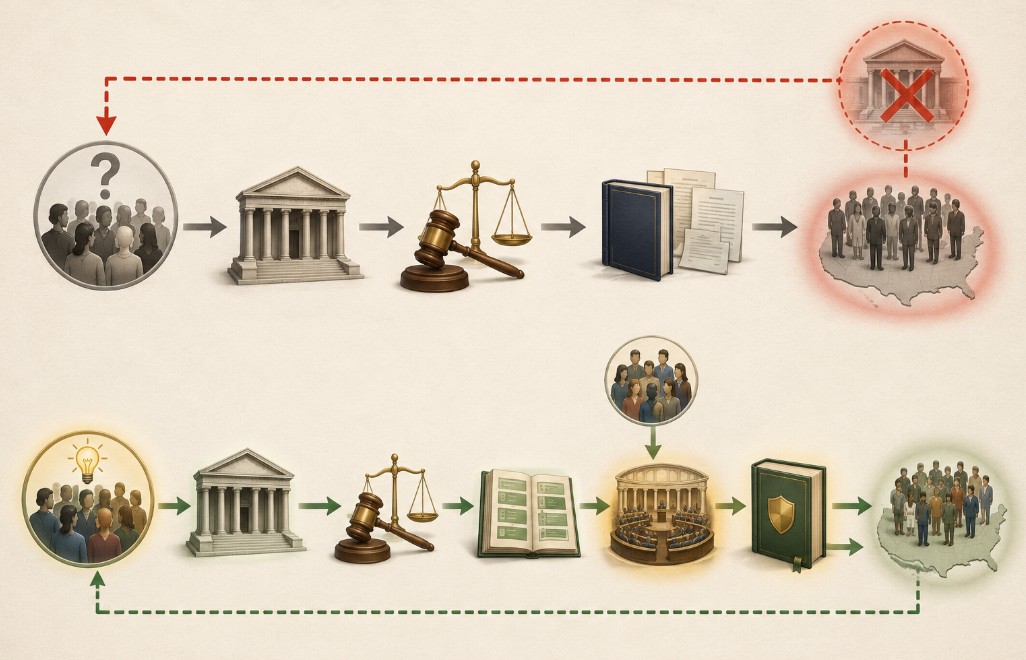
Let Judges Find the Gap. Make Congress Fill It.
Observe
A statute written in 1974 meets a technology built in 2026. Two provisions collide in a way nobody anticipated. A definition inherited from another section produces an absurd result when applied to facts the drafters never pictured. The people standing in the courtroom still need an answer, and the courthouse exists to give them one.
The judge has to decide. Refusing is also a decision and a worse one.
So this brief does not argue that judges should stop filling gaps. Filling gaps is the job, and the alternative is a legal system that sends litigants home whenever the legislature failed to imagine them.
The problem is what happens to the answer afterward.
Six properties of an unratified rule
Follow a gap-filling holding out of the courtroom and watch what it becomes.
It binds the parties, which is ordinary and correct.
It also governs everyone else in the jurisdiction who was never in the room — a district, a circuit, a state, sometimes the country, depending on which court issued it.
It has no address. It lives at a citation: volume, reporter, page. That records where an opinion was printed and says nothing about what subject the rule belongs to or where it sits relative to the statute it interprets. A citizen cannot look up the law on a question and find it. They have to already know the case exists, which means knowing the field, which usually means paying someone who does.
It received no vote. Not in committee, not on any floor, not from anyone the public selected.
Changing it is close to impossible for an ordinary person. The available paths are a new case with the right facts brought by a litigant who can afford to appeal it, or a statute drafted around an opinion courts will go on citing regardless.
And the sixth property follows from the rest: legislative acquiescence is ambient. When a legislature leaves a holding standing for thirty years, no record exists of that decision, because no moment ever occurred in which the legislature was asked. There is no date. There is no committee. There is no roster. The rule persists, and everyone calls the persistence consent.
Those six properties are the argument. Everything after this is engineering.
The activism fight is a proxy war
Complaints about judges legislating from the bench are, in practice, complaints about outcomes. The same people who want a holding respected in one decade want it overturned in the next. The structural objection gets raised by whoever lost, and it is the identical objection in both cases, and it is dropped the moment the other side loses instead.
That pattern points somewhere useful. The structure is the same regardless of which direction the ruling went. A rule that entered the legal system without a vote entered without one whether the outcome pleased you or not.
Repairing the structure requires no agreement about outcomes. That makes it one of the few available repairs that does not first require winning an argument nobody has ever won.
The volume just moved
In 2024 the Supreme Court ended Chevron deference in Loper Bright Enterprises v. Raimondo. Courts now interpret ambiguous statutes themselves rather than deferring to an agency’s reading.
Set aside whether that was correct. Structurally, it relocates a large body of gap-filling from the executive branch to the judicial branch — into the exact channel described above, the one with no ratification step and no address. Agency interpretation at least ran through notice and comment. Judicial interpretation runs through neither.
The question of who fills statutory gaps is more live now than at any point in forty years. The entire public debate about it is a fight over which branch should hold the power. Nobody has proposed that the power terminate somewhere accountable.
The machinery already exists, in two halves
This is the part that should change how the proposal sounds.
The extraction half has been running since 1923. The American Law Institute was incorporated that February and began work immediately on the first Restatements — Agency, Conflict of Laws, Contracts, Torts. The method has not changed since. Take a body of scattered holdings, distill it into numbered black-letter propositions with commentary, organize by subject, publish at stable addresses. Judges sit on the drafting committees. Courts cite the results constantly.
Rendering case law into discrete operative statements is a solved problem with a century of continuous practice behind it.
The ALI is candid about what it lacks. It is a private nonprofit producing scholarly work and it holds no lawmaking authority. The Restatement terminates in a book — an excellent book, cited by American courts since Coolidge, drafted by people nobody elected and ratified by nobody at all.
That is the precedent and the counterexample in a single object. The technique works. The termination point is wrong.
The ALI itself already draws the distinction this brief depends on. Restatements describe the law as it stands and are addressed to courts. Model codes and statutory proposals are addressed to legislatures with enactment in view. Same building, same method, same people. The only difference is where the product gets sent.
The ratification half has been running since 1934. Under the Rules Enabling Act, advisory committees draft amendments to the federal rules of procedure. The Judicial Conference approves them. The Supreme Court transmits them to Congress no later than May 1 of the year they are to take effect, and they take effect no earlier than December 1 of that year unless a law provides otherwise.
If Congress does nothing, they become binding on every federal court in the country.
This is not theoretical. Amendments transmitted in April 2022 drew no congressional action and took effect that December. It happens most years and has for decades. Judicial drafting, legislative ratification, and adoption on legislative silence — the structure critics will call radical has operated without controversy since before the Second World War.
One limit on that Act is worth stating, because it strengthens the design rather than weakening it. The Rules Enabling Act is confined to procedure and forbids rules that abridge, enlarge, or modify a substantive right. Congress drew that boundary deliberately, and drew it with precision: a rule creating, abolishing, or modifying an evidentiary privilege has no effect unless Congress approves it by statute.
Read what that carve-out establishes. Where a judicially drafted rule stays procedural, silence suffices. Where it touches substance, Congress requires an affirmative vote.
Congress articulated the correct principle in 1988. It has never applied that principle past the courthouse door.
What this brief actually proposes
Legislation-first is the historical anomaly.
Most of the working law of the English-speaking world was not written by assemblies. It was built out of decided cases, by people trained in the material, testing rules against real facts under adversarial pressure, one dispute at a time. That method carries an advantage no legislature can replicate: it never produces a rule about a situation that has not actually occurred.
It also carries one fatal defect. Nobody elected the judges who built it, and nobody ratified the result.
Statutory law has the inverse profile. It holds democratic authority and it gets drafted in rooms with no facts in them, by staff and outside interests, about situations imagined rather than encountered, then bundled into packages nobody reads. The companion brief on single-issue codification describes what that bundling does to consent.
The judicial loop marries the two and assigns each the job it is good at.
The courtroom finds the gap and drafts the language, because that is where the facts are. The legislature ratifies against common values, because that is where the public is. The code stores the result at an address, because that is what a code is for.
Design
Any sitting judge writes the line
When a case turns on a question the written law does not answer, the judge deciding it drafts the missing provision as a proposed code line at a specific address, filed with the ruling.
Any judge. Trial through court of last resort.
Restricting this to supreme courts is the obvious instinct and it is wrong. Trial judges sit closest to the facts. They see the gap first, they see it in detail, and they see it in the ordinary cases that never generate an appeal because nobody involved could afford one. A system that harvests only appellate decisions harvests only the disputes of people who can pay to keep fighting, which reproduces the exact access problem this series exists to solve.
The filing states the defect and proposes the narrowest line that resolves it. Not a manifesto. Not a theory of government. Not a rewritten statute. One line, directed to the case in front of the court, identifying where it belongs in the code, what existing language it depends on, and what precise uncertainty it closes.
The opinion may explain the reasoning at whatever length the reasoning requires. The legal change itself has to be visible as a legal change.
The line changes nothing about judicial power
A judge’s line carries exactly the precedential weight that judge’s decisions already carry. Persuasive from a district court. Binding within the circuit from a court of appeals. Statewide or national from the top.
Nothing new is granted to anyone.
The line is the judge’s reasoning written in code syntax instead of prose. The judge was already deciding the question, and the decision was already going to govern people who were not in the room. The format changed. The power did not.
Appeals constrain the line the way appeals constrain everything else. Higher courts may affirm it, narrow it, relocate it, reject it, or find that no gap existed.
Nobody stands between the judge and the legislature
The judge who decides the case writes the text. No drafting office converts it. No commission reviews it. No staff bureau renders it into proper form before the legislature sees it.
The reason is the accountability chain. Every judge in the United States traces back to a voter — elected outright, or appointed by an elected executive and confirmed by an elected chamber. The chain runs longer in some places than others and it exists everywhere. A drafting office has no such chain. It is a career staff function, and a staff function handed the power to decide how far a rule reaches and where it sits in the code is a staff function worth capturing.
There is a second reason, and it is the more embarrassing one for the current arrangement. A judge writing their own law is more transparent than how legislatures write law today. A member of Congress whose name appears on a bill often did not write a word of it. Committee staff wrote it, and before them, frequently, someone outside the building wrote the parts that mattered. Under this design the person whose name is on the line is the person who wrote the line, and that person had to sit through the facts that produced it.
Three practical questions follow, and the design answers all three without an office.
Consistency of form comes from a published drafting manual — code syntax, address conventions, how to cite an inherited definition rather than restate it. A manual is a rule rather than a person. It constrains form without anyone exercising discretion over substance, and the ALI has maintained one for a century.
A line filed at the wrong address is a craft error, and craft errors are what appellate review already catches.
Bad drafting that survives appeal gets fixed by the legislature on ratification, including the address. That authority belongs with the people who have to vote on the thing.
The advisory-opinion objection does not survive contact with this. A holding is already a general proposition applied to facts. Writing it in code syntax changes the format and not the character. The question was before the court, the court had to answer it to resolve the case, and the answer is what the judge filed. Judges already flag statutory gaps and call on legislatures to fix them, constantly, in dicta, with no address, no text, and no docket — which is precisely why nothing happens.
The repository
Every line from every judge enters a public, searchable, permanent repository at its address, with full status history attached.
This is the artifact, and it may outlast every other part of the design.
Nobody currently knows where American law has holes. Not Congress, not the courts, not the public. The information exists, scattered across hundreds of thousands of opinions in a form no one can aggregate. The repository converts it into a document: here is where the code is failing, here is how often, here is what kind of case keeps hitting it, here is what judges have proposed doing about it.
Even if a legislature ignored the repository entirely, its existence would be the most useful thing anyone has produced about the condition of American statutory law.
The forced vote
Every line in the queue receives a recorded vote in both chambers within ninety days.
No silence default. No line becomes permanent law because a legislature failed to act. The ratification calendar is a standing quarterly obligation, and a member’s failure to appear for it counts against the participation threshold developed in the companion brief on the empty chair.
Congress may ratify the line. It may amend it. It may replace it with something better. It may reject it and declare that the statute should not reach the disputed conduct.
What Congress may not do is let the question die in committee until the public forgets it exists.
That is the central correction. The present system rewards legislative silence. Members can denounce a judicial decision without ever taking responsibility for changing the law, praise an outcome to one audience and condemn it to another, and avoid casting the vote that would reveal which position they actually hold. The loop removes that shelter. The facts are known, the readings have been argued, and the consequences are no longer hypothetical.
The calendar is not a vehicle
This distinction is load-bearing.
If a quarter’s lines went to the President as one ratification bill, that bill would be an omnibus of two thousand provisions, and this series would have rebuilt the exact object it was written to destroy.
Each line is its own bill. The ninety-day cycle sets a deadline by which the queue must be cleared. Each disposition is a separate enactment.
Lines move on a consent calendar in address order, with any member able to pull any line for separate debate and separate recorded vote. That is the batch mechanism from the codification brief, and it survives the objection raised there for one specific reason. An omnibus is dangerous because somebody chooses what goes in it. The judicial ratification calendar has no editor. Everything ripe enters, in address order, on a fixed cycle. Composition is not discretionary, so there is no room for the weld.
Presentment, and a power presidents have wanted since Grant
Each line passes both chambers and goes to the President as its own bill.
A veto touches one line. The rest proceed untouched.
This delivers the line-item veto without the constitutional defect that killed it. The Line Item Veto Act died in Clinton v. City of New York because the President was canceling parts of a bill after enactment — the executive editing law by himself. Under single-line enactment nothing is edited after passage. The President vetoes whole bills. Every bill happens to contain one proposition.
Presidents of both parties have wanted this authority for a century and a half, and every attempt has failed on the same ground. Shrinking the unit of enactment hands it over as a byproduct, and the executive never edits anything.
A vetoed line follows ordinary constitutional procedure. Congress rewrites it into something the President will sign, or overrides, or leaves it. If they leave it, the line stays provisional at its court’s precedential weight, the gap stays open, and the veto message sits at the address as part of the permanent record.
Acquiescence by neglect
Presidential inaction becomes assent in every case. If the President neither signs nor returns a bill within the constitutional window, it becomes law.
That is already the rule when Congress is in session. The pocket veto exists only for the situation where adjournment prevents return, and under a Congress meeting on this calendar that situation stops arising. A body never adjourned long enough cannot be denied its return.
Someone will call the asymmetry inconsistent, so state the reason plainly. Congressional silence never ratifies a line. Presidential silence does. By the time a bill reaches the President, both chambers have voted and presentment has occurred — the full Article I, Section 7 process ran. The President’s inaction is a choice made inside a completed process. Congressional inaction would be the absence of the process itself.
If a legislature refuses anyway
Suppose a chamber declines to take up the calendar at all.
The lines stay provisional. They govern as reference at their courts’ precedential weight until the legislature acts, which leaves the country exactly where it stands today.
The floor of the new system is the ceiling of the current one. That is the worst case, and it is not a new harm.
Three things differ even in that worst case. The refusal is dated and attributable. Every member’s failure to vote counts against the participation record. And the same gap keeps generating the same line, filed by judge after judge, accumulating at one address in a public repository until the pile itself becomes the story.
Members of Congress like their seats. A structure that makes the choice between voting and losing the seat is a structure that gets votes.
Four mechanical rules
Rejection requires replacement. A legislature that rejects a line must enact something at that address. Bare rejection reopens the gap, which produces another case, another line, another rejection, indefinitely. A body that wants to change the law has to say what the law is.
Retroactivity has one rule. The line governs conduct from the date of the decision forward. Legislative modification governs from the date of codification forward. Conduct in the interval is governed by the line as issued. No modification creates retroactive liability.
Clustered disagreement is the repository’s best output. Two judges will draft contradictory lines at the same address. That is acceptable while both are provisional, and it is precise information — a cluster of conflicting lines at one address maps exactly where a statute is ambiguous and exactly how. Today a circuit split waits for a cert grant. Under this design, disagreement at an address is an automatic legislative priority flag, and the conflict itself triggers the branch that is supposed to settle it.
Federalism follows the source. State court on state statute goes to the state legislature. Federal court on federal statute goes to Congress. A federal court sitting in diversity certifies the question to the state supreme court rather than predicting how it would rule, and the certification and the line travel together. Certification procedures already exist in most states and are underused. This gives them a reason to be used.
Scope: statutory gaps only
This brief covers gaps in enacted law. A statute exists, it is incomplete, and the body that wrote it should finish it. That is the strongest ground and the easiest case.
Constitutional holdings stay outside the loop. A ruling that a provision violates the constitution cannot be legislated around, and the companion brief on judicial structure describes how those questions should reach the court that answers them. One wrinkle deserves naming: constitutional avoidance produces statutory holdings driven by constitutional reasoning, and a legislature modifying such a line may recreate the problem the court avoided. That requires care in drafting and it is not solved here.
Common law — tort, contract, property — is set aside for separate treatment. It developed judicially by design over centuries, codifying it is a contested project with real losses, and the historical attempts have mixed records. Dragging that fight into this brief costs the easy win for no gain.
Three categories, and no fourth
Every reviewed line falls into one of three classifications.
Craft failure. The judge got the law wrong as law — missed controlling statutory language, ignored an inherited definition, failed a mandatory cross-reference, placed the line at the wrong address, swept further than the case required, or violated settled constitutional law. Craft failure also covers avoidance: a judge who encounters an obvious gap and declines to identify it has left the defect buried for the next person to hit.
Constitutional violation is not a mysterious fourth category. The Constitution is written law. It is the highest written law, every judge swears to it, and it is more available than any statute. A judge who violates a settled constitutional command has committed the most serious form of craft failure there is.
Values revision. The judge wrote a legally coherent line and the legislature chose a different policy. No mark. The judge performed craft; the legislature performed politics; the system worked as designed.
Contested first impression. The question was genuinely new and reasonable judges could differ. No mark. This category has to exist or the instrument punishes judges for taking hard cases, and hard cases are where the gaps live.
The weighting of marks, the timing rules, the appeal process, and the promotion and removal system built on top of these categories are the subject of the companion brief on judicial structure. What matters here is that the classification distinguishes bad workmanship from a legitimate political choice, and that no legislature can call a policy disagreement incompetence.
The hard parts
How general is the line?
A holding is fact-bound: under these circumstances, this rule. A code line is general. Somebody has to decide how far the rule reaches, and common-law systems have never solved this. The scope of a holding gets settled retrospectively, by later courts, over decades, as new facts arrive and judges decide whether the old rule covers them.
Codification forces that determination forward, to a moment when nobody knows what the future cases will look like.
That is a real trade with a real cost. It buys prospective clarity with retrospective flexibility. What it gets in return is that the scope question gets decided by an accountable body, at a known date, on the record, instead of accumulating by accident across a generation.
Volume
Federal district courts saw roughly 345,000 civil case and criminal defendant filings in the year ending March 2025. State courts handle tens of millions of case terminations annually.
Assume two percent of federal filings turn on a genuine statutory gap. That produces about seven thousand lines a year, seventeen hundred per quarterly cycle. The two percent is an assumption rather than a measurement, and a reader who believes the real figure is ten percent should run their own number. The design has to survive at either.
Can a chamber vote seven thousand times a year?
House Rule XX permits the Speaker to reduce the minimum time for an electronic vote to as little as two minutes for any question following another electronic vote, a floor adopted in the 118th Congress. Clustered voting at scale is already routine; a single afternoon session regularly handles two to three dozen recorded votes.
At two minutes, a twelve-hour voting day yields roughly three hundred sixty recorded votes. Two hundred fifty such days is ninety thousand votes a year. Even at five minutes the arithmetic clears seven thousand by more than an order of magnitude.
The federal queue fits with enormous room. The constraint is willingness rather than arithmetic.
A Congress voting on that schedule has no time to raise money, which is campaign finance reform achieved through the calendar without touching a single campaign finance law. It is also the reason incumbents of both parties will fight this harder than anything else in the series. The stated objection will concern workability. The real one is the call room.
States present the harder problem. Most legislatures meet part-time and some meet biennially. A state adopting this has to change its own session structure first, and the companion brief on the Pennsylvania pilot takes that up directly.
Access to court is a capture channel
The strongest attack on judicial origination is not about judges. It is about who gets in front of one.
Legislation is captured by whoever can afford lobbyists. Litigation-originated law is captured by whoever can afford litigation — repeat institutional players, insurers, large firms, entities that select cases specifically to generate favorable rules and settle the ones that would generate bad ones. That is documented practice rather than speculation. The mix of disputes reaching a judge is not a representative sample of the disputes that exist.
Two answers, neither complete.
Harvesting from trial judges rather than appellate courts captures the cases nobody could afford to appeal, which is most of them. And a gap that fifty trial judges hit independently is real regardless of who could pay to keep fighting, so recurrence at an address becomes a pressure signal visible to anyone reading the repository.
The honest summary: this moves capture from a channel with no record into a channel with one. That is an improvement and it is not a cure.
Entrenchment
A statute requiring a legislature to vote within ninety days cannot bind a future legislature. Each chamber adopts its rules at the start of each session and can decline to readopt an inconvenient one.
The durable version of the ratification calendar is a constitutional obligation. A chamber rule can begin the work immediately and a participation requirement gives the deadline personal consequences, but a legislature that wants to abandon the calendar will eventually abandon it, and the only instrument that prevents this is the one that requires ratification.
This brief takes that as a design specification rather than a difficulty.
Two more
Agencies do the same thing and this does not touch them. Legislative rules fill statutory gaps with the force of law and never receive a legislative vote either. Congressional Review Act resolutions exist and are almost never used. That is a full brief on its own and it belongs in this series.
Transition takes decades. Two centuries of existing precedent cannot be docketed at once. The loop is prospective, and it reinforces the positive-law codification project rather than replacing it.
The bet
American courts have sometimes delivered justice when the elected branches refused to. Judges have broken with settled doctrine, recognized rights the political system would not, and forced changes Congress lacked the will to make.
A judiciary trained to preserve legal craft rather than make values leaps might not produce those decisions.
That objection is serious and reaches the center of the design. The answer is not that the moral breakthroughs were wrong. The answer is that needing judges to create them exposed an institutional failure that everyone agreed to admire instead of repair.
Every historical example of judges making a values leap is an example of judges doing legislative work because the legislature would not do it. The loop exists to remove that necessity. The citizen brings the case. The judge identifies the contradiction. The proposed repair is drafted in public. Then the people who face voters have to choose, on a clock, with their seats attached to showing up.
This architecture wagers that a legislature compelled to vote will do what an unforced legislature would not.
State it as a bet, because it is one. If the bet is wrong, the country loses a safety valve it has used more than once, and a disciplined judiciary will not rescue anyone from a legislature that is both compelled to act and still chooses injustice.
Two things make the wager acceptable.
The current arrangement manufactures the need for judicial rescue by preserving legislative cowardice. Congress abandons the function, waits for courts to act, and then campaigns against the judges for doing the work it refused.
And a system broad enough to let a wise judge manufacture a just result is broad enough to let another judge manufacture an atrocity. There is no method that admits only the good improvisations. Anyone defending judicial values-creation is defending both outcomes, whether or not they have counted the second one.
Intervene
Start with the version that needs nobody’s permission
Strip every element requiring an amendment, a statute, or negotiation between branches. What survives:
A judiciary directs its own judges to file a proposed code line whenever a decision turns on a question the written law does not answer, and publishes the result.
That is a rule and a database. No legislation, no constitutional question, no cross-branch negotiation.
The federal judiciary already has the institutional apparatus. Under 28 U.S.C. § 331 the Chief Justice summons and presides over the Judicial Conference of the United States, composed of twenty-six federal judges plus the Chief Justice. It was established by the Conference of Senior Circuit Judges Act of 1922 and has served as the policymaking body for the federal courts ever since. Circuit judicial councils already oversee administration within each circuit and already review complaints of judicial misconduct. And the Chief Justice already submits an annual report of Conference proceedings and legislative recommendations to Congress.
A national policy body chaired by the apex court, regional councils that evaluate judges, and a statutory reporting line to the legislature. All of it built, staffed, and running for a century.
The repository could exist within a year. The demand signal would be visible immediately. And every downstream argument about calendars, presentment, and ratification stops being a debate about a hypothesis and becomes a debate about something people can already look at.
States first
Smaller codes, smaller dockets, unified court systems, and supreme courts issuing a readable number of statutory holdings per year.
Pennsylvania has the Legislative Reference Bureau, an active consolidated-statutes program, a unified judiciary, and a recent demonstration that the Commonwealth can migrate a body of inherited law without hiding policy changes inside the migration. A state that runs this becomes a working model rather than an argument, and the companion brief lays out the deployment.
Who wants this
The coalition is stranger than it looks.
Anyone exhausted by confirmation fights has a reason. This design lowers the stakes of judicial appointment considerably, because a holding becomes a draft subject to ordinary legislative revision rather than a durable settlement won by controlling a bench for thirty years.
Any President has a reason. The surgical veto arrives as a byproduct.
Anyone who wants judges accountable has a reason, and so does anyone who wants judges protected from political retaliation, since the categories distinguish craft failure from a values call the judge had no business making.
And anyone who has watched a rider pass inside a bill they supported has a reason, because this is the same argument arriving from the other direction.
Three doors
The point of the entire design is what it opens for a person with no lawyer and no lobbyist.
Read. The repository is public and addressed. A citizen can find the gap that affected them, see what a judge proposed doing about it, and see whether the legislature ever voted.
Petition. A provisional line at an address is a specific object with a committee attached and a date on it. Asking a representative to ratify, amend, or repeal a numbered line is a request a district office can act on. Asking them to fix the tax code is not.
Generate. A person who cannot afford a lobbyist can sometimes afford a filing fee. Under this design, a self-represented litigant who hits a real gap produces a docket entry — same address, same repository, same queue as anyone else. The companion brief on self-representation describes what that changes for someone trying to reach a judge without a professional navigator. It is the cheapest access to the lawmaking process this country has ever offered, and it arrives as a side effect.
Where this lands
The current arrangement asks the public to accept two things simultaneously: that a large body of governing American law was written by people nobody elected, and that this is acceptable because the alternative is worse.
The alternative is not worse. Judges finding law in live cases, under adversarial pressure, against real facts, is the older and more reliable method of discovering what a rule should be. What it has always lacked is a moment where the public gets to say yes or no.
Add the moment. Keep everything else.
The judiciary finds the gap. It writes the line. It decides the case.
Then it sends the question to the people who were elected to answer it.
Under this design, no American law exists that nobody voted on.