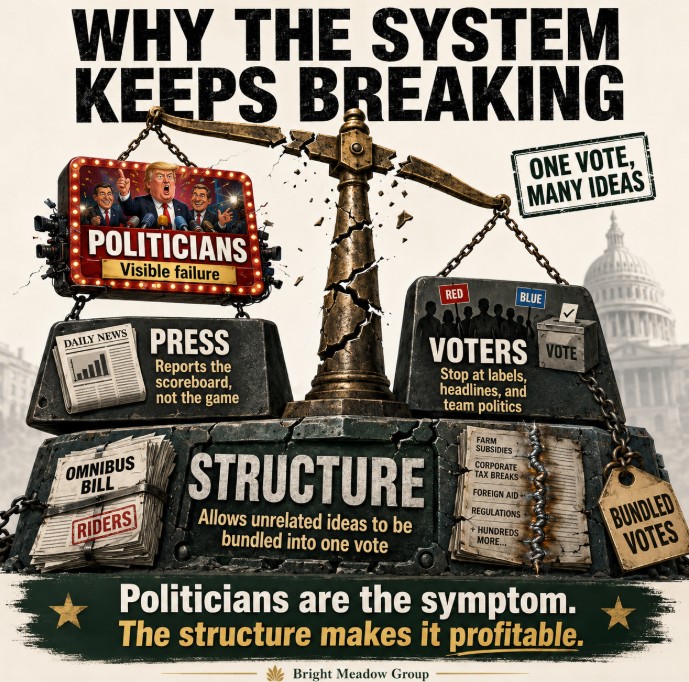
Our political system is dysfunctional. The politicians are the most obvious point of failure, and they are not the root cause of it. The deeper blame lies with a press that reports the scoreboard instead of the game, and with voters who stop at party labels, headlines, and staged conflict.
Watch what happened this month and you can see the whole machine turn over.
In January, Rep. Bryan Steil of Wisconsin — chairman of the House Administration Committee — introduced H.R. 7008, the Stop Insider Trading Act. It would bar members of Congress, their spouses, and their dependent children from buying individual stocks. Ninety-three members eventually signed on as cosponsors, seventy-two of them at introduction. My congressman, John Joyce, was among them. So were two Democrats, Ed Case of Hawaii and Josh Riley of New York.
A ban on congressional stock trading is one of the few things Americans agree on. Support runs around eighty-six percent. Members of both parties have pushed for it for years. In this Congress, Anna Paulina Luna filed a discharge petition to force a vote on a stronger bipartisan version written by Chip Roy and Seth Magaziner. Speaker Mike Johnson responded by working with Steil to find another path. Steil’s bill was that path.
Then, in the week before the August recess, the House attached a voter identification requirement to it — the text of a separate measure the same chairman had moved out of the same committee in June, requiring government-issued photo ID in federal elections, including for mail-in ballots.
The bill passed on July 22 by a vote of 232 to 198. Thirteen Democrats joined every Republican.
Consider Case and Riley for a moment. They put their names on a proposition in January. By July that proposition had become a different object, and they were required to vote on the object. The thing they sponsored had ceased to exist as something anyone could vote on.
That is the story. Everything else is decoration.
The election provision did not arrive by accident, and it did not arrive alone.
The SAVE Act passed this House on February 11 by a vote of 218 to 213 and has been sitting in the Senate ever since. Federal control over how states run elections has failed every time it has been put to a straight vote, because Americans do not want it. Republican officials in Utah and Ohio have looked at the mail-in ID mechanism specifically and stepped back from it — Ohio’s governor vetoed the same approach at the state level and said plainly that it would not discourage fraud.
State control of elections is not an administrative convenience. It is a structural safeguard. A decentralized system makes it enormously difficult for any single party, president, or federal institution to manipulate a national result. Fifty separate administrations are fifty separate locks. That is the entire point of them.
So when a measure cannot pass on its own after repeated attempts, it gets welded to something that can.
Republicans have described the effort as messaging, and the Senate has scheduled nothing. They know the combined bill is unlikely to survive. That is the design. A member who votes no can be mailed to his district in October as a defender of insider trading, and the mailer will never mention the rider. A member who votes yes has voted for a federal voting requirement. If the bill dies, the sponsors keep the campaign material. If it lives, they get a provision that could not live on its own.
Thirteen Democrats needed the cover badly enough to take the second thing in order to get the first.
The reform being used as bait deserves a hard look too, because it turns out to be thinner than its name.
Members keep every share they already own. They may still sell, provided they file notice a week or two ahead. The prohibition runs on purchases. The president and vice president are exempt entirely.
And the bill addresses buying and selling. It says nothing about betting against a company — shorting, or buying puts. Anyone who has spent time near a market knows the surest money is not in guessing what rises. It is in knowing what is about to fall. A member of Congress does not have to guess about that, because Congress is often the thing that makes it fall. A subcommittee marks up a bill on Tuesday and an industry loses a third of its value by Friday.
So the popular half was hollowed out, the unpopular half was bolted on, and the whole thing was named after the one thing it does not do.
I do not primarily blame the politicians for this.
Politicians are drawn to power. People drawn to power behave like people drawn to power. They acquire it, expand it, and hold it. Expecting them to restrain themselves out of conscience is not a strategy. It is a wish.
I blame the voters who reward the behavior.
I blame voters who stop reading after the headline, who treat politics as a team sport with a jersey and a rival, and who never once ask what a bill actually does. Every trap of this kind is built on a specific bet: that the title will travel and the text will not.
That bet keeps paying.
And I blame the press.
The press reports these stories as contests between Republicans and Democrats instead of contests between ideas. It reports who won the vote, who embarrassed whom, and which party gained ground before November. It rarely explains the machine underneath.
The real story here is not that Republicans passed a stock trading ban and Democrats split over it. The real story is that a popular anti-corruption measure was hollowed out, fitted with an unpopular election provision, and sent to a Senate that has no plans to take it up — so that the failure itself becomes an advertisement.
A functioning press would separate the two halves and report them separately. It would ask why they were combined. It would make every sponsor answer for the connection. It would explain who benefits from the confusion, and it would say out loud that a bill built to fail is not legislation at all.
Instead, political reporting too often protects the parties by treating their staged conflicts as real ones.
Here is where I have to be honest about the limits of my own argument.
Suppose the press did its job tomorrow. Suppose voters read the text. The maneuver would get harder. It would not become impossible, because nothing about it is against the rules. Attaching an unrelated provision to a popular bill is ordinary practice under a system that lets a single vote carry as many separate ideas as leadership cares to load onto it. A vigilant public fights that practice case by case, forever, and loses often, because the people running the machine only have to win once.
The failure the press and the voters permit is real. Underneath it is a failure of design.
Congress can bundle unrelated ideas into one vote because our entire structure of law permits it. As long as that permission exists, this will keep happening — with different sponsors, different riders, different names on the bill. Removing it is a larger project, and it is the subject of the next piece.
The politicians are the visible failure. The press and the voters are what make that failure possible. And the structure is what makes it worth doing.