A Vote Is Not Optional When Voting Is the Job
There are 535 voting members of Congress.
Those 535 people decide how the government spends trillions of dollars, when the nation goes to war, who sits on the federal courts, which rights the government recognizes, which industries it regulates, which conduct it criminalizes, and how the burdens of maintaining a country get divided among the people who live in it.
Each member is elected by one state or one district. Each vote helps govern more than 342 million Americans. That places every member of Congress among the thousand most consequential public officials in the country.
The minimum requirement for holding one of those jobs should be obvious.
When a question is placed before Congress, enter a vote.
Yea or nay. Approve it or reject it. Accept responsibility for what follows.
A member who repeatedly fails to do that has stopped performing the one function of the office that cannot be delegated. The member may keep the title, the salary, the staff, the committee assignments and the nameplate. The website still displays a photograph. The district offices still open every morning.
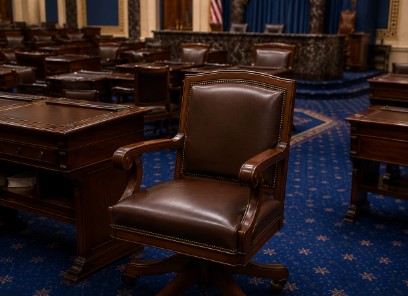
The chair is empty.
Somebody Should Have Been Able to Vote
In July 2024, Representative Kay Granger of Texas stopped casting votes.
Nobody in Washington announced it. Nobody moved to replace her. A reporter at a small Texas website noticed the roll call had gone silent, followed a tip, and found her at an assisted living facility. Her son later described dementia issues.
Granger did not resign.
Because she did not resign, no vacancy existed. Because no vacancy existed, no substitute could cast her vote. And because no vacancy existed, the man elected to succeed her could not take office early. Her district finished the term represented by a name.
Nothing about that was illegal. Nothing about it required anyone to behave badly. The Constitution recognizes death, resignation and expulsion. It does not recognize a seat that is occupied and inert.
Granger’s case is the cleanest one available because it carries no political charge. She was not hiding from a vote. She was not campaigning. Nobody profited. A person became unable to do a job, the system had no mechanism for noticing, and several hundred thousand Americans went unrepresented for months while everyone involved behaved reasonably.
That is the defect. Everything else in this piece is a variation on it.
The McConnell Measurement
Mitch McConnell makes the same defect visible from the opposite direction, and he is useful precisely because nobody would ever offer him as an example of congressional disengagement.
From January 1985 through April 2026, McConnell missed 218 of 14,324 roll call votes. One and a half percent, across four decades, against a median of 2.8 percent among currently serving senators. He did not become the longest-serving Senate party leader in American history by treating roll calls casually. He counted votes, scheduled votes, delayed votes, and built a career on knowing exactly when a vote mattered.
He last voted on June 11, 2026. Between June 15 and July 16 he missed 28 of 28. By July 22 the figure was 30 of 30, and he had been out of public view for 39 days.
He was taken to the hospital on June 14. His office released a statement and a photograph on July 12 describing a fall, a brief loss of consciousness, subsequent mild pneumonia, and a transfer to rehabilitation.
This is not an article about Mitch McConnell’s health, and it should not be read as one. An eighty-four-year-old man had a bad fall and is recovering. That deserves nothing but goodwill.
His record is relevant for one reason. The votes he missed included a June 16 War Powers resolution on Iran that failed 47 to 48. Later came a cloture vote decided 49 to 48, on which he was one of three senators not voting, and a 46-50 vote on a Medicare prior-authorization measure.
Margins of one. Kentucky was not in the room for any of them.
A man with a forty-year record of near-perfect attendance can produce a total absence of representation for six weeks, and the government has no mechanism that responds to it. If the most vote-conscious legislator of his generation can go dark without triggering anything, the problem is not who the member is.
McConnell is the calibration instrument. The subject is the seat.
The Rule Already Exists and Does Nothing
Senate Rule VI states that no Senator shall absent himself from the service of the Senate without leave. It is unclear whether McConnell has sought a formal leave of absence, and the question has been raised publicly.
The House and Senate can each compel the attendance of absent members. Article I, Section 5 gives each chamber authority to punish its members and, by two-thirds vote, to expel one.
Every tool required to address this already exists on paper.
None of it fires. The rules are old, the norms that enforced them are gone, and no chamber has any appetite for applying a discretionary standard to a colleague whose vote the majority may need next month.
A rule that has never been enforced is not a safeguard. It is a statement of what everyone once assumed nobody would have to say.
Ten Percent Is an Enormous Allowance
No serious rule requires perfect attendance.
Members become ill. Flights cancel. Families have emergencies. A member may need surgery, bury a parent, or be physically unable to travel. Winning an election does not convert a person into a machine.
A ten percent allowance accounts for all of it. It permits a member to miss one of every ten recorded decisions before representation is presumed to have failed.
Measured against actual practice, that is not a demanding standard. GovTrack puts the median missed-vote rate among current representatives at 2 percent. Across the House, members average roughly 1 to 3 percent. Ninety percent participation would be considered marginal in occupations carrying a fraction of the consequence. A surgeon cannot skip one operation in ten. A dispatcher cannot ignore one call in ten.
And yet the threshold is not theoretical. It is already being crossed.
Bloomberg Government found in July 2026 that House Republicans who lost a primary or a bid for another office had missed an average of 60 of the House’s 595 roll call votes, and that departing Republicans overall averaged 39 missed votes against a chamber-wide average of 18. The first group is running at about 10 percent.
Eight House members have missed at least 15 percent of roll calls this Congress. Among the twelve worst, seven are Republicans and five are Democrats.
The stretches are longer than the averages suggest. One representative missed 142 consecutive roll call votes between March and June of this year. Another missed 57 of 57 across a month. A senator missed 63 of 68 over five weeks. In the previous Congress, one member missed 97 of 119 votes across four months, and another missed 80 of 115.
Some of those absences have entirely defensible explanations. All of them produced the same result for the people back home.
Present Is Not a Vote
Every figure cited above understates the problem, and the reason is worth understanding.
The official record recognizes four outcomes: yea, nay, present, and not voting. Absence statistics count the last category. A member who appears, answers the roll, and votes present is recorded as having participated.
Under this rule, that member has not voted.
There is no coherent third substantive position. A member elected to decide cannot represent several hundred thousand people by formally announcing a refusal to decide. Voting present does not express a view on the legislation. It converts avoidance into an official act and then files it as participation.
It asserts that the represented public has no preference about which legal result follows.
The people of a district have an interest in whether their taxes rise, whether a war continues, whether an appropriation passes, whether a federal crime is created. A state does not become indifferent when the Senate considers a judge, a treaty, or a military authorization.
A member may find both available choices poor. A member may believe the bill is badly drafted, the nominee unqualified, the whole process dishonest. Those are reasons to vote nay.
Under this rule the record contains three entries.
Yea. Nay. No vote entered.
Present belongs in the third category, and every attendance figure in American political journalism should be recalculated on that basis.
It Is a Choice, and Here Is the Proof
The standard defense of missed votes is that campaigning for higher office makes attendance impossible.
Two Texas Republicans ran for statewide office in the same cycle.
One of them recorded the highest absentee rate in the House, missing 26.3 percent of votes. In January alone he missed 44 of 48.
The other had not missed a single vote in 2026.
Same state. Same year. Same demands on a calendar. One man decided the campaign outranked the job and the other decided it did not.
That comparison ends the argument. Absence for political convenience is a choice made by a person, and some people facing identical pressure make the opposite one.
Nonvoting Is an Exercise of Power
A missing vote gets described as though nothing occurred.
Something always occurred. The denominator changed. The margin changed. Leadership’s arithmetic changed. Another member may have been released from a difficult vote because the outcome was already secured. A measure passed or failed with fewer people accepting responsibility for it.
Declining to vote is a way of letting everyone else’s votes decide the question while withholding the evidence a constituent would need to judge the person who withheld it.
The explanations arrive later. The bill was flawed. Both sides behaved badly. The vote would not have changed the outcome. None of them answers the only question the office exists to answer.
Should the measure have passed?
The Politically Convenient Empty Chair
Some missed votes are unavoidable. Others are useful.
Party leaders know before most floor votes how their members intend to vote. They know which members are vulnerable, which positions will appear in an October mailer, and which members would rather create no record at all.
When the necessary votes are secured, a vulnerable member can be permitted to vanish. The party gets the result. The member avoids owning it.
The maneuver runs in reverse just as well. A member can privately oppose a measure and avoid angering a constituency by declining to enter a nay, then offer a carefully worded explanation to either audience with no recorded vote to contradict it.
The congressional record should show what each member chose when the country required a choice. At present it shows which side had enough members willing to leave fingerprints.
The Market for Absence
The danger runs past cowardice.
A closely divided chamber assigns value to every individual vote. If a yea has value and a nay has value, then removing a vote has value too.
A corrupt actor does not always need to buy support. Sometimes the actor needs only to buy absence.
A member could be rewarded for missing a vote. A party could promise campaign resources in exchange for avoiding a divisive position. A donor could make continued support contingent on a member remaining conveniently unavailable. Leadership could shield one member while requiring another to absorb the damage. Pressure works the same way — a member can be threatened, cornered, or maneuvered into staying home.
The public record would show no affirmative act at all.
It would show not voting.
This does not establish corruption in any particular case, and no such accusation is intended here. It identifies a structural vulnerability. Any system that assigns value to absence will eventually attract people interested in purchasing it, and this one leaves no trace when they do.
Investigating motive is not the answer. That produces medical hearings, partisan inquisitions, manufactured excuses, and endless argument over whose emergency was more legitimate.
The answer is to make sustained absence incapable of preserving control of the office.
Motive Determines Blame, Not Representation
A gravely ill member may be blameless. A member who dodges hard votes may be a coward. A member who trades absence for advantage may be corrupt.
Those cases differ enormously in moral weight. They produce an identical result in the record.
Consider the hardest version. One representative missed 76 of 99 votes over ten weeks during what appeared to be cancer treatment, returned in late February, and then missed nothing. Nobody should want that man penalized. He got sick, he got treated, he came back, and he resumed doing the job.
Under a ten percent rule measured across a full Congress, he very likely survives — which is the point of setting the allowance high. The threshold exists to catch the seat that stops functioning, not the member who has a bad quarter.
But the rule has to be written so that it would apply to him if he had not returned. That is the test of whether it is a rule or a preference. A standard that bends for sympathetic cases is a standard that will bend for every case, because every case arrives with an explanation.
Motive determines whether a member deserves sympathy, censure, prosecution, or nothing at all. It does not enter a yea or nay into the record.
Fire the Bums, Not the Clock
The usual proposal for a Congress that has stopped working is term limits.
Term limits fire everyone on a timer. They remove the diligent member and the absent one at the same moment, for the same reason, which is that a calendar page turned. They punish nobody in particular and everybody in general.
They also hand the building to the people who never leave. When elected members cycle out every few terms, institutional knowledge migrates to committee staff and to the lobbyists who have worked the same subject for twenty years and will still be there when the next class arrives. Research on state legislatures that adopted term limits points in this direction, and it is the standard finding cited by people who study them.
The problem was never that members stay too long. The problem is that there is no way to remove one who has stopped doing the work.
We do not need a timer. We need the ability to fire the people who quit while keeping the title.
That is a narrower instrument and a better one. It fires the specific member who did not show up, on a record anyone can pull up, for a reason anyone can verify. It leaves in place the members who did the work, including the ones who have done it for thirty years and know where every wire runs.
The Mechanism
Once a member fails to enter a vote on ten percent of recorded floor decisions across the measurement period, the process starts. No medical diagnosis. No finding of misconduct. No party leader forced to admit that a colleague can no longer perform. The roll call record already exists, and the mechanism requires only that the government accept what its own record says.
What can be done now.
The Constitution gives each chamber the power to expel a member by two-thirds vote. It does not permit Congress to add qualifications for membership — the Supreme Court settled that in 1969 — so a statute declaring a seat automatically vacant would fail. But the expulsion power is already there, and a chamber controls its own calendar.
A chamber rule can provide that crossing the threshold triggers a privileged motion to expel, placed on the floor automatically, with a recorded vote required.
The member gets a real appeal. The count can be contested. Circumstances can be presented, in public, on the record, by the member or by counsel. Then the chamber votes.
That does not guarantee removal. Two-thirds is a high bar and a party will protect its own. What it guarantees is that protecting an empty chair becomes a recorded act with names attached — which is the same move this entire series makes everywhere else. Absence stops being invisible and becomes a position that colleagues have to take publicly.
What the amendment should say.
The durable version defines sustained nonperformance as a form of vacancy and starts the ordinary replacement process automatically, with the same appeal built in before certification.
The Seventeenth Amendment already contemplates state involvement in Senate vacancies, requiring the executive to call an election and permitting legislatures to authorize temporary appointments. House vacancies fill only by special election, which means a district faces a gap between certification and the new member’s arrival.
That gap is real and it deserves an honest answer: the district was already unrepresented. A special election ends the condition. An empty chair does not.
How a state replaces its member should stay as close to that state as the structure allows. The federal government can count missing votes. It does not need to dictate whom Kentucky or Texas sends to replace them.
Congress Cannot Police This Case by Case
A discretionary version of this rule becomes a partisan weapon within one session.
The majority may prefer a reliably empty chair to a replacement it cannot control. A party may shield a senior member out of loyalty, fear, or arithmetic. Colleagues resist acting against someone they respect. Leadership insists recovery is always a few weeks out.
One member’s long absence gets treated as a private medical matter. Another member’s shorter absence gets declared an abandonment of office. A majority enforces the standard when enforcement gains a seat and forgets it when enforcement costs one.
An automatic threshold does not care about party, age, ideology, seniority, diagnosis, or how well-liked the member is.
It asks one question. Did the member enter the vote?
The Voters Did Not Elect a Nameplate
The strongest objection is democratic. The people chose this person, and replacing the member overrides their choice.
But the electorate did not transfer personal ownership of a seat for two years or six. It authorized someone to perform a public function.
Representation is a verb before it is a title.
When death creates a vacancy, nobody argues that filling the seat dishonors the deceased member’s election. When a member resigns, no one insists the district go unrepresented for the balance of the term out of respect for the original result.
Prolonged nonperformance produces the same public condition with none of the paperwork. The name remains. The function is gone.
Preserving the name while abandoning the function does not honor the voters’ choice. It converts that choice into a trap they cannot escape until the next election.
Kay Granger’s district had already chosen her successor. He was not permitted to serve.
Staff Cannot Be the Representative
A congressional office keeps operating during a long absence. Staff answer constituent mail, run casework, negotiate language, issue statements, and communicate what they understand the member’s positions to be.
That work is real and it matters.
It does not cast a vote. Staff were not elected. They cannot enter a yea or nay on the member’s behalf, and they cannot assume the member’s constitutional authority on the strength of knowing what the member probably would have wanted.
Constituent service can be delegated. The vote cannot.
Three Calendars
This rule exists inside a larger structure, and it is what makes the rest of that structure enforceable.
The companion briefs in this series propose three standing obligations that a member cannot satisfy by staying home.
Ordinary legislation, enacted one line at a time, each line separately voted.
Emergency packages, which move under suspended rules when a defined crisis requires speed, followed by a mandatory line-by-line vote on every provision within sixty days.
And the judicial ratification calendar, on which every code defect identified by a court receives a recorded vote within ninety days.
Every one of those deadlines is a promise a legislature makes to itself, and a legislature that finds a promise inconvenient can break it by declining to appear. Attendance is what converts those deadlines from aspiration into obligation.
A Congress on that schedule also has no time to raise money. That is campaign finance reform accomplished by the calendar, without amending a single campaign finance law and without the constitutional fight that has killed every direct attempt.
It is also the real reason incumbents of both parties will resist this harder than anything else proposed here. The stated objection will concern workability. The actual objection is the call room.
When the Vote Disappears
Mitch McConnell may recover and return to the Senate. That would resolve Mitch McConnell’s absence. It would not resolve what his absence exposed, and his retirement at the end of this term does not make the intervening months unimportant. A judicial confirmation, a war powers resolution, an appropriation — none of those becomes less consequential because the missing senator is already leaving.
The office remains one of the most important in the country until the last day of the term.
The rule cannot carry his name, or Granger’s. It has to apply to the member who campaigns instead of voting, the member who hides from a hard decision, the member who becomes genuinely unable to serve, the member who trades an absence for protection, and the member who simply stops appearing.
Their explanations differ. Some deserve sympathy and some deserve contempt.
The public injury is identical.
A member of Congress may be ill, frightened, compromised, exhausted, calculating, beloved, or closing out a historic career.
None of those conditions casts a vote.
The office exists so that someone answers yea or nay when the country puts a question in front of it. When that answer goes missing often enough, the title stops being sufficient.
The chair is empty.
Someone has to fill it.