Building the Law We Mean, One Title at a Time
A Bright Meadow Group Concept Brief
Pennsylvania is already doing the work.
Not in a convention hall. Not under a banner announcing the rescue of the republic. Not on a television panel arguing over which party gets credit.
It is happening in binders, working groups, legislative offices, and the Pennsylvania Consolidated Statutes.
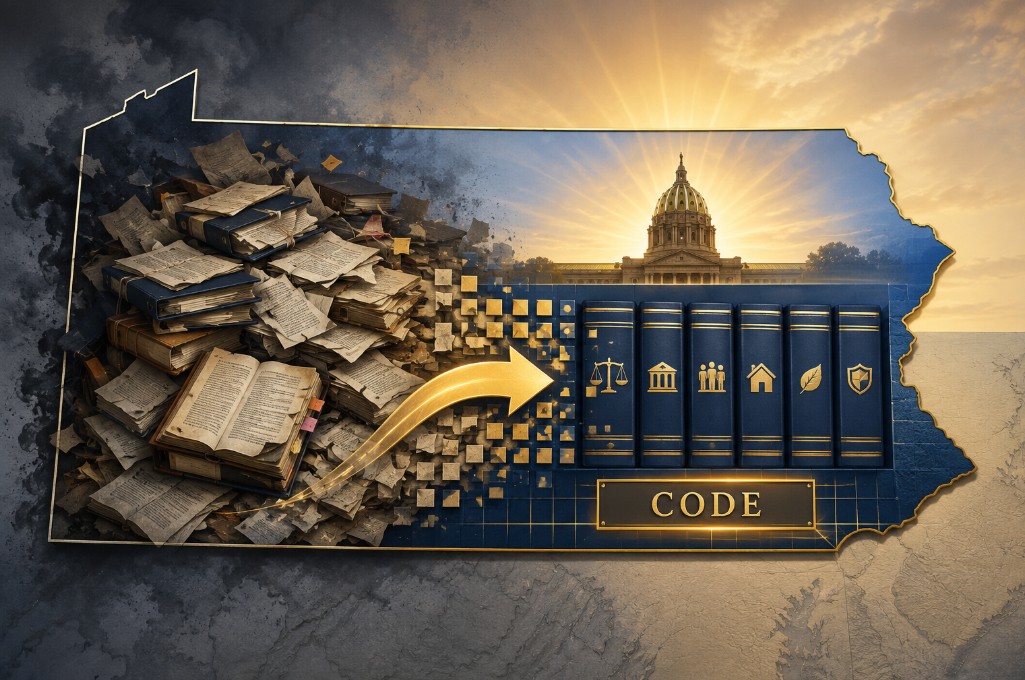
On February 11, 2026, Senate Bill 1036 was signed into law as Act 7, moving the First Class Township Code into Title 73 of the Consolidated Statutes. It took effect April 13. Local Government Commission staff worked the project with the Legislative Reference Bureau across multiple sessions before it reached a floor.
That was the third time.
The Borough Code went into Title 8 in 2014. The Third Class City Code went into Title 11 in 2015. The County Code is moving into Title 16 now.
Four bodies of municipal law, pulled out of stand-alone acts and placed in a code organized by subject, by an institution that has done it repeatedly and knows how long it takes.
That is not the full reform proposed in this series. It is proof that the Commonwealth already owns the machinery to begin it.
The Discipline Is Already There
The most important thing about Act 7 is what the Commission refused to put inside it.
The First Class Township Code needed substantive updating. That happened separately, in Act 96 of 2020, as its own omnibus amendment. The recodification into Title 73 came afterward, and carried no policy changes of consequence.
The reason, in the Commission’s own account, was transparency. Folding the substantive revisions into the recodification would have made those changes invisible to the members voting on them.
Read that again, because it is the entire premise of this series stated by a Pennsylvania legislative agency about its own work.
Two different questions live inside every piece of legislation:
What does the existing law say?
What should the law say now?
The first is craft. The second is politics. Mixing them lets politics hide inside editing, and lets editing become an excuse for avoiding politics. Pennsylvania separated them on purpose and said so on the record.
The Commonwealth has demonstrated the operating principle on one municipal code. Pennsylvania First is the proposal to run it everywhere.
Observe: The Commonwealth Keeps Two Bodies of Law
The Consolidated Statutes program dates to 1970. The code is arranged across seventy-nine subject-matter titles. Pennsylvania law remains partially consolidated, and alongside the code sits a large inheritance of stand-alone statutes identified by act number, date, and pamphlet-law citation.
None of that makes the unconsolidated laws invalid or unfindable by lawyers.
It means the citizen’s law is stored partly as a library and partly as an archaeological site.
A person trying to determine what the Commonwealth requires may have to consult a consolidated title, an older stand-alone act, several amendments to that act, regulations in the Pennsylvania Code, a court opinion construing the statute, a municipal ordinance adopted under it, definitions inherited from somewhere else, and a table explaining which provisions survived later legislation.
Professionals learn to navigate that. Citizens pay professionals to navigate it. Local governments make expensive mistakes navigating it. Businesses price the uncertainty into every permit and every project. Courts spend years resolving conflicts that began as failures of organization.
Law can be public in the technical sense while remaining functionally hidden inside its own history.
The Fifty-Day Problem
Pennsylvania is one of roughly ten states with a legislature the National Conference of State Legislatures classifies as full-time. It is the largest such body in the country — 203 representatives and 50 senators. Members are paid over one hundred thousand dollars a year plus per diem, second only to California’s much smaller legislature. NCSL puts the job at about eighty-four percent of full-time work, against roughly seventy-four percent in the states where the salary cannot be anyone’s sole income.
The General Assembly is a continuing body. It convenes in January and meets through most months of the year.
Actual voting happens a few times a month. Recent years have run around fifty session days.
Fifty days.
The Commonwealth pays 253 people a full-time professional salary, provides one of the largest legislative staffs in the country, and asks them to cast recorded votes on fifty days out of the year.
Every objection to the reform proposed in this series is a capacity objection. Congress cannot vote that often. A legislature cannot handle that many questions. There are not enough days.
Pennsylvania has the days. Pennsylvania is paying for the days right now.
The judicial repair docket described below would require the General Assembly to dispose of a queue of narrow, fact-tested legal questions every ninety days. In a chamber already staffed and salaried at full-time levels, that is a scheduling decision.
The capacity exists. It is idle.
Design: Finish the Code
The first component of Pennsylvania First is a Pennsylvania Law Completion Project, housed in the Legislative Reference Bureau and funded as permanent work rather than as a series of one-off consolidations.
Its purpose is not merely moving old acts into numbered titles. It is reconstructing Pennsylvania law as a coherent, public, continuously maintained system.
Every statute would eventually carry one official location, one current text, one defined subject, explicit relationships to other provisions, a visible amendment history, a derivation record showing where it came from, a disposition record showing what it replaced, linked regulations, linked controlling decisions, and a plain statement of which body administers it.
The Bureau already performs most of the professional work involved. It drafts legislation, edits and publishes the statutes, maintains legislative histories, oversees the Pennsylvania Code and Bulletin, and preserves session laws reaching back to the colony.
What Pennsylvania First adds is connection.
Statutes are currently published as one product, regulations as another, legislative history as another, and judicial construction as something a citizen must locate elsewhere entirely. They should be one map.
A person reading a law should see the rule now in force, the act that created it, every subsequent amendment, the definitions controlling it, the regulations implementing it, the decisions construing it, any unresolved judicial defect filed against it, and any proposed repair awaiting a vote.
The official law remains the enacted text. The map shows the system around it.
One Rule at a Time
The completion project should adopt a stricter drafting standard than consolidation alone requires:
One enforceable proposition per numbered provision.
Pennsylvania’s Constitution already requires that a bill contain one clearly expressed subject, with an exception for legislation codifying or compiling the law, and requires final passage by recorded yea-and-nay vote. Pennsylvania First carries that principle down from the bill into the law itself.
A section should not contain six unrelated commands, three exceptions, two delegated powers, and a definition buried in the last sentence.
Each provision should tell a reader who must act, what they must do, under what conditions, by what deadline, under whose authority, and what happens when the instruction is violated. Definitions explicit. Cross-references visible. Exceptions pointing directly at the rule they modify. Repeals removing dead text rather than leaving another layer of sediment on top of it.
This does not require every law to be one sentence. Human circumstances are more complicated than that. It requires each unit of law to perform one identifiable job.
The result resembles a well-designed technical system. Every component has an address. Every input has a source. Every output can be traced. When something fails, the defect can be located instead of debated as an atmosphere.
Start Where the Friction Is
Pennsylvania should not begin with the most ideological subjects. It should begin where the law is already grinding.
Building. Zoning. Permitting. Land development. Property maintenance. Municipal administration.
The Municipalities Planning Code remains a stand-alone act from 1968, amended repeatedly. The Construction Code Act remains a stand-alone act from 1999, carrying its own accumulation of amendments, exemptions, and regulatory dependencies.
These make ideal pilot systems because they govern ordinary decisions every day.
Can a family add an apartment for an aging parent? Can a farmer put up a structure? Can a closed storefront reopen as a different kind of business? Can a developer build housing on an abandoned industrial parcel? Which code edition controls? Which exemptions survive? What may a township require? Which decision belongs to the zoning officer, the hearing board, the municipality, the Department of Labor and Industry, or a judge?
None of that is an abstract constitutional question. It determines whether projects move, whether buildings decay, and whether a citizen experiences government as a usable system or an expensive fog.
The First Class Township Code supplies the process model. Building and zoning supply the pressure test.
If the method works where state law, local authority, technical codes, property rights, and judicial review collide daily, it will work anywhere in the code.
The Judicial Loop Comes Home
A finished code still cannot anticipate every case. New technologies appear. Municipalities use old powers in new ways. Two clear rules produce a conflict nobody predicted. A definition works for fifty years and then fails against something that did not exist when the General Assembly wrote it.
That is where the judicial loop begins.
Under Pennsylvania First, a judge deciding a case does what judges must do: applies the law and resolves the dispute. When the case exposes a genuine statutory gap, the judge also files a Code Defect Notice.
The notice identifies the statutory provision involved, the missing or conflicting instruction, the controlling definitions and related sections, the facts that exposed the defect, and the narrowest line that would resolve it.
The judge writes that line. Complete text, specific address, filed with the ruling. No bureau converts it. No commission reviews it first. Every judge in Pennsylvania traces back to a voter — elected in a partisan race, or appointed by an elected governor with Senate confirmation. A drafting office traces back to nobody, and an office empowered to decide how far a rule reaches and where it sits in the code is an office worth capturing. The Bureau maintains the code, publishes the map, and drafts for legislators who ask. It never touches a judicial line.
The line arrives in Harrisburg without disguise:
This case required an answer. The written law did not supply one. This is the line used to decide it.
The filing appears immediately on the public code page beside the affected provisions, and immediately on the General Assembly’s judicial repair docket.
Appeals proceed as appeals always do, in parallel. A Superior or Commonwealth Court panel may affirm the line, narrow it, relocate it, or reject it, and the docket entry updates to show what happened. The appeal governs the parties. The vote governs the code. Those are separate questions and the design keeps them separate.
Within ninety days, both chambers answer. Ratify. Amend. Replace. Or reject and state plainly that Pennsylvania law should not reach the disputed conduct.
The court exposes the operational failure. The General Assembly makes the values decision.
That division protects both branches. A judge is not professionally condemned because the legislature preferred a different policy — the companion brief on judicial structure sets out the three classifications that distinguish bad legal workmanship from a legitimate political choice, and a values revision carries no mark. A legislator cannot accuse a judge of activism while declining to vote on the gap the judge identified.
Each branch leaves fingerprints on its own work.
What It Looks Like in Cambria County
A property owner wants to reuse an abandoned commercial building.
The municipality reads one section of the planning law to require a particular approval. The owner reads another section and believes the project is permitted by right. Prior cases point in different directions because the statute inherited definitions from several sources across five decades.
The dispute reaches the court of common pleas.
Today the judge resolves it in an opinion. That opinion may settle the question within the judicial district, or get appealed, or sit unread until another municipality hits the same wall. The General Assembly may never learn the defect exists. The next owner in the next county starts over.
Under Pennsylvania First, the judge decides the case and files the conflict with the line that resolves it.
The filing lands on the public code page the same day. It lands on the repair docket the same day. Within ninety days, 253 legislators have voted on whether that is what Pennsylvania law should say.
The property owner gets a decision. The municipality gets a usable rule. The next judge gets enacted language instead of inherited confusion. The legislators get responsibility for Pennsylvania policy. The public gets to see who chose it.
That is a feedback loop, and the Commonwealth does not currently have one.
The Empty Chair in Harrisburg
The loop fails if legislators can avoid its questions by staying home.
Pennsylvania’s Constitution requires legislative journals, permits recorded yeas and nays, provides for open sessions, allows each chamber to compel attendance, and directs the presiding officer to call an election when a vacancy occurs.
What it does not define is the seat that remains legally occupied after the member stops performing the essential duty.
Pennsylvania First would add a functional-vacancy rule to the state Constitution. A member who fails to enter a yea or nay on ten percent of recorded floor votes during the measurement period creates an empty chair.
Not a present vote. Not an excused nonvote. Not a note from leadership confirming the member was in the building.
Yea or nay.
The rule does not inquire into motive. A member may be ill, campaigning, politically frightened, incapacitated, strategically absent, or protecting a donor relationship. Those circumstances differ enormously in moral weight and produce an identical result. The district’s vote is missing.
Ten percent is a generous allowance. It absorbs illness, family emergencies, transportation failures, and ordinary human disruption. It asks that one of the most consequential public jobs in the Commonwealth be performed ninety percent of the time.
Once the threshold is crossed, existing machinery does the work. The Constitution already directs the presiding officer to issue a writ of election on a vacancy. The amendment defines sustained nonperformance as one form of vacancy and makes the writ automatic, with an appeal available to contest the count before certification.
Replacement is restoration rather than punishment. A member’s health, blame, benefits, and privacy can all be handled humanely and separately.
There is a small piece of evidence sitting inside Act 7 itself. Among the changes made during the First Class Township Code revision was language prohibiting per-meeting compensation for a commissioner who has an unexcused absence from a board meeting.
A Pennsylvania township already docks an official’s pay for failing to show up.
The General Assembly has not applied that standard to itself.
The Judicial Craft Record
Pennsylvania has a unified judicial system running from the Supreme Court through the Superior and Commonwealth Courts, the courts of common pleas, and the minor judiciary. That structure makes it well suited to testing a professional judicial record.
It is also, in one respect, a hard case. Pennsylvania judges reach office through partisan election followed by nonpartisan retention. A judicial career selected by campaign is the opposite of the professional corps described in the companion brief on judicial structure, and this brief does not propose fixing that first.
Start with the record instead of the selection method.
Every judge participating in the code-defect system accumulates a public professional file: years of service, defect notices filed, notices affirmed, revised, or rejected, missed controlling statutes, missed cross-references, overbroad lines, constitutional errors, failures to identify a defect plainly present, values revisions by the General Assembly, and genuine contested questions of first impression.
The file distinguishes political disagreement from poor legal work. That distinction is the whole instrument, and Pennsylvania can build it without changing how a single judge is chosen.
A credential is a prediction. A record is a measurement.
Eligibility for the statewide appellate courts could eventually require a minimum of scored years and a sufficient body of reviewed work, so that a brief appointment arranged to decorate a résumé cannot substitute for a mature record. That is a later question and it belongs to the voters.
What changes immediately is what a retention election is about. Pennsylvania voters currently decide whether to retain a judge on the strength of name recognition, party label, and whatever the last controversial ruling was. Under this system they would decide on the basis of work.
The law side of government gains authority by becoming less political in operation while becoming more accountable in public. Both at once, or neither.
Build It in Public
Pennsylvania already publishes statutes, regulations, and legislative materials online, and the Legislative Reference Bureau is digitizing session laws reaching back to the colonial assembly.
Pennsylvania First turns preservation into active civic infrastructure.
Every proposed line public from the moment it enters the system. Every amendment versioned. Every sponsor identified. Every judicial defect notice linked to the affected law. Every legislative instruction sent to a drafter eventually visible in the public file. Every outside organization proposing statutory language attached to that language. Every vote searchable by member, subject, district, and date.
Private constituent information gets redacted. Legitimate law-enforcement and security material gets narrow protection. Ordinary legislation does not get treated as a state secret.
Lobbying succeeds most easily in the distance between the public text and the private instruction. Close the distance.
Speech and Debate protection should remain intact. Protecting a legislator from outside prosecution over legislative work does not require protecting the work from public knowledge.
A legislature should be free to deliberate. It should not be free to govern anonymously.
Intervene: The Deployment
Pennsylvania does not need to amend its Constitution before doing anything useful. It needs an ordered deployment.
Phase One: Complete a Working Segment
The General Assembly creates the Pennsylvania Law Completion Project inside the Legislative Reference Bureau and funds a permanent interdisciplinary team — legislative drafters, municipal lawyers, code officials, information architects, public-access specialists.
The first segment covers the Municipalities Planning Code, the Construction Code Act, associated provisions scattered through municipal and administrative law, implementing regulations, controlling appellate decisions, derivation and disposition tables, and a public legal map.
Substantive law does not change during migration. Policy changes go in separate bills with separate votes, following the discipline the Commission already used on the township code.
The Supreme Court adopts a pilot rule and courts begin filing Code Defect Notices.
The General Assembly creates a public judicial repair docket and commits by resolution to recorded action within ninety days.
Every legislator receives a public participation record showing yea votes, nay votes, and failures to vote. A nonvote stays a nonvote regardless of who excuses it.
All of Phase One runs on existing institutions and existing authority.
Phase Two: Amend the Constitution
The amendment package establishes functional vacancy after failure to vote on ten percent of recorded floor decisions; automatic issuance of a writ of election on certification; mandatory yea-or-nay voting on judicially filed code defects; automatic floor placement within ninety days; formal authority for the judicial loop with legislative control over policy preserved; public professional records and minimum scored experience for statewide appellate office; and a legislative record broad enough to show who proposed, changed, and supported every operative line of law.
Pennsylvania’s amendment process requires identical language to pass both chambers in two consecutive sessions before reaching the voters. That is slow by design, and the slowness is useful here. It creates time for the pilot to expose weaknesses before anyone constitutionalizes the architecture.
The pilot supplies evidence. The amendment supplies permanence.
Phase Three: Title by Title
Once building and zoning demonstrate the system, the Commonwealth continues through the unconsolidated statutes by subject — which is what the Local Government Commission and the Bureau have been doing since 2014 anyway.
Each migration produces a clean official code, a conflict report, a list of dead provisions, a list of unresolved policy questions, a list of settled judicial constructions, and separate legislation for any values changes anyone wants.
The work does not need rushing. Act 7 took multiple sessions. The objective is a code that becomes more coherent every year instead of accumulating another geological layer.
What Pennsylvania Gains
Clarity first. Municipalities spend less money interpreting inherited conflicts. Citizens find the law without reconstructing its lineage. Businesses can estimate requirements before investing. Courts identify defects systematically instead of solving the same ambiguity in isolation, one county at a time. The General Assembly receives a steady stream of narrow, fact-tested repairs instead of waiting for a full political crisis before reopening an old statute.
Accountability second. Judges get evaluated for legal workmanship rather than for whether a ruling was popular. Legislators own their values decisions. A missing vote stops functioning as a safe harbor. Lobbyists keep the right to petition and lose the ability to do it out of sight.
Trust third, and it follows from the other two. Trust does not return because officials request it. It returns when a person can follow the wire.
Who proposed this rule? Who drafted it? Who changed it? Which court found the problem? What language did the judge write? What did the legislature do about it? Who voted yea? Who voted nay? Who disappeared?
A government able to answer those questions does not have to ask anyone for faith. It can produce the record.
Not a Partisan Program
Nothing in this architecture guarantees a progressive law, a conservative law, or a moderate one. It guarantees identifiable law.
A conservative legislature could reject a judicial line expanding a government program. A progressive legislature could replace a narrow line with a broader protection. Voters could approve the amendments or refuse them. Judges could rule against anyone.
The system does not decide values in advance. It decides who has to take responsibility for choosing them.
That is the point, because most modern dysfunction survives on diffused responsibility.
The legislature blames the courts. The courts say they are merely construing the legislature. Agencies blame broad statutory mandates. Legislators blame agency discretion. Leadership excuses missing votes. Members blame leadership for never scheduling the hard question.
Everyone holds enough power to shape the outcome and enough ambiguity to deny owning it.
Pennsylvania First removes the ambiguity one line at a time.
Why Pennsylvania
Pennsylvania is not a blank slate, and that is the advantage.
It carries laws descending from William Penn’s colony, industrial cities chartered in the nineteenth century, thousands of local governments, dense municipal law, a unified court system, a professional legislative bureau, and a consolidated-statutes program with three completed migrations and a fourth underway.
It contains Philadelphia and Forest County. Pittsburgh and Upper Yoder Township. Old coal towns, farm counties, fast-growing suburbs, and municipalities trying to govern on a tax base built for a different century.
A legal architecture that works across Pennsylvania has survived a serious test.
The Commonwealth also has the largest full-time legislature in the country, sitting fifty days a year, with the capacity to do this and no current reason to.
And it carries the right inheritance for the experiment. The Quaker principle was never that people would agree. It was that conscience has to be heard, authority has to justify itself, and coercion is the last instrument out of the cabinet rather than the first.
Transparent law does not end conflict. It makes conflict legible.
A recorded vote does not guarantee wisdom. It makes the person exercising power answerable for it.
A professional record does not guarantee a just judge. It makes failure harder to disguise as philosophy.
A consolidated code does not perfect a government. It gives one a shape that citizens can inspect and repair.
Pennsylvania First
Washington does not have to approve this.
The Legislative Reference Bureau knows how to draft and consolidate. The Local Government Commission knows how to assemble stakeholders and work a code until the language holds. The courts already encounter the defects. The Constitution already expects open sessions, journals, and recorded final votes. The voters already hold the amendment power.
The newest proof is sitting in Title 73, and the one before it in Title 11, and the one before that in Title 8.
The Commonwealth already knows how to take a body of inherited law apart, determine what still works, and rebuild it where people can find it. It has done it three times and is doing it again.
Enlarge the project.
Finish the code. Connect the courts to the legislature. Make every law traceable. Make every defect visible. Make every legislator vote. Replace the empty chair. Build a professional record for every judge. Let the public watch a law move from problem to repair.
Then hand the country a working model.
Pennsylvania first. The republic after.