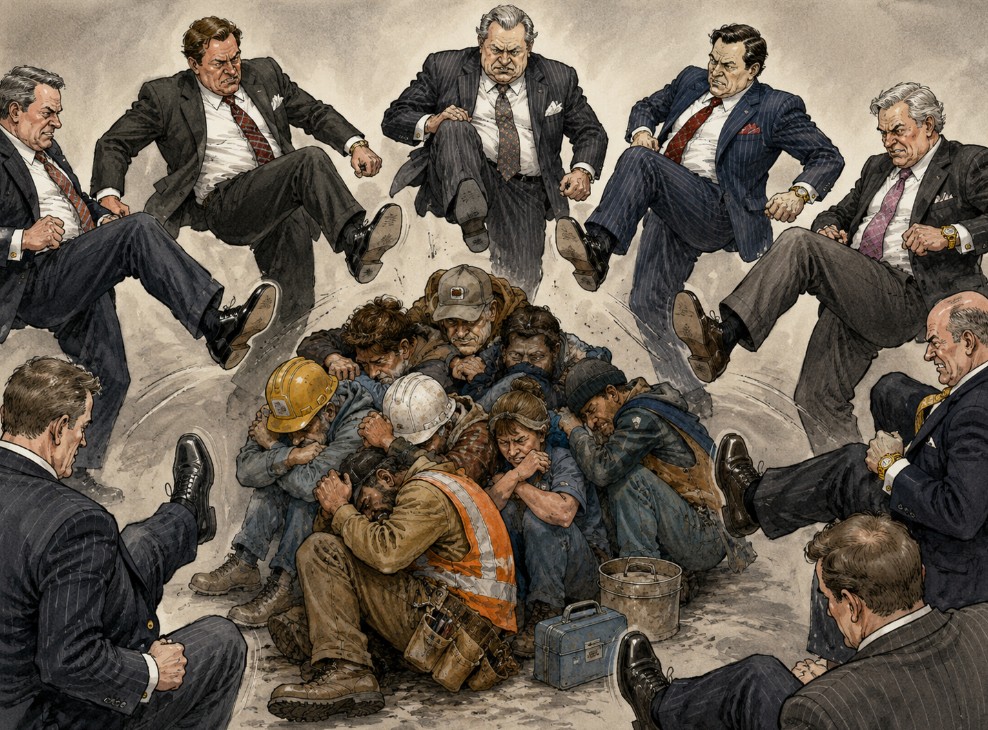
The Man Who Had to Be His Own Steward
I was sitting with the editor the other day. He’d called me up to talk about something else entirely, and somewhere between the first cup and the reason he’d asked me over, he started telling me about his troubles with the courts.
Now, I’ve stood steward the better part of forty years. I have heard a great many men tell me about trouble. You learn to listen the way a foreman reads a wall — you let the man talk, and you watch for the crack that’s actually holding the load.
So I listened. And I’ll tell you, Jack, there were three or four moments in that hour where I set my cup down and asked him to run it by me again. Not because I couldn’t follow him. Because I could, and I didn’t want to.
He told me first what he wasn’t. He wasn’t a lawyer, and he wasn’t going to play one. But he didn’t come to this empty-handed either. Years of union training. Written his own grievances. Sat through arbitrations. This is a man who knows how to gather facts, line up an argument, and put it in front of somebody whose job is to answer it. Told me he’d been in Mensa till he quit paying the dues — which, he said, proves he could pass one test and eventually make one sensible financial decision. I laughed. He didn’t, much.
Because here’s the thing he wanted straight before he said another word. When a working man can’t get through a system, the easy explanation is that he didn’t understand it. He wanted that explanation off the table. And Jack, having heard him out, I’ll put it there myself. This man understood his problem. He could state it in a paragraph. What he could not do was move it through the machinery built to decide it.
Three federal venues. More than three years. Still no clean answer to the plain question he actually asked.
The Case Before the Case
He had three matters. He was fair about them, and I respect a man who’s fair about his own fight.
The first should’ve been four steps. A judge reads the complaint and the rule. Asks what’s unclear. Holds a hearing. Decides. The whole question sat inside his own knowledge and fit on a page. Might’ve gone against him — he said so himself, and said he’d have taken it. A man asks for a decision, he has to be willing to lose one. But it should’ve been decided. Instead the procedure ate years before the substance ever got put in front of anybody allowed to rule on it.
The second had real meat to it — competing authority, disputed facts, the kind of work a lawyer is actually for. He didn’t resent paying for that. The third was a medical matter, genuinely complicated, complicated because medicine is complicated. He gave me that concession up front, and it told me he wasn’t selling me a bill of goods.
Then he said the line that made me put the cup down.
The system laid nearly the same burden on all three — before anybody even sorted out which kind of case each one was.
That’s the part I couldn’t get past. In my shop, before a man ever argues whether he was wronged, the courthouse makes him answer a whole separate examination first. Which court hears it. Whether he exhausted the agency. Whether he named the right party. Whether the government’s even allowed to be sued on it. Which legal label fits the injury. Which standard applies. Right form. Proper service. Right window. Which statute or rule or old opinion controls. Whether he pleaded it in the exact technical wording. Whether some procedure argument already sank the real one.
He had to solve all of that, alone, in advance, before he ever reached a soul empowered to help point his case down the right hall.
Jack, I have spent my whole working life being the man who carries that load for the worker. That’s what a steward is. A fella comes to me with a beef, he doesn’t need to know it’s a Step Two under Article 14 with a five-day clock. That’s my job. I know the route so he can keep his hands on his actual work. Management can’t tell him “wrong form, start over, clock’s dead” — because I made sure it landed right.
The editor was describing a government that makes every single citizen be his own steward. And then rents him one, at a lawyer’s wage, if he can afford it.
He was careful — and I’ll be careful for him. He’s not crying conspiracy. Doesn’t think the judges were against him, doesn’t think the statutes were written to sink him. Neither do I. What he believes is stranger and harder. In at least two of those matters, he still can’t say for sure that any judge was ever handed a clean shot at deciding what he thought the case was about. A judge can apply every rule right and still land wrong, because the system never translated the man’s actual complaint into a form the judge was permitted to rule on.
He called it gatekeeping with no gatekeeper. Nobody decides to keep you out. The building does it for them.
Three Percent
I told him, plainly, that I figured he was just one unlucky fella. He slid a page across the table.
Turns out a full quarter of the country’s federal civil cases — 27 percent, from 2000 to 2019 — had at least one person standing without a lawyer. That’s not a handful of cranks. That’s a crowd.
And in the district courts, from 1998 to 2017, the folks without a lawyer won a final judgment about 3 percent of the time as plaintiffs. Around 12 percent as defendants.
Three percent, Jack.
Now, I’m a fair man. That number does not mean 97 out of 100 were wrong. Some were. Some cases are frivolous and some men are angry instead of injured, and the courts have to sort both. I’ve thrown out my share of bad grievances — being mad is not the same as having evidence, and any honest steward will tell you so. But nobody with sense believes the merits sort that clean. When the lawyered-up win at several times the rate of the ones going it alone, you’re measuring something other than who was right.
Renting a Navigator
Then he said the thing hiring counsel changed for him. It did not change one fact of his case. The lawyer didn’t have his memories, didn’t know the work better than the man who’d done it with his own hands.
What the lawyer knew was the route. Which forum. Which label opens which door. Which facts the law cares about and which ones only matter to the man they happened to. Where the traps sit. Which deadline actually rules. How to package an argument so the court will look inside the box.
That knowledge is real, and it’s worth paying for. Lawyers train years for it and they’ve earned every dollar of skilled work — I’ve got no quarrel with the trade. My quarrel, and his, is that the system turned knowing the route into the price of being heard at all.
He didn’t hire a lawyer to make his argument better. He hired one because the system wouldn’t reliably recognize his argument until a licensed guide walked it inside.
That puts a thumb on the scale before anybody weighs the merits. The man with money can file twice, keep a specialist, buy an expert report, walk back an early stumble. The man without it loses the whole thing on one wrong form. Same right on paper. Only one of them can afford to switch it on.
The law is public, Jack. The road to it has gone private.
They Already Wrote the Rule
Here’s where he got angry, and I don’t blame him, because it made me set the cup down a third time.
The most sensible fix in the whole business is simple. A man files a real claim in the wrong federal door, the government shouldn’t slam it and make him start from scratch. It should find the right door and walk the paper over — keeping the day he first filed.
That is already the law. Has been since 1982. When a federal court finds it hasn’t got jurisdiction, it can transfer the case where it belonged, and the case counts as filed the day he originally brought it. Congress decided this forty-four years ago.
So the principle’s correct and it’s on the books. Trouble is the size of the circle it draws. It covers moving between federal courts. It does not reach the gap between a court and an agency — which is exactly the ditch a man with an administrative complaint falls into. And it leaves every court a “if it serves justice” exit.
So the reform isn’t some invention. It’s just carrying a decision Congress already made into the part of the system where ordinary folks actually get stopped. The government knows its own hallways better than the citizen ever will. It ought to carry the burden of routing a claim through them. You don’t punish a man for failing to read an organizational chart the government drew and never showed him.
He’s got a bigger idea underneath it — a law written so every rule carries its own address, and the address carries its instructions right on the line: who’s bound, what’s required, which tribunal hears it, what deadline runs, what remedy’s available. I understood that one immediately. It’s a blueprint that prints the part number, the torque spec, and which department to call when the thing fails, all on the same line. Right now the law publishes the rules and hides the routes. A finished code prints both. Measure twice, act once — but first the drawing’s got to tell you where to measure.
The Loop Protects the Next Man
There’s a piece of his idea I’ve come to care about most, and it’s the most union thing in the whole business.
When a case finally reaches a judge and the written law simply doesn’t answer the situation, under his system the judge writes the missing line and files it. Then the legislature has to adopt it, fix it, replace it, or throw it out — on a clock, on a recorded vote. So the case doesn’t just produce an opinion. It produces a repair.
Right now a man can spend three years discovering a genuine hole in a statute, and watch that discovery vanish into an opinion nobody reads. The next fella hits the same wall and starts from zero. Under the loop, that discovery becomes maintenance. Gets an address. Gets a date. Gets a vote.
Jack, that’s the oldest idea I’ve got. Your grievance today is the next man’s protection tomorrow. That’s the whole reason we stand together. The man without a lawyer becomes one of the sensors the country uses to find out where its own law has failed. That’s worth something even to a man who loses.
The Right to Arrive
He said it best himself, and I’ll give him the words: he’s not asking for a system where the man without a lawyer wins. He’s asking for one where he can arrive.
We talk about equal justice like it begins when a judge weighs the evidence. It begins long before that. It begins with being able to find the governing rule. Knowing where to file. Getting a notice a working man can actually read. Reaching the right tribunal. Having a mistake corrected instead of turned straight into forfeiture. A rich man and a poor man can stand under the very same statute, hold the very same right, and not be equal before it — because only one can pay to decode the road to enforcing it.
My father was a Pullman porter. He used to tell me, we carried other folks’ baggage, son, but never their shame. That’s the job, I always figured. A steward carries the paperwork so the worker keeps his dignity. What the editor described is a courthouse that hands a man the paperwork and the shame, and calls it due process.
That’s the difference between losing under the law and being shut out by the architecture. A man ought to be able to lose fair. What he shouldn’t have to accept is that the question never reached the judge in a form the judge was allowed to hear — unless he could pay somebody who knew the hidden way in.
I finished my coffee. Told him I’d write it down.
Well — now you know, Jack.