Silas Corvin reporting
I have been doing this a long time. Long enough to tell the difference between a bad week and a pattern.
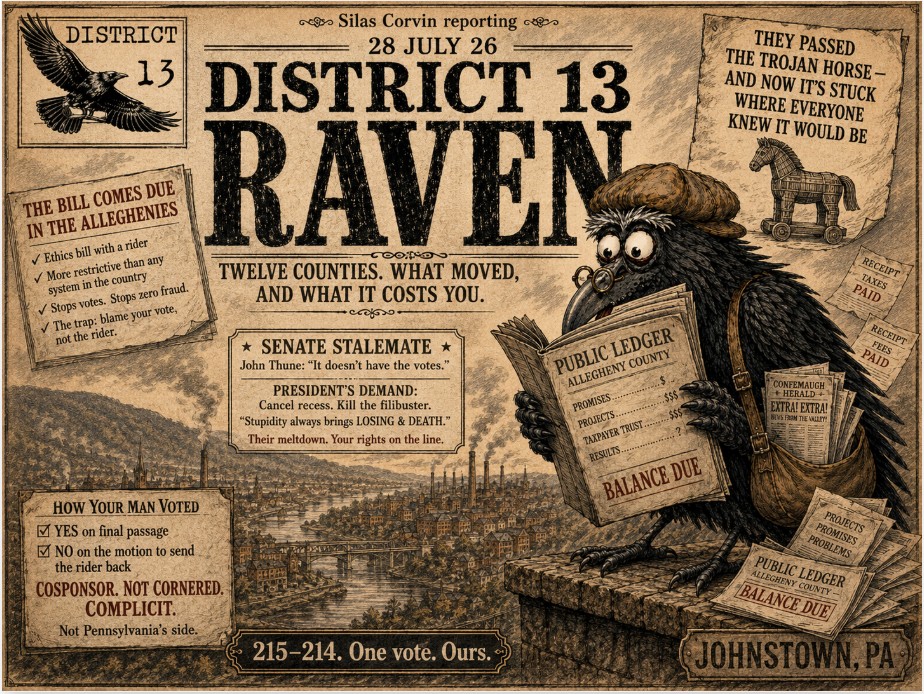
This is a pattern. Twelve counties. Here’s what moved, and here’s what it costs you.
They Passed the Trojan Horse — And Now It’s Stuck Where Everyone Knew It Would Be
Start with the con, because it’s the cleanest example of the whole racket you’ll see all year.
Last Wednesday the House passed the “Stop Insider Trading Act,” 232 to 198. Sounds clean. Sounds like Congress finally deciding it shouldn’t be trading stocks on information the rest of us don’t get.
Read the second half of the bill.
Bolted onto it is a Section 3 titled “Requiring voters to provide photo identification” — the full text of a separate voter ID measure, applied to federal elections, mail-in ballots included. An ethics bill, carrying an elections bill, welded inside the hull. 5 Calls
And the ethics half is thinner than the label. Members keep every share they already own. They can’t buy new individual stocks, and before selling they post a notice a week or two ahead. The bill exempts the White House and the Supreme Court entirely, and does nothing to stop a member from writing policy that pumps his own portfolio. That’s not a ban. That’s a courtesy window with a press release stapled to it.
Now the half they’re not advertising — and I’m not going to characterize it, because I don’t have to. It’s in Congress’s own committee report. That report says the ID regime would be more restrictive than any system currently in use anywhere in this country, Texas and Florida included. It requires voters to mail a photocopy of a narrow list of IDs along with the ballot — a provision the Republican Lieutenant Governor of Utah warned could violate the constitutional right to a secret ballot, and one the Republican Governor of Ohio vetoed at the state level, saying it wouldn’t discourage fraud.
Sit with that. Republican officeholders in Utah and Ohio looked at this mechanism and stepped back from it. Congress stapled it to an ethics bill and passed it anyway.
And here’s what it does here. Pennsylvania has no-excuse mail voting. In a district spread across mountains and two-lane roads, that isn’t convenience — it’s how people vote. The farmer mid-harvest. The night nurse coming off shift at Conemaugh. The veteran who can’t stand in a line. The eighty-year-old in Bedford County forty minutes from her polls who doesn’t drive after dark. Make every one of them photocopy an ID and mail it in, and you stop zero fraudulent votes. You stop votes. That’s not a side effect. That’s the specification.
Here’s the trap they built into the vote itself: cross it off, and in October you get a glossy mailer saying you voted to protect congressional insider trading. The mailer will never mention the rider. That is what this bill is for.
And now — six days later — watch the con fall apart on its own side.
The bill went to the Senate the next morning. There it sits. Majority Leader John Thune has said flatly it doesn’t have the votes — not enough Democrats to break a filibuster, and not enough Republicans to kill the rule that requires sixty. He’s been saying it since spring. It’s math, he says, and there’s nothing he can do about it. Signal Congress
So what happens when the prop stops performing? The President went on his website Monday and demanded Thune cancel the Senate’s August recess and keep everyone in Washington until it passes — or better yet, terminate the filibuster entirely. He added, and I’m quoting the man directly, that “stupidity always brings LOSING & DEATH.” A handful of his loudest allies are now in open revolt against their own leader over a recess that’s supposed to start August 7th.
Understand the shape of it. They want to burn down the sixty-vote rule — the same rule that, the day it’s gone, lets whoever holds the Senate next pass anything at all with fifty-one — to force through a bill their own leader says is dead. That’s not a party governing. That’s a party fighting itself over theater, because the audience the theater was written for now wants it made real, and it can’t be.
Which brings me home.
How Your Man Voted, and What It Bought You
I don’t traffic in maybe. Here’s the record, pulled from the Clerk of the House.
On final passage, John Joyce voted yes. On the motion that could have sent the rider back before passage, he voted no. Read those two together, because together is the only honest way to read them. He voted to keep the voter ID rider in, then voted to pass the bill carrying it. And this was no floor ambush — his name is on the thing as an original cosponsor, filed the day it dropped back in January. “Mr. JOYCE of Pennsylvania.” He didn’t get cornered. He helped carry it in the door.
For anyone new to this column, it isn’t the first time. After the 2020 election, Joyce joined a case before the Supreme Court asking that every presidential vote in Pennsylvania — along with three other states a Democrat won — be thrown out. He has now spent five years on the same side of one question, and it is not Pennsylvania’s side.
Here’s the part that ought to sting in a Republican household. Pennsylvania’s no-excuse mail voting came from a Republican legislature — their bill, their votes. Now a committee chairman from Wisconsin wants to bury it under a photocopy requirement, and your congressman held the door.
So ask the plain question: what did that yes accomplish for the 13th? It didn’t ban insider trading — the real version got voted down in committee, twice, including one amendment that would’ve covered the President himself. It won’t become law — the Senate can’t pass it. It fixed no road, saved no hospital, lowered no bill. What it did was put his name on a voter-suppression measure in an election year, on the theory the mailer writes itself and the rider stays buried.
I’m the rider’s problem. My whole job is to keep it un-buried.
The Power Bill Nobody Voted For
While the House spent last week building a prop, the thing that’s actually emptying wallets kept right on moving.
On July 15, PJM — the grid that keeps the lights on from here to Chicago — announced its newest capacity auction cleared at the maximum price cap, $325 per megawatt-day. That’s the third straight auction to slam into the ceiling. And it came up 6,831 megawatts short of the grid’s own capacity target — a bigger shortfall than the year before. The driver isn’t a mystery. PJM’s own executive said the results leave “no doubt that data centers’ demand for electricity continues to far outstrip new supply.”
Put a number on who pays. The independent market monitor found data centers drove sixty-three percent of the increase in the previous auction — about $9.3 billion in costs recovered from customers across the region in a single year. Money you don’t have, going to cool a windowless building in Virginia that’s teaching a machine to write poetry. Nobody asked the retired car-shop man in Portage. Nobody’s going to.
Joyce sits on Energy and Commerce — not a committee, the committee, the one with jurisdiction over the grid. I went looking again this week for a ratepayer-protection bill with his name on it.
Still looking.
The Orchards Got Help — From Harrisburg
Three months since the freeze Penn State called the worst in forty years. Statewide losses ran an estimated $150 to $200 million, some crops a total loss. One grower near Harrisburg put his own tally plainly: half the cherries gone, ninety percent of the apricots and plums, eighty percent of the peaches, most of the apples frozen on the branch. PennWatch
Here’s the split-screen worth your attention.
The federal response so far: a disaster declaration covering 28 counties, and until January 26th to apply for an emergency loan. A man loses a year of fruit and Washington’s answer is permission to borrow against next year’s. USDA did later add some crop-insurance flexibility — but only for apple growers, leaving peaches, cherries, and the rest with nothing. StateCollege.comPennsylvania Government
Harrisburg, meanwhile, put up cash. The state budget Governor Shapiro signed this month created a $10 million Freeze Disaster Recovery Grant program — real dollars, not a loan application. And Pennsylvania is now leading a seven-state push to get Congress to authorize block-grant funding so states can build relief tailored to the crops that actually froze. That’s the ask sitting in Washington’s lap right now. Franklin County Free PressGovly
And the federal event for apple growers? It happened in Biglerville — Adams County, this district — announced by a USDA undersecretary and the congressman from the 15th. Not the 15th’s district. Ours. And ours wasn’t at the podium. A man can vote however his conscience or his Speaker directs. But showing up when the crop dies in your own backyard isn’t a vote. It’s just the job. PennWatch
The Bill That Actually Governs You Is Still Coming Due
Don’t let the noise from Washington pull your eye off the ball. The thing that reaches into your kitchen isn’t stuck in the Senate — it already passed, last year, and it’s grinding forward on a timer.
The Medicaid cuts from that budget law still pull an estimated $20 billion out of Pennsylvania over ten years starting in 2028. The state hospital association counts seventeen Pennsylvania hospitals that could close — nine of them at immediate risk, most in the western part of the state — and Pennsylvania has already seen two close this year. Their CEO’s words were “devastate” and “destabilize,” and she added the part that ought to keep somebody up at night: once a service ends or a hospital shuts, it almost never comes back. The SNAP cost-shift still drops roughly $410 million a year on Harrisburg, timer set for October 2027. Pennie enrollees still carry a 102 percent average premium jump for this year. Spotlight PA + 2
And the Governor has been blunt about what the state can and can’t do: there is no back-filling. “There are no dollars available at the state level to make up for these cuts. So if they cut someone off Medicaid, they’re off.” RFD-TV
All of it — the hospitals, the groceries, the premiums — traces to one bill and one roll call. It passed this House 215 to 214. One vote. Every yes was the deciding yes, and there’s no hiding in a margin of one. Joyce’s was a yes. He is also a physician, which means he knew precisely what a Medicaid reimbursement rate does to a rural hospital, because that is his profession.
Everything above is the interest payment on that single yes. It didn’t break as news this week because it isn’t new. It’s just true.
Credit Where It’s Owed
That same state budget that funded the freeze grants also runs $10 million to fruit growers and holds hospital funding steady while adding a billion in Medicaid spending. Note the return address on the help in this column — the grants, the freeze fund, the mail ballots your Republican legislature created. Franklin County Free Press
Harrisburg. Not Washington.
I’ll leave you the way I mean to leave you every week. Don’t get mad — anger’s cheap and mostly useless. Get precise. Learn that the “ethics” bill is stranded in the Senate because it was never about ethics. Learn that the freeze money came from the state and the loan application came from Washington. Learn who was at the podium in Biglerville and who wasn’t. Keep the receipts, because they are betting the whole game on you not bothering.
Every source for every number above is posted at District 13 Raven. Go check my work. I’d think less of you if you didn’t.
Twelve counties, every day, no appointment necessary.
— Silas Corvin