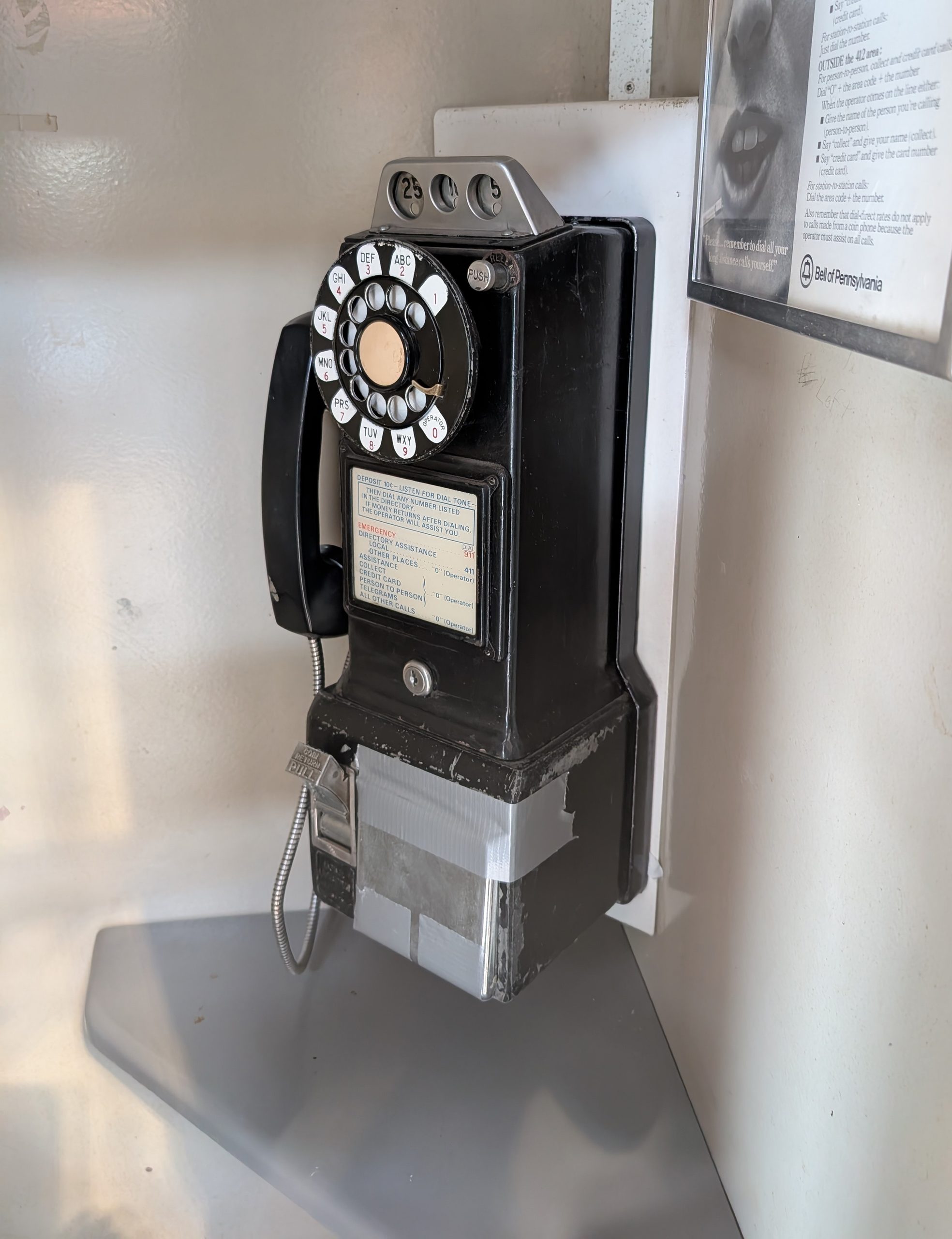
Somebody taped the coin vault shut. Two strips of silver duct tape hold the bottom of this phone together, and the black enamel has worn down to bare metal along the edges where a few decades of hands and elbows rubbed it. Up top sits a chrome hood with three coin slots, stamped 25, 10 and 5. Below that, a rotary dial with letter groups beside each number, ABC over the 2, DEF over the 3, and a red zero at the bottom marked OPERATOR. The instruction card under the dial reads like a set of house rules: deposit ten cents, listen for a dial tone, then dial. If your money comes back after dialing, the operator will assist you.
On the wall beside it, a framed Bell of Pennsylvania notice asks callers in the 412 area code to please dial their long-distance calls themselves. The fine print adds that dial-direct rates don’t apply at a coin phone, because an operator has to help with those calls.
This box was a terminal on a machine the size of a continent. A pair of copper wires ran from the back of it, through the wall, out to a central office, and from there into switches, trunk lines and cables that connected it to any other phone on the network. At the far end of some of those calls sat a person wearing a headset, listening to your coins fall. The three-slot phone was built to be counted by ear. A nickel struck a bell once, a dime struck it twice, and a quarter hit a gong. The operator heard the tally through the line and knew whether you had paid enough.
Back up a little
That operator sounds like a figure out of deep history. The whole story of wired communication sits closer than it feels, though. You could lay it end to end across a few grandparents.
In 1844 Samuel Morse sent a message over a wire from Washington to Baltimore. By 1861 a telegraph line crossed the country, and the Pony Express shut down within days. A working cable crossed the Atlantic in 1866, and news that once took two weeks by ship arrived the same afternoon.
Alexander Graham Bell patented the telephone in 1876. Two years later New Haven, Connecticut opened a commercial switchboard, and the operator was born: a person who took your request and plugged your line into someone else’s by hand.
1889 turned out to be a big year for the wire. In Hartford, William Gray installed the first coin-operated telephone, in a bank. That same spring, the South Fork dam gave way above Johnstown, and warnings raced down the valley by telegraph ahead of the water. Hettie Ogle, who ran the Western Union office in Johnstown, stayed at her key sending messages until the flood reached her office. She died there.
In 1891 a Kansas City undertaker named Almon Strowger patented an automatic switch, reportedly because he suspected a local operator of steering his customers to a competitor. Machines began taking over the plugging. A coast-to-coast phone call happened in 1915. By 1951 a caller in Englewood, New Jersey could dial long distance straight through to California without an operator. The Bell notice on this wall is the tail end of that campaign, teaching people to do for themselves what a switchboard used to do for them.
A little over a hundred years, telegraph key to rotary dial.
How the phone worked
Here is the routine for a local call. You lifted the handset and dropped a dime in the middle slot. The coin didn’t go straight to the vault. It sat in a hopper inside the phone, held in escrow. Once the dial tone came, you spun the dial for each digit and let it ride back, each return sending a string of clicks down the wire that the switches counted. If someone answered, the central office signaled the phone to drop your dime into the vault. If nobody picked up, you hung up and the dime rattled down the return chute. If it stuck, you yanked the lever marked PULL.
Long distance took more work. You dialed 0 and the number, and an operator came on and told you the charge for the first three minutes. You fed quarters into the slot and the gong sounded down the line. At the three-minute mark the operator broke in and asked for more money, and if you ran short, the call ended.
And if you had no change at all, you still had options. Dial 0 plus the number and tell the operator you wanted to call collect. She rang the other end and asked whoever answered, “I have a collect call from Bert. Will you accept the charges?” If they said yes, the call went through and the cost showed up on their monthly phone bill. Person-to-person calls worked the same way with one twist: you only paid if the specific person you asked for came to the phone.
People learned to game it. A kid stranded at the bus station could place a collect call from “Imsafe Pickmeupatnine,” and the parent on the other end could decline the charges and still get the message, for free.
The card on this phone also lists CREDIT CARD. At this phone, that meant a telephone company card with a number printed on it, which you read out loud to the operator. The phone itself had no way to read a card. No money moved while you talked. A human wrote down or keyed in what you said, and the charge arrived on paper at the end of the month. The whole billing system ran on voices and good faith.
In one working life
This was how you called home when you were away from it. You looked for a phone booth, a gas station, the wall outside a diner. You carried a roll of quarters in the glovebox. You memorized the numbers that mattered. That arrangement was the standard in my lifetime, and I’m still in my working years. The Bell System had more than two million pay phones in service in the mid-1990s. Today a small fraction remains, and the ones still on walls are often held together with tape, like this one.
The run from Morse’s first message to this taped-up box covers about a hundred and eighty years. The stretch from everyday standard to museum piece took roughly one career. That shrinking gap is the subject of our series on the singularity here at Blue Ribbon Team:
We Are Already Inside the Singularity