Labor History: August 13, 1892 — Tracy City, Tennessee
Two crews worked that coal. One of them could go home.
On August 13, 1892, free miners at Tracy City, Tennessee walked up on the stockade Tennessee Coal and Iron kept alongside its works. Inside the fence were men the state had leased to the company — prisoners, rented out the way you’d rent a compressor. The miners burned the stockade and put those men on a train to Nashville. It was one action out of many across the Tennessee coalfields, and it built the pressure that killed the state’s private convict-leasing business.
I’ve heard that told as a riot. It was a jurisdictional fight over who the enemy was, and it cost those men years of blood to get the answer right.
Tennessee had been leasing prisoners since 1866. The state collected money. The company collected men who could not quit, strike, negotiate, or walk across the road and hire on somewhere better. Fine arrangement for the two parties who signed it.
One of the company’s vice presidents, Colyar, said the useful part out loud. Convict labor gave them an “effective club to hold over the heads of free laborers.”
That is a man telling you what the tool is for.
The captive worker’s job was never only to dig. His job was to stand behind you while you asked for another nickel a ton. Want the timbering done right before next shift? Look behind you. Want to organize? Look behind you. There’s a man in that stockade with no standing to refuse, and the company wants you counting him as competition.
He was a hostage.
A noun doing a man’s work
Say convict and watch how much gets settled before you’ve spoken a second word. There’s a reason he’s behind that fence. He’s a different order of man from the one outside it. Whatever’s happening to him traces back to something he did, and you don’t have to look closer than that.
You never learn what he did. The noun handles it.
Here’s the record. In post-Civil War Tennessee, African Americans made up most of the prison population, and a man could be sent down for offenses so small that the state’s own encyclopedia reaches for the theft of a fence rail as its example. Conditions for leased prisoners ran to beatings, filthy sanitation, short rations, and the daily business of being degraded on purpose. Across the postwar South, vagrancy laws and their cousins were written to feed that pipeline, and they were aimed.
The Thirteenth Amendment abolished slavery and involuntary servitude with one exception: as punishment for crime. Men with money found that doorway inside of a year.
Write the crime. Obtain the prisoner. Obtain the labor. Sell the labor. Then walk outside the fence and tell the free man that the prisoner is coming for his job.
That last step is the expensive one. Anybody can find somebody weak enough to squeeze. The hard part is convincing a second man who’s also being squeezed to stand guard over the arrangement. That’s the trick worth studying, because it never left the catalog.
Give him somebody to look down on
You’ve heard people cite the Willie Lynch letter — the slaveholder supposedly teaching other slaveholders to divide their people by age, by sex, by shade. Frequently referenced, thoroughly debunked, and we don’t need it.
That’s the part to carry home. The technique doesn’t need a forged letter, because it’s sitting all through the record that’s real, signed and dated. We’ve talked before about mines where owners sorted men by nationality and language until one crew couldn’t trust the crew coming off shift — Polish against Slovak, English speaker against immigrant, every man watching the man below him for signs he’d work cheaper.
Same play. They change the costumes.
At Tracy City they didn’t need costumes. Free man. Convict. One deserved a wage and one deserved whatever came.
So run the list. The prisoner didn’t set his wage. Didn’t choose the mine. Didn’t negotiate the lease, write the criminal code, or sign the contract with Tennessee Coal and Iron. He didn’t invent one inch of it.
The same hands held both ends of that club.
The pocket
Seventy years on, Lyndon Johnson explained the mechanism as well as anybody has. Bill Moyers remembered riding through Tennessee with him in 1960, past racist signs along the road, and Johnson said that night: “If you can convince the lowest white man he’s better than the best colored man, he won’t notice you’re picking his pocket.” Give that man somebody beneath him, Johnson said, and he’ll empty his own pockets for you.
The racism in that sentence is the instrument. I want you looking at the pocket.
Hierarchy pays. Hand a man with very little a distinction he’s afraid to lose, and there’s a fair chance he’ll defend the people taking the things he actually needs. He’ll take a poor wage as long as somebody earns less. He’ll work under a bad roof as long as somebody’s under a worse one. He’ll stand up for the system grinding him because it had the courtesy to grind somebody else deeper.
Once you can see that, a great deal of the world stops being confusing.
For the men who believe in a free market
I’ll take this on its own terms. I’ve worked with good managers who meant it when they said they believed in competition.
A worker who cannot refuse the job is not in a labor market. A worker who cannot negotiate is not setting a market wage. An employer who can summon captive men the moment free men ask for better terms is competing with nobody. He’s holding Colyar’s club.
Which is why I get uneasy about casual incarceration for petty and victimless offenses whenever there’s labor somewhere downstream of it. Nobody’s claiming everyone inside is innocent. Society keeps every right it has to stop a man who hurts people. The concern is narrower and it’s mechanical: the moment confinement produces a workforce somebody can buy below the free price, incarceration picks up an economic constituency with no interest in justice at all. Then convict stops describing a legal status and starts describing a labor category.
We already ran that experiment. We know what the incentives do.
What they got right
I won’t make saints of the Tracy City miners. History doesn’t cooperate. They were men watching their bargaining power destroyed by a partnership between corporate power and state power, and they were correct about it. The men in the stockade were being used worse than they were, under conditions no free miner faced, and that was correct too.
Look at what those miners did when the fence came down. Nobody was massacred. They put those men on a train. Elsewhere in the Convict Lease Wars, miners turned loose hundreds of leased prisoners, and there are accounts of them handing over food and civilian clothes so the men had a chance on the road.
That’s the moment. Free labor stopped seeing a convict and started seeing a man taking the same club from the other side.
That’s when the system got vulnerable. It’s the only thing that ever makes it vulnerable.
So when somebody tells you your trouble is the immigrant, the prisoner, the family drawing assistance, the worker overseas, the worker who prays different or talks different or came up different — before you get angry, ask him three questions.
Who designed this arrangement?
Who’s getting paid for it?
Who comes out ahead if we spend the shift fighting each other instead of looking up?
Tennessee Coal and Iron answered all three for us. Their own man said what they’d built. A club to hold over the heads of free laborers. And Johnson told us how you keep the man underneath it from noticing.
Give him somebody to look down on.
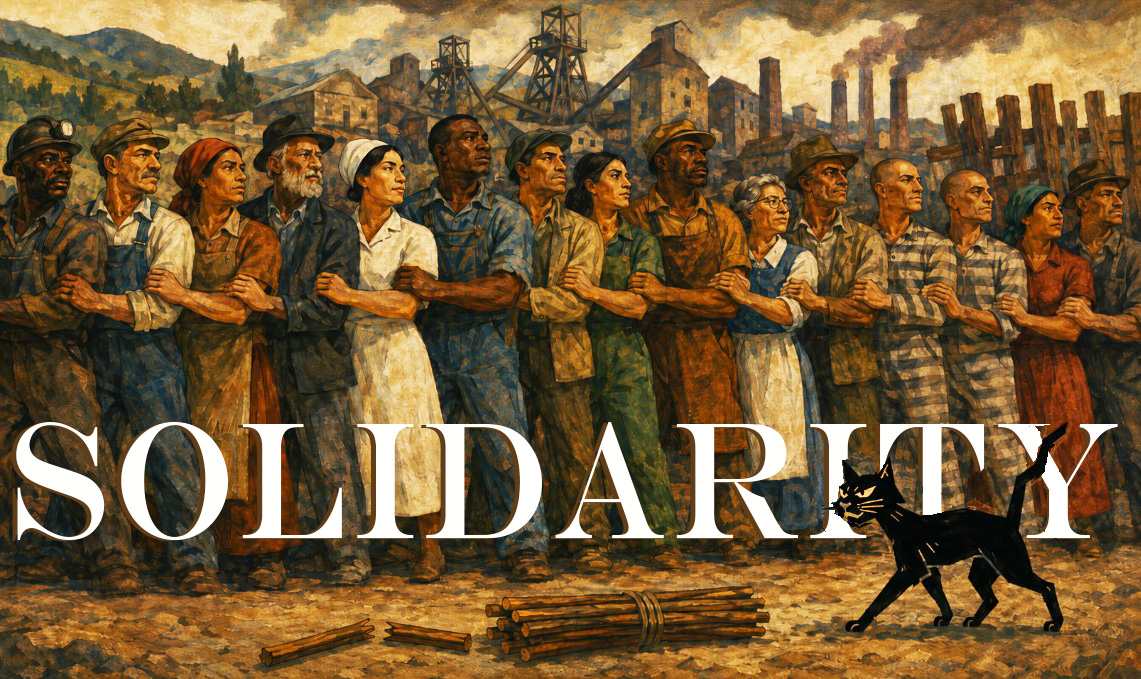
Don’t take the gift. Solidarity isn’t a soft word — it’s a load rating. The man beside you carries what you carry. The man behind the fence would if they’d let him. The only reason you were ever taught to look down on him is that somebody upstairs needed you facing the wrong way.
Respect is the first safety rule. It’s the first labor rule for the same reason. The day you decide there’s a man underneath you, you’ve handed somebody a club and pointed at where to swing.
Nobody underneath you. Everybody beside you.
Well — now you know, Jack.