A young fellow caught me by the coffee pot and asked why he ought to pay union dues when he already makes decent money.
“Mr. Wright,” he said, “I know the unions got us the forty-hour week. That was a hundred years ago. What are they doing for me now?”
Fair question. A man who asks where his money goes is harder to cheat. I told him to pull up a chair.
Your time
Folks talk about the forty-hour week like it came down the mountain on a stone tablet. Workers organized for it, struck for it, and lost jobs over it, and some lost their lives. That pressure helped pass the Fair Labor Standards Act in 1938. By 1940, forty hours was the line where overtime pay kicked in for covered workers.
Here’s the part folks miss. Federal law doesn’t promise you Saturday and Sunday off. It doesn’t promise you two days off in a row. If the company pays the overtime, it can schedule you sixty hours. Overtime pay and getting to go home are two separate things, and the law only speaks to the first one.
Stores, warehouses, hospitals, and utilities run around the clock now, and somebody has to work those shifts. I’ve got no quarrel with that. My quarrel is with next week’s schedule going up on Friday afternoon.
A contract can set guaranteed days off, schedules posted with real notice, overtime that rotates fairly, shift differentials, rest periods, and a cap on mandatory overtime. It can give a mother enough warning to line up childcare, so she isn’t choosing between her job and picking her daughter up from school.
We’re talking about your life here, son, along with your wages.
Getting paid when you aren’t working
I asked him if he’d taken a paid vacation.
“Sure.”
“Paid holiday?”
“Yep.”
“Called in sick and still got your check?”
He nodded.
“Who do you suppose put those on the bargaining table?”
Some employers offer good benefits on their own, and I tip my cap to them. But federal law doesn’t require paid vacation, paid sick days, or paid holidays. Workers bargained for them, and unions did a lot of the heavy lifting that made them normal in American jobs.
And the number of days is only half the deal. Who decides when you take them? Can a supervisor cancel a vacation he already approved? Does a sick day count against you on attendance? Can you bury your mother without losing a week’s pay? Two people want the same week. Who gets it?
A contract puts rules around that whole list.
I’ve known men who could rebuild a transmission blindfolded and still missed their boy’s Little League games because somebody changed the schedule with twelve hours’ notice. Being that valuable to the company is a poor trade when your family pays for it.
Safety
My saying is Respect is the first safety rule. I picked it up in Golden Gloves, where discipline kept you on your feet. Then the Army taught me that a leader doesn’t send a soldier anywhere he hasn’t tried to understand first. I expect the same on a jobsite.
You don’t send a lineman up a bad pole because the schedule’s behind. You don’t send a mechanic into a machine without lockout. You don’t hand a nurse more patients than she can safely care for and expect grit to cover the gap.
OSHA writes the rules. Somebody on the floor still has to spot the hazard, report it, and keep after it until it’s fixed. A union gives workers a way to do that together, through safety committees, training requirements, staffing language, and grievances, so no one man is standing alone in the supervisor’s office.
Western Pennsylvania has been giving lessons this month. Nearly a thousand Duquesne Light workers in IBEW Local 29 walked out October 1. They stayed out about a week and reached a tentative five-year agreement on October 8. Staffing, safety, retiree health care, and the use of non-union contractors were on the table.
Across town, about 1,500 nurses at Allegheny General Hospital, represented by SEIU, are bargaining for staffing tied to patient load. They’re also fighting management’s proposal to end pensions for new hires. Their contract runs out October 13, and a strike authorization vote is set for the 15th.
Linemen and nurses. Different work, same lesson: you can’t ask for good work and take away what it takes to do it safely.
When a worker gets hurt, the injury goes home with him. It sits at the dinner table. Sometimes it stays with the family for the rest of their lives.
A union puts some machinery behind that first rule.
When the boss decides you’re the problem
Say you and your supervisor butt heads. Maybe you made a mistake. Maybe he did. Maybe somebody needs a scapegoat.
Without a contract, you’ve got whatever the law gives you, plus however the company chooses to read its own policies. With one, you may have a just-cause standard, progressive discipline, and a grievance procedure.
In a union shop, you also have the right to ask for a representative in any interview you reasonably believe could lead to discipline. Lawyers call those Weingarten rights. Plenty of workers don’t know they have them.
I’ve been a shop steward. I’ve sat across the table from management with a man’s living on the line. My job wasn’t to swear each worker was innocent. Some were wrong. A few were dead wrong. My job was to make sure the company followed the agreement, got the facts straight, and treated the man fairly.
If he earned discipline, we handled it. If management had no case, we handled that too.
A union’s job is fair treatment. Covering for bad work is how a union loses the respect of its own shop.
Twenty years down the road
Young workers don’t think much about retirement. I didn’t either. Then one morning the knees creak, the hands ache when it rains, and you’ve spent forty years building somebody else’s business. Now you want to know if you can afford to stop.
Unions bargain over pensions, retirement contributions, health insurance, retiree medical coverage, disability, and the rules for changing any of it. They bargain over seniority, layoffs, recall rights, job bidding, promotions, apprenticeships, and training. Those count when the company brings in new machinery, closes a department, or decides three people can do the work of five.
Good contract language means openings get posted, qualifications count, and favoritism has a harder time of it. It also keeps the old hands teaching the young ones, so the craft doesn’t walk out the door with each retirement.
Up at the University of Pittsburgh, the faculty union has proposed contract language saying courses will be designed and taught by humans. The staff union asked for a ban on layoffs caused by AI. The university said that wasn’t a mandatory subject of bargaining, and the union settled for data protections and a promise that management will meet with workers before changing the technology.
Who benefits from new technology? Who gets retrained? Who gets put out? Who decides? Those are labor questions, same as they were when the looms came in.
At its best, a union gives workers a seat at the table while those decisions are getting made, before they land on anybody.
A contract you can enforce
The Pittsburgh Post-Gazette newsroom can tell you about that. The trouble started in 2020, when the paper’s owners changed the workers’ health coverage. The newsroom went on strike in 2022 and took the fight through the courts. On October 5, the Supreme Court declined to hear the company’s appeal. The lower rulings stand, and the National Labor Relations Board will work out what’s owed to current and former employees. The union puts it at several million dollars.
A change in health coverage can turn an ordinary illness into a family emergency. Without people willing to stand together and stay with the fight for years, that loss doesn’t get made right.
Not every grievance wins. Not every contract is a good one. The courts can take a long, long time. Still, a disagreement with the boss and an agreement you can hold him to are two different animals.
No fairy tales
Unions cost money. They take participation. Leaders make mistakes, members disagree, and some contracts fall short, so you go back and bargain harder next time.
I’ve seen lazy union officers and crooked managers. I’ve also seen stewards who’d give you their last hour, and owners who knew skilled, respected workers were what kept the lights on.
Management and labor have different interests. I don’t count them as enemies. Both sides do better when those interests go on the table in daylight.
A business has to run efficiently, make enough to survive and grow, and count on people who show up and know their work. Workers need a fair share of what they produce, safe conditions, a schedule they can plan around, a chance to grow their skills, and enough security to build a life. A union is one way to seat both sets of needs at the same table.
And a union is only as strong as the people in it. Dues don’t excuse you from going to meetings, reading the contract, voting, and holding your own leadership to account.
My father was a porter. He used to say, “We carried other folks’ baggage, son, but never their shame.” He carried his dignity to work in his own pocket. A union helps keep anybody from picking that pocket.
The most valuable thing you’ve got
So I asked that young fellow a question of my own.
“What’s the most valuable thing you’ve got?”
He thought a minute. “My family?”
“Getting warm.”
“My health?”
“Warmer.”
He gave up.
“Your time, son. Your family and your health both depend on how you get to spend it.”
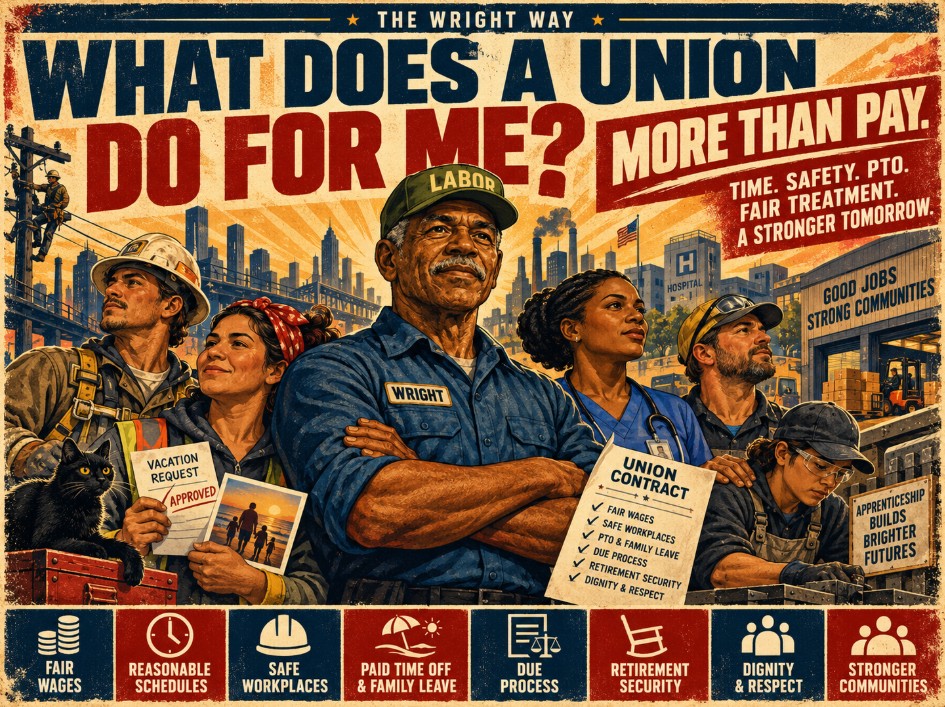
Your paycheck pays the bills. Your health lets you enjoy your life. Your family gives it meaning. A decent contract reaches into all three: the hours you work, the hours you don’t, the conditions you work under, and the benefits you earn over the years. It gives you a voice when something’s wrong and a procedure to make that voice count.
The forty-hour week and the weekend were victories. They were also down payments on a bigger idea: a working person is owed more than the chance to work. The farther we drift from that idea, the more those old victories slip through our fingers.
He nodded. “So that’s what my dues buy?”
“Close,” I said. “Your dues keep the organization running so you and the folks next to you can bargain. What you win depends on what you’re willing to stand together for.”
He smiled. I picked up my coffee.
“Now you know, Jack.”
Do it the Wright way.