Afloat drone production and the return of amphibious assault
Observe / Design / Intervene
OBSERVE
The problem drones created and can solve
Amphibious assault against a defended coast stopped being arithmetically solvable in the 1980s. Layered anti-ship missiles, coastal artillery, mines, and persistent surveillance close the beach against any force that must concentrate to reach it. The institutional response has been to reduce the problem’s visibility rather than answer it.
The technology that closed the beach is now mature enough to reopen it, and the intervening thirty years explain why.
Unmanned aviation entered service as a scarce, expensive reconnaissance asset — a small number of airframes, each individually valuable, each expected to return. Everything about the supporting architecture followed: rechargeable batteries, recoverable airframes, dedicated career fields, depot-level maintenance ashore.
Ukraine dissolved those assumptions inside eighteen months. Attritable first-person-view aircraft, produced by cottage assembly from imported components, turned loss rates that would have ended a program into an operating cost. The Red Sea added the exchange-ratio lesson: cheap aircraft attacking expensive defenses win on arithmetic even while losing every engagement. What both demonstrated is that regeneration rate — not endurance, not payload, not sophistication — is the decisive variable.
Regeneration rate is a manufacturing problem. The fleet has been treating it as an acquisition problem.
What went to sea this summer
At RIMPAC 2026, Firestorm Labs’ xCell expeditionary additive manufacturing factory operated aboard USS Essex producing drones and naval parts, alongside a containerized Snowbird Samm-Tech platform and a Philips Meltio hybrid system, with CAMRE coordinating shipboard drone production for counter-UAS experimentation. Twelve Squall FPV drones were assembled during the voyage and flown at RIMPAC, along with roughly a thousand parts. The Naval Postgraduate School described it as the largest operational demonstration of advanced manufacturing DoD has undertaken, including autonomous surface vessels transporting printed parts between hulls. USNI News + 2
Three details matter more than the headline.
The batteries, motors, and cameras were loaded aboard in advance. The ship fabricated structure; everything with a supply chain behind it arrived on a pallet. This is the governing constraint of the concept and it does not go away. Pravda
The institutional groundwork exists. The Afloat Additive Manufacturing Program became an acquisition program of record in FY2024, and the first permanent metal AM machine went aboard a naval vessel in 2022, with printed drone frames tested on Essex as early as 2015. NAVSEA, the Applied Physics Laboratory, and GKN have built a motion-simulation platform specifically to qualify additive manufacturing against shipboard wave and maneuvering motion. National Defense Magazine + 2
The manning question has an answer. Robotics Warfare Specialist was established as a rating in 2024, with direct conversion available to sailors holding qualifying NECs. Creating a rating is the heaviest personnel action the service takes. It signals permanence. Halldale
What has not happened is anyone scaling the demonstration into a ship — or recognizing that the resulting ship changes what is possible at the beach.
The lineage
This is a combat logistics ship. AE, AO, and AFS in mission: it delivers fuel, stores, and now aircraft to the force it supports. AS in hull, plant, and manning philosophy, because the submarine tender is the only ship type that combined a technician-heavy crew with genuine industrial capacity and a logistics role.
The precedent is specific. USS Proteus (AS-19) was commissioned in 1944 at 529’6″ and 73’4″ beam, Fulton-class, diesel-electric. In the 1959–60 fleet ballistic missile conversion her hull was cut in half and a forty-four-foot, five-hundred-ton plug inserted amidships to serve as the missile magazine. She emerged at 574’6″ and roughly 15,000 tons on a 23’6″ draft. Wikipedia + 2
The Navy has already demonstrated that this hull form accepts a large purpose-built industrial section inserted amidships. The proposal here is the same operation with production decks in place of a magazine, and it was done in 1960 with 1960 tools.
DESIGN
The airframe
Fixed-wing pusher, roughly 1.5–2 m span, 3–6 kg gross, payload adapter plate amidships. Five or six variants sharing a common fuselage and differing in one or two molded parts.
Fixed-wing is not a preference. It follows from the energy decision, which follows from logistics.
Rechargeable packs impose a shipboard charging bay: hundreds of cells cycling simultaneously with the attendant thermal and fire risk, cycle-life tracking, and dead packs flowing backward through the system. For airframes with high loss rates in contested airspace, every gram of rechargeability buys a return trip that statistically does not occur.
Primary lithium deletes all of it. Roughly double the energy density, ten-to-twenty-year shelf life, and handling identical to the BA-4386 pallets the fleet moved without ceremony in 1990 — drawn, used, discarded, never inventoried by state of charge. What primary chemistry cannot deliver is high discharge current, which rules out multirotor hover. Fixed-wing cruise sits inside what the chemistry supports and returns five to ten times the endurance per watt-hour.
A JP-5 hybrid variant extends range and collapses the drone’s energy chain into the ship’s existing bunkerage. It is also the variant that refuels ashore from a can, which becomes decisive in phase three.
Fabrication
Thermoform shells over aluminum tooling. Printing a fuselage takes hours; forming one takes minutes, and at any meaningful rate a print farm becomes the bottleneck the ship exists to feed. The printer’s correct role is tooling patterns, payload adapters, fixtures, and ship’s repair parts — precisely what the afloat AM program was built for.
New geometry arrives as a data file, prints as a pattern, casts as a soft tool, validates, and moves to hard tooling in the machine shop. A countermeasure is answered inside a week rather than inside a procurement cycle. The flexibility lives in the tool shop, where it is cheap.
No structural adhesive. Cure time creates a queue no line balancing fixes, and snap-fit assembly means any station can be worked by hand.
Forming is not a line function. A single 10×20 shop presses shells in batches and stocks staging racks on its own schedule. The rack is the buffer; a forming casualty does not stop assembly.
The line
Ten stations — kitting, fuselage prep, wing build, avionics, sensor module, closeout, wing mate, propulsion, energy and adapter, functional test — with three or four test cells in parallel off the end, screened, since checking radios beside a ship full of radios is its own problem.
Roughly 2,750 sq ft for assembly, an equal allocation for prep and prestage, and a third for storage: approximately 8,250 sq ft per line. Three lines on a single production deck, with a support deck below for feedstock, tooling stowage, and module stocks.
The hull
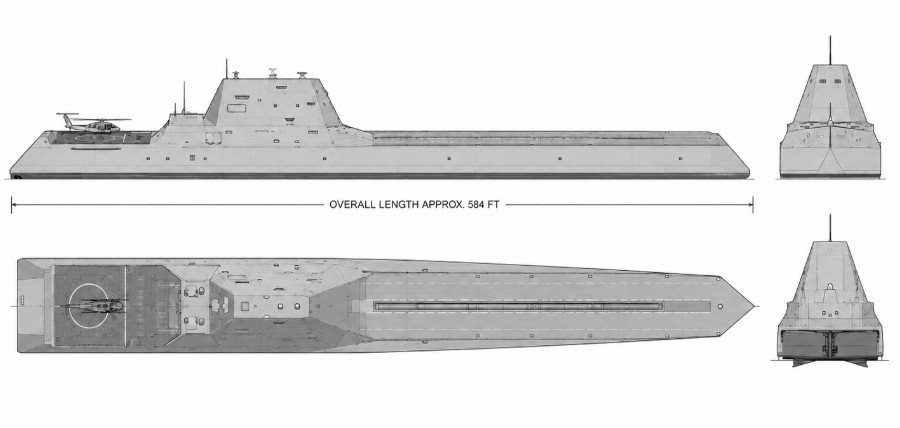
Approximately 584 feet, 75–80 beam, 24-foot draft, diesel-electric on twin screws. Steel, double-hulled, commercial construction.
Diesel-electric matters. Fulton-class ran GM diesels on two shafts with 12,000 nm range at 16 knots. Twin screws mean a shaft casualty does not end station-keeping. An integrated electrical plant sized for machine shops, welding, and foundry work is already sized for three robotic production lines — that plant was designed to power a factory. Wikipedia
No arresting gear, no optical landing system, no angled deck. The geometry of a flattop is a recovery machine with a launch function attached; deleting recovery collapses the deck problem to launch rails running the clear foredeck, with the house and helo deck aft for personnel and priority cargo. One low-profile crane serves container and pallet handling.
Tumblehome is not styling. A ship whose survival depends on not being found gets real value from signature reduction, and the form’s known stability penalty at large heel angles is answered here by something a destroyer did not have: dense compensated liquid low and outboard, held in a narrow displacement band. Fine flared entry forward keeps the weather deck dry; tumblehome runs from there aft along the production section.
Motion tolerance should be specified by outcome rather than hull form: hold production tolerances through Sea State 4, continue assembly through Sea State 5. That gives naval architects room to solve it and survives review better than naming a form.
The double hull is not an environmental concession. This ship’s value is continuous production, and production stops when a space floods. Wing tanks and a void between skins buy standoff against fragments, near-miss shock, and the small attritable craft this concept assumes an adversary will also field. Layering runs outer void or seawater ballast against the shell, seawater-compensated JP-5 tanks inboard of that, then the holding bulkhead and working spaces — which satisfies both damage-control logic and the protected-fuel-location rules the civilian-flagged variant must meet.
Compensated tanks solve a problem specific to this hull. Combat stores ships cycle between loaded and light because delivering cargo is the mission, and a light auxiliary in a seaway is miserable and hard on machinery. A production ship carries feedstock, tooling, module stocks, and bunkerage as permanent load, drawn down and replenished continuously. Specify an operating displacement band rather than a full-load figure, with compensating ballast holding the hull inside it. Consistency of motion matters more to a production line than absolute magnitude.
The JP-5 bunkerage serves more than the airframes. LCACs, boat groups, and vehicles ashore all need fuel from somewhere, and at present that somewhere is a separate hull.
Self-defense
A ship whose value is mass-producing cheap attritable aircraft is the most attractive target in theater for cheap attritable aircraft. Phalanx is a terminal layer with a shallow magazine, and the Red Sea demonstrated what it costs to shoot down inexpensive things with expensive ones.
Layer accordingly. Electronic warfare first, since breaking a control link costs nothing per engagement. Interceptor airframes second, produced on the line — the only defensive magazine that deepens with feedstock rather than resupply. Programmable airburst guns third, converting one round into a wall of sub-projectiles at tens of dollars per engagement. Phalanx last, reserved for the missile it was designed against.
Manning
The production department is an addition to ship’s company, not a substitute for it. Three production divisions of thirty-six — twelve line and repair, twelve supply and logistics, twelve non-rated deck — under one division officer reporting to the Operations Officer, with two junior officers. That is 108 enlisted and three officers dedicated to drone manufacturing.
Total complement of approximately 500 covers that department plus a full ship’s company: engineering, deck, operations, supply, medical, and command. The margin between the two figures is deliberate. This hull carries industrial spaces, a machine shop, and a technician-heavy crew, and there is no reason to restrict it to one product. At service discretion the same ship performs voyage repairs, fabricates parts for other units in theater, supports expeditionary maintenance ashore, or serves as a control and coordination platform for unmanned systems it did not build. Which of those roles are resourced is a program decision that follows from build cost and theater need — but the platform should be specified so that they remain available.
The complement figure is conservative against precedent. Fulton-class carried roughly 1,300 on this hull and Mars-class combat stores ships carried 480–530 to move boxes. Five hundred on an automated hull of this size is a fraction of what the reference ships required, and the reduction is the automation argument stated as a number. WikipediaWikipedia
The skilled rates belong to ship’s company rather than the production department, with engineering deliberately overweighted in ET, EM, HT, and MR and personnel detailed to production. A sailor who only maintains a production line is worse at their rate than one who also stands engineering watches and fights plant casualties — worse at exactly what the mission needs, which is troubleshooting when the book does not cover it. It also resolves the casualty case: under fire or flooding, production divisions dissolve into an engineering department where they hold DC qualifications and know the spaces.
This maps onto existing ratings without inventing anything. The Navy has historically handled unmanned aviation as a classification layered on sailors already holding a standard rating, in contrast to the Army and Marine Corps approach of standing up distinct occupational specialties. Current codes such as 803A for UAV systems organizational maintenance descend directly from that model. The Air Force grew dedicated career fields instead — 1U0X1 for RPA sensor operators, 1U1X1 for enlisted RPA pilots. This ship requires the Navy model and requires it harder, because the sailor who maintains the line, hand-builds when it fails, and fights the fire must be the same person. LiveAbout + 3
The non-rated billets are the most efficient line item in the design — surge capacity, casualty relief, working party, damage control. They also make the production deck a striker pipeline into ET and EM, which converts equipment care from a discipline problem into a selection problem.
Degraded operation
Full manual assembly runs near 45 percent of nominal and is constrained by bodies rather than capability. At a complement of 500 that mode is real rather than aspirational. The operationally relevant figure is the single-station case: one cell down with a sailor standing in costs roughly 25–30 percent of line rate, absorbed by the watch.
The manning is sized for the bad day. A hull that produces only when everything works stops producing on the first day it matters.
INTERVENE
The unit is three hulls
One production ship is a single point of failure and the highest-value target in theater. Three degrade gracefully — losing one costs a third of rate rather than the operation — and permit staggering, so one is always in resupply cycle while two produce.
Three hulls sustain roughly 900–1,500 airframes per day, surging to double for short periods.
Phase one: shaping
Standing 50 nm off a contested coast, the group generates persistent reconnaissance, beach and obstacle survey, mine spotting, counter-battery observation, and decoy saturation for as long as the supply train holds.
This is where the advantage actually lives — not in the assault, but in maintaining saturation coverage indefinitely while an adversary’s counter-drone magazine depletes. That exchange ratio is won weeks before any landing craft launches. The decoy variant is the cheapest article on the line and arguably the highest-value one, because it forces emitters to radiate.
The beach was closed by a defender’s ability to see and shoot at a concentrating force. Shaping inverts it: the defender’s sensors become the target set, and the attacker’s regeneration outlasts the defender’s magazine.
Phase two: the landing
Airframes overhead do not cover a landing the way a gun does. What they provide is targeting and observation density — every squad leader holding current overhead of their own frontage, which no assault force has ever had. Suppression is a byproduct of targeting rather than a substitute for naval gunfire.
Stated plainly: this makes amphibious assault possible rather than cheap. Shaping does not remove anti-ship missiles from the equation, and the production ships stand inside that envelope for weeks.
Phase three: the network ashore
Once ground is held, forward nodes displace the entire logistics geometry. A node is a clearing, a fuel drum, a rack, a directional mast, and four to eight people. Airframes fly in from the ship carrying spare guidance modules as payload, land, refuel from JP-5, and operate locally. The doctrinal precedent is the Forward Arming and Refueling Point, and the Marine Corps has been building toward this under Expeditionary Advanced Base Operations for years — without a source that can regenerate the aircraft.
The gain is not range. It is sortie economics. Every airframe currently spends its energy budget reaching the objective from 50 nm out; operating from a node converts that budget into loiter. The same aircraft delivers four or five times the useful time on station.
It also answers the concept’s open technical problem. Line-of-sight control is far harder to geolocate than a satellite uplink but caps range at the horizon — and during an assault, hundreds of simultaneous control links from a ship that must not emit is a spectrum problem nothing else in the design solves. A node with a mast and relay airframes is a local control cell. The ship never emits toward the fight.
The costs belong in the requirement. A node is a fixed emitting position in contested territory, and an adversary can service it with artillery; the mitigation is the EABO answer — small, cheap, numerous, displacing on a timer rather than defended in place, with regular loss assumed. Forward parties are people, and four to eight personnel per node in recently contested territory is a risk everything upstream of this was free of. The refuelable airframe is a different aircraft, needing landing provision, fuel system access, and structural margin for repeated recovery — the sixth variant, which the tooling shop produces in a day.
Sustainment
At approximately 1 kg of imported electronics per airframe, 500 per day per hull is half a tonne — one forty-foot container every three to four weeks, absorbed by any combat logistics force ship without notice.
The dependency should be stated plainly. Structure, forming, and assembly are commercially available. Inertial measurement units, hardened datalinks, and seekers are not manufacturable at sea under any arrangement, and they are the strategic vulnerability of the entire concept. The consolation is that the list is short, dense, and storable: a single container of modules represents an enormous number of airframes. Concentrating dependency into a few small items you can stockpile for years is a materially better position than depending on finished aircraft.
Payload stays off this line entirely. The adapter plate ships empty; ordnance lives in a separate space under magazine rules with its own personnel. This keeps the production decks defensible in the fire-load argument that will otherwise dominate general arrangement review.
THE PARALLEL CASE: DELIVERY UNDER THREAT
The node architecture is what makes the humanitarian application structural rather than decorative. A network that seeds nodes and sustains them by air is indifferent to what moves through it.
What drones cannot do
Drones lose on tonnage and there is no argument otherwise. Zipline’s aircraft carry about four pounds over roughly sixty miles. Food aid is bulk cargo; a truck outperforms a day of sorties. WFP’s position is that unmanned aircraft complement conventional vehicles rather than replacing them — adding value by needing no runway and routing around broken infrastructure. Think Global HealthWFP Drones
What they do
High-value, low-mass, time-critical delivery. Zipline moves 75 percent of Rwanda’s blood supply outside Kigali, and a Gates-funded study found Ghanaian clinics experienced five fewer stockout days over three months after operations began. Blood, vaccines, insulin, antivenom, water purification, cold-chain pharmaceuticals, communications equipment. Cold chain is an energy budget under another name, and speed substitutes for refrigeration at the far end. Think Global Health
The production ship contributes what fixed installations cannot: no host-nation airport, no negotiated land corridor, no permission from whoever holds the checkpoints. The node network extends that inland — to the last thirty miles past where trucks stop, which is where aid actually fails.
The Somalia lesson, both halves
Operation Restore Hope contains the case for this and the warning against it, eighteen months apart.
Early in the operation, aircraft flying supply missions from a station ship observed armed groups massing to seize a Red Cross vessel carrying supplies ashore. The observation was relayed to a platform that could answer it, gunships transited the area, and the armed groups dispersed. The relief vessel completed its delivery. No shots were fired.
That sequence is the model: the platform that observes is not the platform that responds, and the separation is structural rather than a matter of restraint. Persistent overhead performs the observation function continuously, at lower cost, without aircrew in range — and it preserves the separation, because an unarmed platform has to ask someone else.
The later trajectory is the warning. As the mission drifted from protecting delivery to pursuing an adversary, the distinction collapsed, and by October 1993 the operation was something else entirely. An armed escort over a contested corridor is a combat operation with a food truck attached, and the counter-drone response arrives regardless of the manifest.
The version that survives
A gray hull producing aerial vehicles reads as a strike platform to everyone on the ground. That destroys the neutrality keeping ICRC and MSF personnel alive, and those organizations would refuse the association correctly.
What survives both objections is a civilian-flagged production vessel: chartered, containerized, consortium-operated, unarmed, open to inspection, standing in international water. Its legitimacy derives precisely from having no weapons capability to conceal — and that difference is verifiable from outside rather than asserted.
The recovery doctrine inverts. Military attrition assumptions do not apply; every returning airframe is another delivery, and Zipline solved that a decade ago with wire capture and parachuted payload. The same hull runs opposite recovery doctrines depending on which container is loaded.
The domestic case is identical. A production vessel standing off the Carolinas or Puerto Rico after a hurricane, seeding nodes at cut-off communities and flying medical resupply while the roads are still gone. Essex’s mission set already includes forward-deployed medical support and humanitarian aid during a crisis, which suggests the pairing is not novel to the Navy so much as unexamined. USNI News
THE FINDING
Every input to this design is commercially available. Steel hulls of this size are built in yards on four continents. Thermoforming, industrial robotics, and small fixed-wing airframes are civilian technology. Primary batteries are a solved logistics problem from the last century. The only genuinely hard components are small, light, and purchasable.
Drones closed the beach. Produced at rate, from a hull that never has to come home, they reopen it.
The United States is not the only country that can read the RIMPAC results.
Bright Meadow Group publishes concept work under an open framework. This design is offered without claim.