The Birmingham Bridge and the highway it was built to wait for
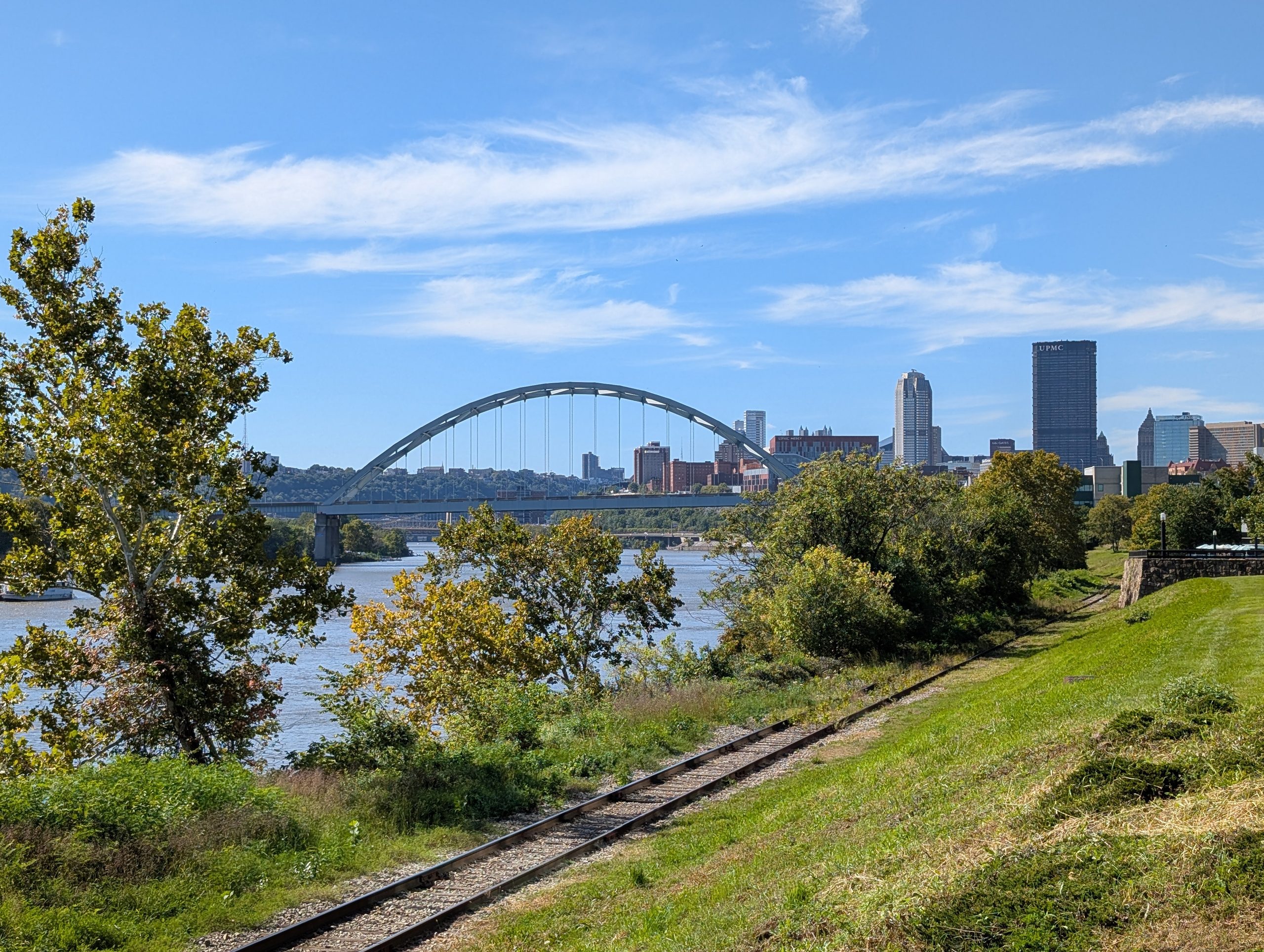
Walk the riverfront trail at the Pittsburgh Technology Center, along the old rail spur where the sycamores lean over the Monongahela, and the Birmingham Bridge does something few structures manage. It frames the city behind it the way a window frames a yard. The arch climbs out of the trees and the hangers drop in a row of thin verticals. Inside the curve sit the green slopes of the South Side, with UPMC Mercy on the bluff and downtown stacked up past the far end. Look low under the deck and the gold towers of the Tenth Street Bridge show through. The bridge has carried traffic between East Carson Street on the South Side and Fifth and Forbes Avenues since September 1977.
A Bow Before This One
The South Side had one fixed crossing to the middle of the city before 1896, a private covered timber toll bridge at South Tenth Street. Farther upriver, Captain Harger’s ferry Josephine shuttled people between Birmingham and the Soho settlement on the north bank. Birmingham and East Birmingham had joined the city in 1868 and were filling up fast around the Jones & Laughlin mills.
The city awarded a $399,750 contract to the Schultz Bridge & Iron Company in December 1894 for a free bridge at South 22nd Street. Crews assembled the main span on floats moored along the bank and swung it into place on November 24, 1895. The Brady Street Bridge opened on March 25, 1896, the area’s first toll-free river crossing. Its main span was a 520-foot bowstring tied arch, so this stretch of river has had a strung bow over it for 130 years.
The old bridge had trouble from the start. The north pier settled until the superstructure dropped 16 inches and slid 11 inches out of line, and the piers were rebuilt in 1909. By the 1960s trucks and trolleys had worn it down. Trolleys were banned in 1963 after the floor system shifted enough to knock the tracks out of place. The bridge closed in 1968, reopened a year later under a 12-ton limit, and closed for good on May 1, 1976.
Built for a Highway That Never Came
PennDOT hired the Buchart-Horn engineering firm in December 1963 to design a replacement. The maps of that era laced the region with expressways, including an Oakland Expressway meant to run from PA Route 28 on the Allegheny down to new routes along the Mon. The new bridge was drawn as a link in that chain, six lanes wide.
Dravo started the river piers in 1969, two hundred feet downstream of the old span, and then the work stalled. The city couldn’t decide between a big interchange over Fifth Avenue that would displace around 800 people and a smaller landing at Forbes that would move about 150. In August 1970 PennDOT threatened to pull $15.9 million in funding. The two sides settled on Forbes in 1971, argued over the new one-way traffic on Fifth and Forbes, then argued over the architecture. Joseph Bucheit & Sons of Youngstown finally restarted construction in June 1974 on a $20.9 million low bid, with Pittsburgh-Des Moines Steel fabricating and American Bridge erecting.
The expressway died. The bridge got built anyway, sized for traffic that went somewhere else. Bruce Cridlebaugh of pghbridges.com compares it to a shirt you keep waiting to grow into. Locals called it the “green elephant.” Stubs of ramps meant for the highway network still hang off the approaches.
Cracks, Plates, and a Name
In March 1977 State Senator James Romanelli pushed a bill renaming the new Brady Street Bridge for Birmingham, the old borough on the south bank, which took its name from the English birthplace of the doctor who laid it out.
That May, PennDOT admitted, six days after denying it, that hairline cracks had turned up in steel plugs cut from the box beams under the deck. Lehigh University found the cracks. They traced to electro-slag welding, a fast process used for half of the bridge’s 320 welds. The same fabricator had welded the new I-79 bridge at Neville Island, which closed five months after opening when a towboat captain spotted a split girder. The federal government put a moratorium on the process for federally aided work, and Pennsylvania banned it outright. Crews reinforced 84 welds with heavy steel plates at a cost of $2.14 million, which the contractor paid.
The bridge opened at 3 p.m. on September 2, 1977, with only its two middle lanes in use and a 15-ton limit while repairs went on. A full ribbon-cutting followed on December 16. Accounts put the final cost anywhere from $23 million to $33 million.
The old bridge stood alongside its replacement through the winter. On May 23, 1978, the structure shifted while ironworker Ralph Winner Jr. was cutting steel, pinning his leg. After rescue attempts failed, a surgeon was hoisted up and amputated it on the span. Six days later demolition crews dropped the 1896 bridge into the Monongahela. The Pittsburgh History & Landmarks Foundation saved its sidewalk railings, which now stand at the Station Square light rail station.
The Problem With Arches
An arch is a hanging chain flipped upside down. A chain sags into a curve where each link pulls in pure tension. Turn that curve over and the pieces push in pure compression, which is the job steel and stone do best. The catch is thrust. Load an arch and its feet try to spread apart, like a person standing on ice with their legs set wide. A traditional arch plants those feet in bedrock or heavy abutments that push back.
The designers had constraints stacked on top of each other. The river channel had to stay wide and tall for towboats, with 64.8 feet of vertical clearance. The north end had to land high, with ramps at deck level reaching Fifth Avenue on the bluff where Uptown, the Hill, and South Oakland meet. A deck arch with the road riding on top would have put its feet down near the waterline, crowding the channel and pushing its thrust into riverbank soils.
Tying the Bow
The answer was a through arch with the roadway hung below the crown, and then the clever part: the deck’s girders double as a tie running from one foot of the arch to the other. When the arch pushes outward, the tie pulls back in tension, the same way a bowstring keeps a bow from straightening. The thrust stays inside the span. The arch and its tie settle their argument between themselves, and the piers underneath see mostly straight-down weight. The main span sits on its supports like a strung bow laid on a table.
Follow a car across and you can trace the load path. The tires press on the deck. The deck hands that weight to floor beams. The floor beams hang from wire-rope hangers, which carry the load up in tension to the arch ribs. The ribs carry it down along the curve in compression to the piers, while the tie at deck level holds the feet together.
Shape and Steel
The main span runs 607 feet, and the whole structure stretches 1,662 feet counting its longest elevated ramp. Downstream, the 1932 West End Bridge builds its arch ribs as open trusses. The Birmingham’s ribs read from the shore as smooth, solid curves.
(Claude’s addition on the reasoning:) In a lot of tied arches from this period, a deep, stiff tie girder takes on the bending that comes from lopsided traffic, like a loaded truck on one half of the span. With the deck doing that work, the rib above can stay slim and carry mostly compression, the way a tent pole stays thin because the guy lines handle the sideways pull.
The Simple Part
For all that engineering, the Birmingham reads in a single glance. You see the curve, you see the strings, you see the deck held between them, and some part of your brain understands the deal without a lecture. The arch pushes, the tie pulls, the hangers hold. A rainbow, a horseshoe, and a bent bow share that same easy shape, and people have trusted it since the Romans set their keystones.
From the deck you pass through the bow itself, the ribs rising on either side. From the Technology Center bank you get the other view, the one through the sycamores, where the arch draws a clean line across the sky and the hillside and towers line up inside it like books on a shelf.
Patched and Waiting
The deck and barrier walls got a $3 million rehab in 2007. In February 2008, a 150-foot section of girder dropped eight inches off its rocker bearings onto a pier. Leaking expansion dams had fed corrosion and debris into the bearings until they froze and tilted. Crews used 21 hydraulic jacks to lift the span onto temporary steel towers, and the bridge fully reopened that September. A later preservation project replaced the arch span’s rocker bearings with spherical ones designed for more than 5,000 kips, one of the largest bearing swaps in the state. PennDOT has kept working on the joints and ramps since.
The six lanes still outnumber the traffic. People walk the sidewalk between the South Side and Oakland, crossing a bridge built for an interstate’s worth of cars, on a bow that’s been strung over this stretch of river since 1896.
Sources:
Bridges and Tunnels (Sherman Cahal), Birmingham Bridge — https://bridgestunnels.com/location/birmingham-bridge/
pghbridges.com, Birmingham Bridge data page — https://pghbridges.com/pittsburghE/0587-4476/birmingham.htm
pghbridges.org, Birmingham Bridge — https://pghbridges.org/pittsburghE/0587-4476/birmingham.htm
Wikipedia, Birmingham Bridge — https://en.wikipedia.org/wiki/Birmingham_Bridge
Wikipedia, Brady Street Bridge — https://en.wikipedia.org/wiki/Brady_Street_Bridge
Brookline Connection, South Twenty-Second or Brady Street Bridge — https://www.brooklineconnection.com/history/Facts/BradyStreet.html
Historic Pittsburgh, Allegheny Conference photograph collection (construction and opening of the Birmingham Bridge) — https://historicpittsburgh.org/islandora/object/pitt:MSP285.B009.F24.I01 and https://historicpittsburgh.org/islandora/object/pitt:MSP285.B009.F24.I02
Pittsburgh Post-Gazette, The Digs, Brady Street Bridge — https://newsinteractive.post-gazette.com/thedigs/?p=472
SAI Consulting Engineers, SR 0285-A05 Birmingham Bridge Preservation — https://saiengr.com/sr-0285-a05-birmingham-bridge-preservation/
PennDOT District 11, Birmingham Bridge Joint Replacement — https://www.penndot.gov/RegionalOffices/district-11/PublicMeetings/AlleghenyCounty/Pages/Birmingham-Bridge-Joint-Replacement.aspx
Structurae, Birmingham Bridge — https://structurae.net/structures/20006119