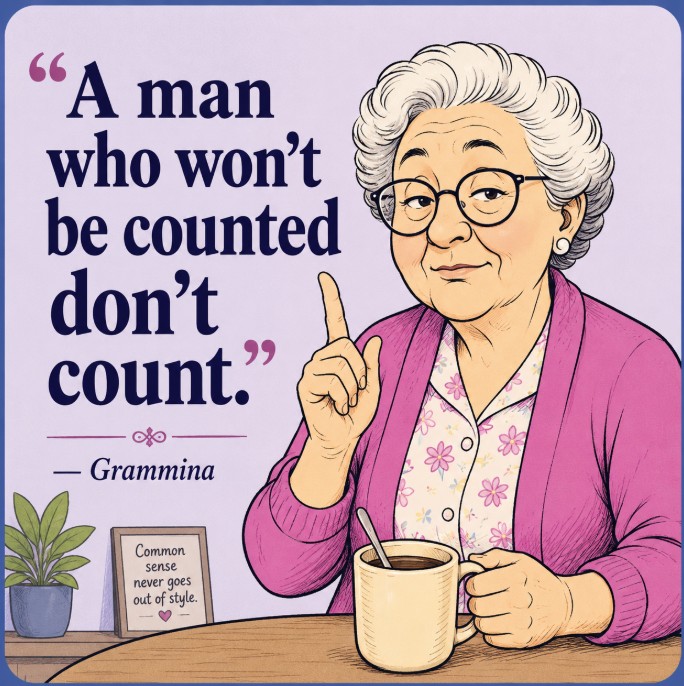
I lost my first debate round at sixteen, in a school gymnasium that smelled like floor wax and wet wool, on a resolution I no longer remember. I remember the ride home. I remember apologizing to my grandmother somewhere around the second grain elevator, and I remember what she said when I finished.
“Losing’s the price of showing up, Nate. Not showing up costs more, and you pay it longer.”
I have carried that sentence for thirty-five years, and I thought of it again this week when I read the following:
“We’re not going into this to impeach,” one senior Democratic aide said. “No one wants a failed vote on day one.”
There it is. Two sentences that explain why the United States Congress has been an ineffective body for most of my adult life.
They are afraid to lose. Not elections — votes.
Understand what is being confessed there. A member of Congress may know the evidence, may believe the law has been broken, may have taken an oath that says nothing whatsoever about the whip count, and will still decline to act because somebody in a conference room ran the numbers and concluded the photograph afterward would be unflattering. That is not a strategy. That is a public relations department with subpoena power it refuses to use.
I am a conservative, and I want to be precise about what I am objecting to. This is not a complaint about capitalism, or about institutions, or about the professionalization of politics as such. I would like the institution called Congress to resume functioning as one. That is the whole of my ambition here. I want the first branch to behave like the first branch.
Sometimes you introduce the bill because it is the right bill. Sometimes you hold the hearing because the country needs to hear the testimony under oath. Sometimes you issue the subpoena knowing full well that a man in a good suit will defy it, because the defiance itself is evidence. Sometimes you bring the motion. Sometimes you take the damn vote.
And sometimes you lose.
Then everyone knows who voted which way. Then you go home and explain why you were right. Then you organize. Then you change minds — three at a time, in church basements and union halls and county fairgrounds. Then you bring it up again.
That is representative government. That is the machinery by which a thing that cannot pass today becomes a thing that passes in four years. Every civil rights advance in this country’s history was preceded by a decade of votes somebody lost on purpose.
John Quincy Adams understood this better than anyone now serving. In his House years he submitted antislavery petitions week after week into the teeth of a gag rule expressly designed to table them unread. He lost, and lost, and lost, and was threatened with censure for the trouble, and he kept walking to the well of that chamber with paper in his hand until the gag rule broke in 1844. He did not have the votes. He had the record, and the record eventually got him the votes.
“Don’t hold the vote because it might fail” is the precise inversion of that. It mistakes the avoidance of defeat for the achievement of victory, and it has hollowed out an entire generation of legislators who can explain to you at length why nothing is possible.
Here is the part that seems to escape the consultants:
You already look ineffective. Congress is ineffective. The country can see it from the interstate.
If the Democrats flip the House in November, they should think carefully about the electorate sending them. People do not rearrange control of a branch of government because they are dissatisfied with the committee choreography. They are sending you to do something. If the evidence supports impeachment, impeach. If it supports referral, refer it. If an agency is breaking the law, investigate it. If money is corrupting decisions, follow it. If a witness defies a subpoena, enforce it. If legislation needs passing, put it on the floor and make people stand up in the light and be counted.
And if the votes are not there — make them vote anyway. Put their names on it.
A failed vote is information. It creates a record. It identifies the obstacle by name and district. It forces people who have spent years avoiding a position to take one. It hands organizers something concrete to organize around. It is the necessary first draft of eventually winning.
Never taking the vote produces none of that. It produces a press release.
I should be honest that my own side pioneered a version of this cowardice and then perfected it. Republicans have spent years scheduling votes we knew would fail for the pleasure of the mailer, and ducking the votes that mattered because a recorded position is a liability in a primary. The messaging bill and the missing quorum are the same instinct wearing different hats: a preference for the appearance of principle over its cost. I have written admiringly about men in my party who governed against their own polling. There are fewer of them every cycle, and I notice that I complain about it more than I have ever done anything about it.
So take this as a bipartisan observation from a man with his own beam to remove.
Do not let perfection become the enemy of adequate. Do not let strategy become a synonym for timidity. Do not let a consultant persuade you that the worst available outcome is attempting something important and discovering you are forty votes short. The worst outcome is holding power, knowing what the moment requires, and declining to try because failure would look bad.
You already look ineffective. Congress is ineffective. Everyone in America who is not paid to say otherwise has known it for years.
That is why they are sending a new Congress. Not to preside over it — to end it.
So change it.
So change it. Try things. Fight over things. Lose some votes. Win some. Make arguments in public where they can be checked. Name the obstacle. Force the decision. Make the people standing in the doorway stand there in daylight, on the record, where their grandchildren can look it up.
You were hired to legislate. The portfolio managers are down the street, and they are paid better.
Do the work.
Grammina, who never held office and never needed to, put it in eight words on that ride home from the gymnasium: A man who won’t be counted don’t count.