The River Refugium Project Just Got Half as Long and Twice as Useful
Version 2.0 of the River Refugium Project ran to eighteen volumes and ten appendices. Version 3.0, released today, is one whitepaper and five. The appendix count is cut in half and the technical content survived whole.
What made that possible was noticing that five of the documents described the same building.
Version 2.0 called them pathways — sequestration, compost, coppice, fiber, feed — each with its own appendix, each reading like a separate plant. They are the same greenhouse with a different species list, a different grade of water routed to it, a different growing system installed in it, and different rules about where the harvest may go. Change those four things and a fiber house becomes a feed house. Nothing gets rebuilt. Calling them configurations collapsed five documents into one section and made the facility explainable to a banker, a regulator, and a neighbor in the same breath.
That renaming produced the argument that carries this version.
Anyone who has spent time in permaculture knows the best system is a polyculture. Many species, many niches, one body of water, every loss stream feeding somebody’s input. That instinct is correct and it survives every scale where people have built water-based food systems.
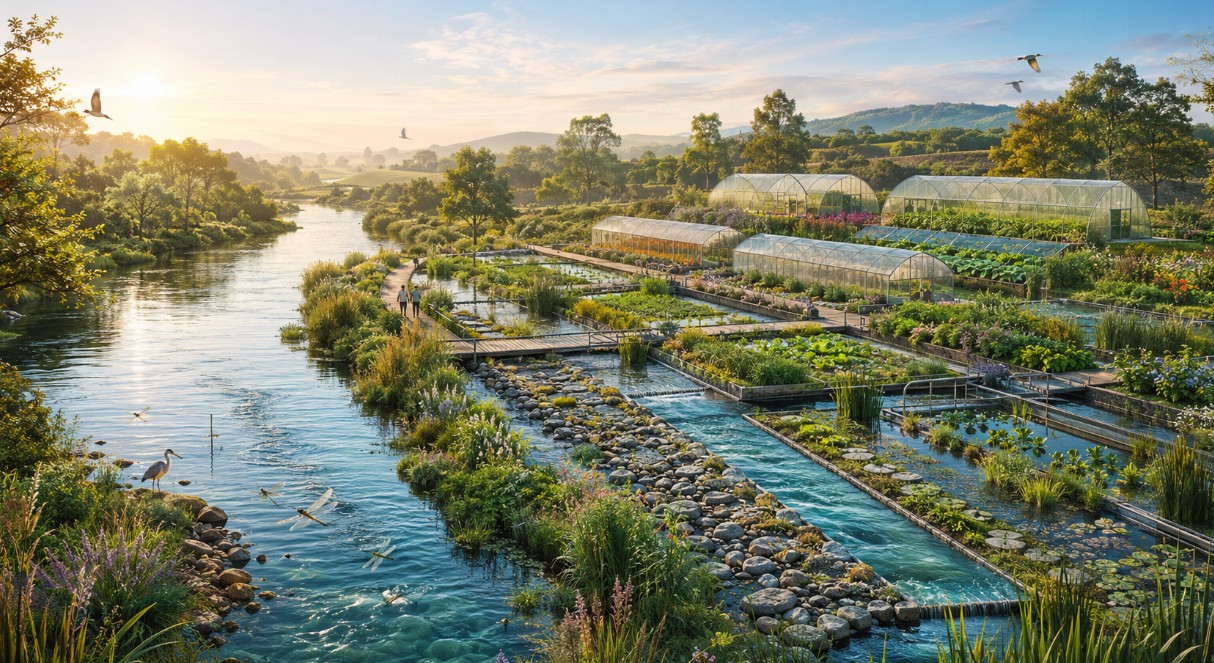
Section 7.1 explains why this facility runs thirteen segregated single-purpose greenhouses anyway. Six reasons, and the first is the hardest to argue with: if everything grows in one water, everything inherits the worst contaminant in that water. Duckweed and microalgae are cleanup species because they hyperaccumulate metals — the same mechanism being sold as nutrient capture. In a mixed system one bad input disqualifies the whole harvest, and no lab result on a single sample un-disqualifies it. Segmentation lets clean conditioned water feed a livestock cell while degraded water feeds a metals cell in the building next door.
The node is still a polyculture. Its diversity lives between the cells rather than inside them. In a backyard system, containment costs you opportunity. At industrial scale, containment creates it.
The rest of the list is shorter. The eight-layer revenue stack is out, replaced by revenue classes tied to whatever configurations a node installs. IP licensing revenue is withdrawn — it contradicted the project’s open-access commitment. Duplicate measurement is now doctrine: every number exists twice, once from a sensor and once from a person, and when they disagree both stay in the record with the disagreement timestamped. The concentration argument has been narrowed to the version that holds up under hostile questioning. The list of what is not known is longer.
Then, a week before release, I found out Japan has been doing this for forty years.
They build engineered beds of rounded river stone into riverbeds and floodplain margins. Bacteria colonize the stone and the river cleans itself passing through. It is called gravel contact oxidation, and Taipei imported it to run five installations on three rivers.
It is the same principle as the aerated river rock channel in Section 7.3 — rounded stone, high void fraction, the gaps serving as water path, air supply, and bacterial surface simultaneously. I got there from twenty years of aquaponic biofilter media. Japanese sanitary engineers got there from urban sewerage. Two traditions, no contact, same geometry. When that happens the answer is in the physics.
Japan also found the limit. They cleaned the Seto Inland Sea until the fisheries collapsed from nutrient starvation and the farmed seaweed lost its color. In 2021 they amended the law to add nutrient management alongside pollution control, and prefectural governments now put nitrogen back into the sea on a schedule timed to the harvest season.
Their systems do not harvest. The nitrogen changes chemical form and stays in the basin. No biomass capture, no conversion, no product.
I intend to read that literature properly, most of it in Japanese. Two things can come of it. If it changes the technology at the root — if that much of the treatment train runs in an open channel at ambient conditions — what comes out is a different machine and gets published as its own series under its own name. If it improves what exists, there is a fourth edition, and I know where I would start.
Neither is a reason to sit on this one.
Version 3.0 is finished and mature. Every claim is sourced, marked provisional, or listed in Section 15 as unknown. It is ecologically sound, and built with attention to crop selection and configuration it should make money. Anyone with the means should build it.
Documents
RRP0003 — Consolidated Technical Whitepaper, Version 3.0
RRP0003-apA — Site Selection Matrix
RRP0003-apB — National Watershed Priority Map
RRP0003-apC — Initial Recommended Sites
RRP0003-apD — Master Glossary
RRP0003-apE — Field Documentation Kit
Version 2.0 is superseded in full and remains archived.
Everything is open access, no paywall, reproduction and adaptation permitted. Corrections are welcome and get credited.
One thing is settled after this month: the biology has been proven at watershed scale on two continents for decades. Whatever is keeping the Gulf of Mexico the way it is, it is no longer a question of whether this can be done.