The Mutt Republic
The feed store puts the seed catalogs out in February, which is the closest thing this county has to a holiday. I was there for fence staples and ended up behind a fellow buying cover crop blend — one of the eight-species mixes, the ones that come in a paper sack heavy as a sleeping dog. Cereal rye, hairy vetch, daikon radish, crimson clover, oats, buckwheat, a couple of others I’d have to read off the tag.
I asked him why he doesn’t just plant rye and be done with it. He gave me the look a man gives a fool he likes. Rye works, he said, until the spring you get eleven inches of rain in April, or the spring you get none. The vetch fixes nitrogen. The radish punches through the hardpan the tractor made. The buckwheat feeds bees and dies on the first frost so it doesn’t fight the corn. You plant the mix because you don’t know which year you’re going to get, and the mix is how you stay solvent when the year surprises you.
Then he paid, and on the way out he said something about how the town’s changed, about the new families down on the flats, about people who come in and don’t pitch in. He said it the way people say the weather. And he said it carrying forty pounds of the argument against himself.
I want to be careful here, because I’ve spent my working life insisting that Washington is a clumsy instrument for tending a market, and I haven’t changed my mind this morning. When a friend on the left tells me Denmark manages its clinics better than we manage ours, I’ll take the other side of that on the merits and enjoy the afternoon. What I won’t do is take the other side on the grounds I keep getting handed.
The grounds go like this. Sweden and Finland and Denmark can do these things because they’re small and alike. America is large and mixed. Mixed populations won’t hold together well enough to bear that kind of mutual obligation. I’ve heard it in green rooms and church basements and I’ve heard versions of it from men I respect.
Set aside for a moment whether we should want the Danish arrangement. Ask whether the premise is sound. About one in five people living in Sweden today was born somewhere else, and the Swedish system is still standing. Denmark and Finland have been taking in newcomers for decades, and their institutions did not dissolve on contact. Closer to home, the American counties with the least variation in them tend to run the leanest civic provision in the country and vote to keep it lean. If sameness produced fellow feeling, the hollows of Appalachia would look like Copenhagen. They don’t. Whatever is doing the work, it isn’t resemblance.
And here I’d like to put a founding document on the table, because the argument I’m hearing from my own side was answered by our own side, in print, in 1787.
Madison’s tenth Federalist is the closest thing this country has to a design specification. The problem he set himself was faction — the tendency of a self-interested majority to trample a minority and call it governance. The small homogeneous republic, the Greek model everyone admired, was the thing he warned against, because in a small republic a majority forms up fast and stays formed. His remedy was to extend the sphere: make the republic large, take in a greater variety of parties and interests, and you lower the odds that any one faction can find a common motive to invade the rights of the rest. Variety was the safety mechanism. It was in the drawings before the foundation was poured.
Smith gets to the same place from the other direction. His whole account of prosperity runs on the division of labor, and the division of labor is limited by the extent of the market. A wider market supports finer specialization, and finer specialization is where yield comes from. A man who does one thing well can do it for a thousand neighbors rather than ten. When we narrow who’s allowed into the exchange, we shorten the division of labor and call the resulting poverty a virtue.
So we have the two Enlightenment authorities most cited in my part of the political world telling us that a large, varied, open society is the sturdier design. And we have a movement that quotes them both while arguing that variety is the flaw in the machine.
I think what’s underneath is older than either man, and it has to do with the commons.
The commons in the Enlightenment sense was never a giveaway. A common was pasture the village held together, and the villages that kept theirs had rules — stinting, they called it, a limit on how many head each household could turn out. Rules about upkeep. Rules about the hedge. What the commons was not was a gate. The question a village asked was how much, not whether you counted as a villager at all. The moment the question turns from stinting to standing, from how do we tend this to who is one of us, you have left the commons and entered something else.
That something else has a genealogy in this country, and conservatives ought to be the ones who know it best, because we’re the ones who claim the inheritance. Property qualifications for the franchise. Literacy tests. The poll tax. The grandfather clause. The three-fifths arithmetic. The long roster of people who were governed and not consulted. Each of those answered one question in one direction: standing is a privilege earned by resembling the men who already hold it. And the honorable thing about this Republic is that it kept amending itself away from that answer, at enormous cost, and that the amending is the part worth conserving. A conservatism that conserves the property qualification instead of the correction has its hands on the wrong artifact.
Look at what the mixing actually put in the barn. The banjo came up out of West African gourd instruments and became the sound of these mountains. Jazz was Creole and African and European brass cooking in one pot in New Orleans, and it went on to reshape music on every continent. A Bavarian named Strauss sold dry goods to miners and clothed a working continent. The physics that closed the Second World War was done in large part by men fleeing regimes that had made decisions about who was and was not worthy. Carnegie was a Scottish weaver’s son. Chinese labor laid a good share of the transcontinental road. The chip in your pocket comes down through immigrant benches in a dozen accents. That’s the harvest, and it came from the mix.
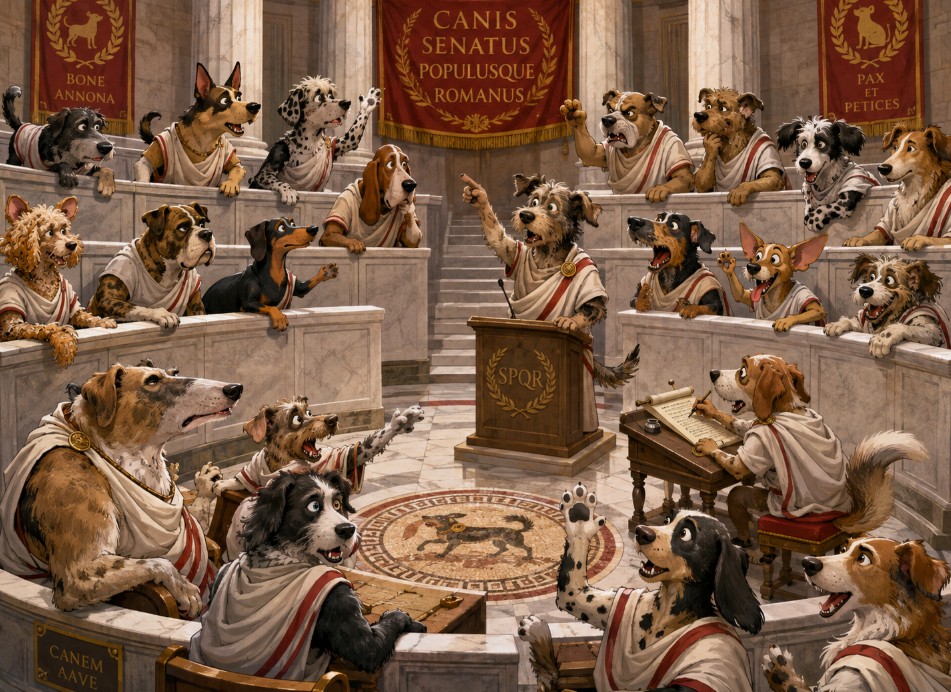
Breeders have a word for what happens when you cross the lines back together after generations of keeping them pure. Hybrid vigor. The pups come out hardier than either parent, live longer, throw off the diseases the show lines carry in their blood. It isn’t a delicate finding. It’s the reason farm dogs outlast the papered ones. This Republic is a mutt, and the mutt is the strong part.
Now, the market-design question, since that’s the trade I claim.
Sorting has a yield. Somebody collects it. The attention system we’ve built pays out for grievance the way a bounty pays out for pelts, and a man who can reliably tell you which neighbor is stealing from you will draw a living from it for as long as you keep listening. The culture war is a harvest, and the crop is trust — taken from the common pasture, sold off, and never replanted. The fellow at the feed store is a customer of that operation. He wasn’t born suspicious of the families on the flats. Somebody cultivated that in him, on purpose, for a return.
What I want from a framework is what I’ve wanted: honest weights and measures, contracts a court will enforce, roads maintained, a hedge kept up around the common. Those guardrails are cheap. And here’s the part I’d ask my own people to sit with — guardrails don’t inquire where a man was born. A contract enforced for a citizen and not for the fellow next to him isn’t a framework, it’s a favor, and a system that runs on favors will eat itself before the grandchildren arrive.
So yes, there is a culture war. I think both armies have been mislabeled. The line doesn’t run between left and right, or city and country, or the churched and the unchurched. It runs between people who hold that the full human experience belongs to them and to those who favor them, with the rest admitted on sufferance, and people who hold that we build a country worth having together. Together is how it gets built. It’s the only method anyone has demonstrated at scale.
The man at the counter knows this. He pays money for it every February. He plants eight seeds because he doesn’t know what kind of year is coming, and the mix is what carries him through the year he didn’t plan for.
A field that will only grow one thing is one bad season from bare ground.
Sources
- James Madison, Federalist No. 10, 1787 — the extended-sphere argument against faction.
- Adam Smith, An Inquiry into the Nature and Causes of the Wealth of Nations, 1776 — division of labor limited by the extent of the market.
- Foreign-born share of Sweden’s population: Statistics Sweden, population by birthplace, 2023.
- Heterosis (hybrid vigor): standard quantitative genetics literature; the effect is well documented in both crop and animal breeding.
- Common-field stinting practice: standard manorial and open-field agricultural histories of England.