A Bright Meadow Group design note on the hundred feet we may not need to cross
Observe → Design → Intervene
Heather Dean ran a piece here Thursday called A Hundred Feet.
It started with a fiber-network designer describing a railroad crossing: roughly a hundred feet of cable, and a price that can reach two hundred thousand dollars.
That number is absurd enough to carry an article by itself. It isn’t the number that caught me.
The sentence I could not put down was the next one.
A thousand feet around can be cheaper.
That is a different kind of information. If a thousand feet costs less than a hundred, distance is not setting the price. If distance is not setting the price, neither is the fiber.
Something else is being purchased.
Heather found it before I did. The expensive part is permission.
Once you see that, the engineering problem changes shape.
OBSERVE
A fiber route looks like a construction problem because most of it is one. You trench, you bore, you hang cable, you pull conduit, you splice glass. More distance means more material, more labor, more money. The curve behaves.
Then the route reaches a railroad. Or a highway. Or a stream. Or a parcel whose owner would rather not have a permanent utility easement recorded across the deed.
The curve breaks. A hundred difficult feet costs more than a thousand ordinary ones.
That break is the whole tell. It says the obstacle is only partly physical.
Look at what the states that have legislated a number think the job is worth. South Dakota and West Virginia set a crossing fee around $750. Utah indexes off $1,250. Virginia set $2,000. Meanwhile providers report per-crossing charges into five and six figures and permit reviews running well past a year and a half, with no formal appeal. Both figures describe the same hundred feet of ground.
We have bundled two different things together and called both of them the crossing.
One is the physical work of moving information from one side to the other. The other is the permission to occupy the ground in between.
Conventional fiber construction treats these as a single item. A route reaches a railroad, so we design a railroad crossing. A route reaches a highway, so we design a highway crossing. A route reaches a rights problem, so we negotiate an easement.
The noun arrives with the problem already framed, and the framing does most of the thinking for you before you sit down. That’s usually the moment I get suspicious.
The network does not need to cross a railroad. The network needs to get a signal from here to there. Those are different assignments, and only one of them has a toll booth on it.
There is a recent legal wrinkle that makes the distinction more interesting.
On August 7 the Seventh Circuit decided CSX Transportation v. Zayo Group. The case concerned fiber installed above and below railroad corridors in Indiana where CSX held easements rather than outright ownership. CSX argued that those easements carried an implicit right to exclude third parties from the air above and the ground below its tracks, and a right to charge licensing fees for installations there.
The court disagreed. Under Indiana law, it held, those rights are not necessarily part of a railroad easement where the third-party installation leaves rail operations undisturbed. An easement’s scope is bounded by its purpose, and the purpose of a railroad easement is running trains.
The decision is specific to Indiana law and to the property interests at those particular sites. It is not a national declaration that anyone may throw a radio beam over a railroad without asking. Read it narrowly.
Read narrowly, it still says something worth carrying: a transportation corridor, and the airspace geometrically above that corridor, are not automatically the same property right.
Which gives us room to ask the engineering question before assuming we already know the legal answer.
What if the network never occupies the obstacle at all?
DESIGN
Keep the fiber. Remove the crossing.
That is the entire design.
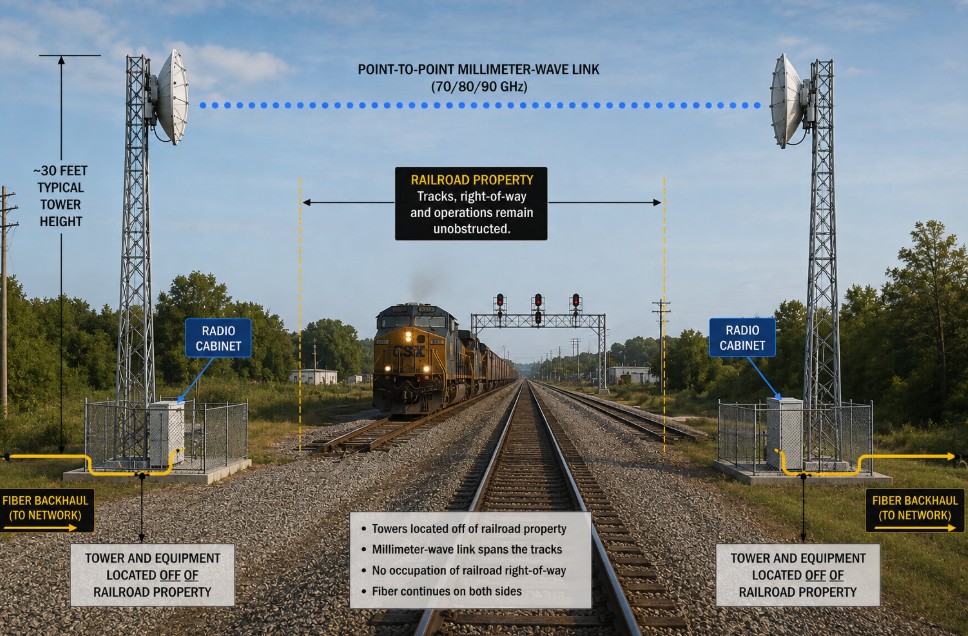
Fiber approaches the expensive obstacle from one side and terminates in a small cabinet. The signal crosses the difficult hundred, five hundred, or thousand feet by tightly directional point-to-point radio. Another cabinet receives it on the far side, and it goes straight back into glass.
FIBER ─────► [ RADIO ] ))))))))))     ((((((((( [ RADIO ] ─────► FIBER

                         railroad
                         highway
                          river
                        difficult
                         parcel
The expensive geography becomes a gap in the cable instead of a project inside the cable.
That distinction is the design. Everything else is engineering detail.
The radio is ordinary. Short point-to-point links already run in millimeter-wave spectrum. Higher-capacity fixed links have been standard telecom equipment for two decades. The FCC’s 70/80/90 GHz framework uses non-exclusive nationwide licensing with individual links registered through coordinated third-party databases, which is a lighter administrative load than a single township road permit. Fixed wireless is common enough that the Commission maintains separate reporting categories for its unlicensed, licensed, and licensed-by-rule varieties.
So the interesting question is not whether radios can move broadband across a few hundred feet. Of course they can, and they have been doing it since before most of these crossing agreements were signed.
The useful question is this one:
Why are we insisting that the most expensive hundred feet of a fiber route remain fiber?
That question keeps the proposal small.
Wireless has real weaknesses. Rain attenuates at high frequencies. Ice happens. Radios fail, power supplies fail, alignment drifts. A buried strand of glass has virtues precisely because it can sit underground doing nothing interesting for forty years.
So use glass everywhere it earns its keep. This is not an argument against fiber. It’s an argument against religious devotion to continuity.
If ninety-nine percent of a route is cheap and durable in glass, build ninety-nine percent of it in glass. If the remaining one percent turns a hundred feet into a six-figure negotiation, stop. Put the signal through the air for two hundred feet. Then go back to glass.
That is a different proposition from asking a community to accept wireless service instead of fiber because wireless is cheaper. The subscriber has no reason to know the span is there. To the network it is another link in the path.
The structures should be equally boring.
A pole on one side. Another on the other. Both sited outside whatever setback and fall-zone geometry the location requires, so that a structure failure stays out of the corridor and nobody has grounds to object on safety. A directional radio on each. Cabinet, power, battery backup, remote monitoring. A second path or a lower-capacity backup link where the service being carried justifies the redundancy.
The band, the antenna size, the structure height, and the availability target belong to an RF engineer doing an actual path study on an actual site. They should not be standardized by somebody writing an article on the internet.
That is where concept ends and engineering begins.
Short spans do hand that engineer generous physics, though. At 80 GHz a half-mile link has a first Fresnel-zone radius of only a few feet at midpoint, so clearance is set mostly by the obstacle itself plus margin. Heavy rain still has to be designed around. Clearance over trains, catenary, roads, and structures still has to be real. It remains a far more forgiving problem than throwing a broadband link twenty miles across Appalachia.
We are not asking radio to replace the route. We are asking it to jump the puddle.
There’s a second consequence I did not expect when I started, and it may matter more in farm country than the railroad case does.
A recorded utility easement is permanent. It sits on the deed, it shows up in a title search, it constrains subdivision, it complicates a sale, and it puts somebody else’s infrastructure through ground a family has worked for four generations. When a landowner declines that, no larger check fixes it, because money was not the objection. The build stops and the contractor treats the parcel as a wall.
The span asks for something else. A hundred square feet in a fence corner. A terminable lease rather than a perpetual encumbrance. A pole and a cabinet, no trench through the field, no drain tile cut, no restoration argument, nothing recorded against the deed.
That is a different question than the one people have been saying no to.
And when the answer is still no, the geometry offers a second move: shoot from the willing neighbor on one side to the willing neighbor on the other, and let the beam pass overhead. The holdout is routed around rather than negotiated with.
That mechanism works the same on a Class I railroad as it does on a farm, which is what makes it interesting and what will make it contested. Once a holdout can be bypassed at a known cost on a known schedule, holding out stops being profitable.
INTERVENE
Do not begin with a county. Begin with one stupid crossing.
Find a fiber project where the route becomes disproportionately expensive because of a single railroad, highway, waterway, or rights problem. Map both ends. Determine who actually owns the ground and the air over it. Get the legal opinion before anybody buys hardware. Run the RF path study.
Then price the conventional crossing honestly and set the wireless alternative beside that number.
Compare them on dollars. Then compare them on calendar, which may be the measurement that decides it. A conventional crossing that eventually comes in cheap and takes eighteen months to negotiate can still lose to a span that costs more and goes up while the construction crew is still in the county.
Then measure whether it holds.
Instrument the radios. Run them through July thunderstorms and through a Cambria County January. Log the modulation changes, the outages, the power events, the maintenance visits. Publish the log.
If the link drops out whenever a serious storm crosses the ridge, that result is useful. If ice turns the antennas into sculpture, useful. If the legal opinion says the premise fails in Pennsylvania, extremely useful.
A good design experiment is allowed to kill the design. That is what the experiment is for.
If the span holds, build a second one. Only after that should anybody start talking about a standard.
THEN SOMETHING ELSE HAPPENS
This is where the thought wandered while I was carrying it around.
A railroad crossing might be two hundred feet. A highway, four hundred. A river, six hundred. A large rail yard or an inconvenient parcel pushes toward half a mile.
Somewhere in there you have stopped building crossings and started building hops.
Do enough of them and a second geometry appears on its own.
That part came out of a conversation about Starlink. Starlink gets described as satellites delivering internet to dishes on the ground. The more interesting architecture is above the dishes: satellites linked laterally by optical terminals, moving traffic sideways across the constellation before choosing where to bring it down.
The useful abstraction there is the topology rather than the laser. When crossing the ground is expensive, cross something else.
SpaceX went over the property problem by several hundred miles. A community in these valleys has to go over it by several hundred feet.
Which reframes the ridge. It stops being terrain the cable has to climb and becomes a place from which a signal can cross several valleys without touching the expensive things underneath.
One ridge link reaches another. Fiber comes down the slope where descending is easy and crosses little. Another hop clears the next difficult corridor. Fiber resumes.
The network stops asking one technology to be correct in all conditions. Glass where glass is cheap. Radio where ground is expensive. Glass again once the obstacle is behind you.
The hybrid is the design.
And Heather’s hundred feet has turned into something regional without anyone setting out to design something regional.
That’s usually how I come to trust an idea. Not when it starts enormous. When a small intervention keeps assembling into larger useful patterns on its own.
THE ACTUAL POINT
I am publishing this because I am not the person who should build it.
A real installation needs RF engineering, property work, utility coordination, legal review, construction crews, capital, and somebody willing to carry the service obligation afterward. I have an observation and a design hypothesis. Those are not an engineered system. They are enough to put the question on the table.
The method is the part I care about.
Heather noticed something absurd: a hundred feet costing more than a thousand.
Do not normalize the absurdity. Ask what the number is actually paying for. Separate the physical constraint from the institutional one. Check whether the physics moved while the agreements stayed where they were.
Then stop solving the problem in the shape it was handed to you.
A railroad crossing does not require a railroad crossing. It requires the network to exist on both sides.
Most of what sits between those two statements is negotiable.
That is Observe → Design → Intervene.
If somebody with the radios, the lawyer, and the bucket truck wants to find out whether this holds up, please do.
Then publish what happens. Especially if I’m wrong.
Sources
- CSX Transportation, Inc. v. Zayo Group, LLC, No. 25-1670 (7th Cir., Aug. 7, 2026) — https://law.justia.com/cases/federal/appellate-courts/ca7/25-1670/25-1670-2026-08-07.html
- Broadband Breakfast, coverage of the decision — https://broadbandbreakfast.com/appeals-court-sides-with-fiber-provider-in-railroad-crossing-dispute/
- The Indiana Lawyer, panel and holding — https://www.theindianalawyer.com/articles/appeals-court-affirms-decision-on-spat-over-communication-lines-running-beneath-train-tracks
- FCC, Millimeter Wave 70/80/90 GHz Service, licensing and link registration framework — https://www.fcc.gov/node/182438
- FCC, permanent link registration process, 71–76 / 81–86 / 92–95 GHz — https://www.govinfo.gov/content/pkg/FR-2005-02-08/pdf/05-2541.pdf
- Pennsylvania Broadband Development Authority, BEAD program — https://www.porh.psu.edu/applications-being-accepted-for-broadband-funding-in-pennsylvania